Terrace Gardening Definition: What It Is, Where It Came From, and How to Do It Today
What is terrace gardening, exactly? Get the full definition — from ancient agricultural origins to modern rooftop and stepped garden applications — plus practical guidance on starting your own.
TERRACE & ROOFTOP GARDENING
3/6/202618 min read
Introduction
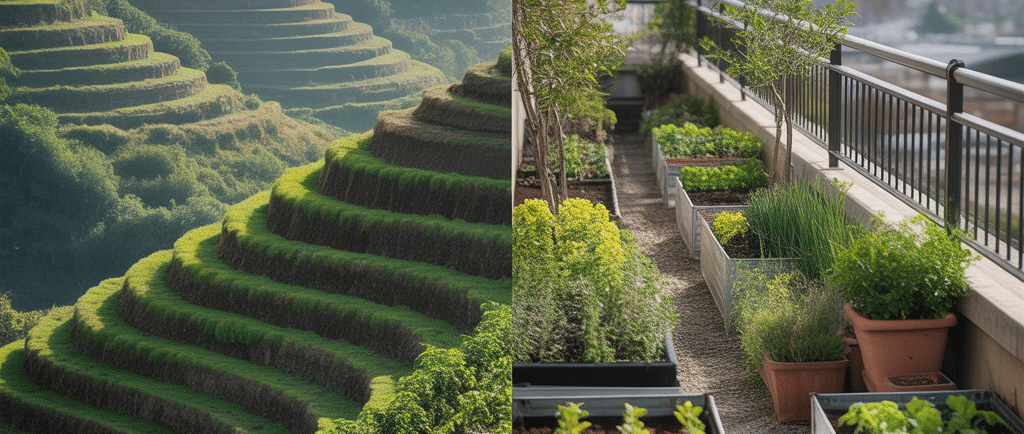
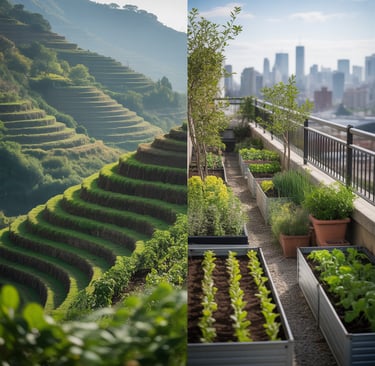
The Banaue Rice Terraces of the northern Philippines — carved into the Cordillera mountains by the Ifugao people over two thousand years ago — are often called the Eighth Wonder of the World. Stretching across more than ten thousand square kilometers of steep mountainside, these terraces fed entire civilizations from land that would have been completely unworkable without the engineering insight that defines terrace farming: if you can't work with a slope, work against it. Cut it into level steps. Hold the soil. Manage the water. Grow food from terrain that would otherwise produce nothing.
That ancient insight is the root of terrace gardening — but it's only one part of what the term means today. Search for terrace gardening and you'll find everything from academic papers on ancient Inca agricultural engineering to Instagram posts of rooftop gardens in Singapore to guides for building stepped garden beds on a suburban backyard slope to articles about growing herbs on an apartment terrace in Mumbai. The word terrace, and the gardening practice associated with it, spans an enormous range of scales, contexts, and intentions — and understanding what the term actually means in each context is the starting point for finding information that's genuinely relevant to your situation.
This guide provides the complete picture: the full definition of terrace gardening across its different uses, the extraordinary history that underlies the practice, the technical principles that make terraced growing work, and the practical guidance for starting a terrace garden in the modern context most relevant to you — whether that's a rooftop in a city, a sloped suburban backyard, or an apartment outdoor space that happens to be called a terrace. Let's start with the definition.
Terrace Gardening Definition — The Complete Explanation
Terrace gardening, at its most fundamental, refers to the practice of growing plants on a terrace — a level or nearly level surface created either by the natural topography of a location or by deliberate construction, typically positioned at an elevated height or as one of a series of stepped levels rising up a slope. The word terrace derives from the Latin terra, meaning earth or land, and its application to gardening reflects both the physical reality of growing on constructed or elevated earthen surfaces and the broader tradition of shaping land deliberately for cultivation.
In contemporary use the term carries two distinct primary meanings that are worth separating clearly because they refer to genuinely different gardening contexts, even though they share the same name and several of the same principles.
The first and historically older meaning refers to agricultural or landscape terracing — the practice of constructing stepped, level platforms on hillsides and slopes to create cultivable land where the gradient would otherwise prevent farming. This is the terrace of the Inca empire at Machu Picchu, the rice terraces of Southeast Asia, the ancient Mediterranean olive groves built on hillside steps, and the modern permaculture practitioner building swales and earthworks on a sloped property. In this context, terracing is a land management practice as much as a gardening practice — a solution to the specific engineering problem of farming on terrain that doesn't want to be farmed.
The second and more contemporary meaning refers to gardening on a terrace as an outdoor living space — the flat, paved, or surfaced outdoor area attached to a building, whether at ground level, on a roof, or on an upper floor. In this context, terrace gardening means growing plants, food, or ornamental gardens on what is essentially an outdoor room — a defined outdoor space that may be a rooftop, a large balcony-style platform, a paved garden area adjacent to a ground-floor dwelling, or any similar configuration. This is the terrace of an apartment in Mumbai or Delhi — where terrace gardening is an enormously popular practice — or the rooftop terrace of a city apartment building, or the stepped terrace design of a luxury urban garden.
The confusion between these two uses is real and frequent, and it matters practically because information aimed at hillside agricultural terracing is not useful to someone gardening on an apartment rooftop terrace, and vice versa. This article covers both meanings thoroughly — because both are genuinely interesting, both are historically significant, and both have practical applications that are worth understanding.
The History and Origins of Terrace Gardening
The history of terrace gardening is essentially the history of human agricultural ingenuity — the story of how civilizations around the world, independently and across millennia, arrived at the same elegant solution to the same fundamental problem: how do you grow food on land that slopes too steeply for conventional cultivation?
The oldest known agricultural terracing dates to roughly three thousand years ago in the Middle East and Mediterranean, though evidence suggests that various forms of slope modification for cultivation developed even earlier in multiple regions simultaneously. The Phoenicians terraced the hills of Lebanon for olive cultivation. Ancient Greeks and Romans cut terraced vineyards into the steep slopes of the Aegean and Italian hillsides — many of which are still in use today, some of the same stone retaining walls maintained through centuries of continuous cultivation. The terraced landscape of the Mediterranean region is so ancient and so continuously maintained that it's difficult in many areas to distinguish original construction from subsequent millennia of repair and modification.
The Inca civilization of the Andes developed what is arguably the most sophisticated system of agricultural terracing in history — the andenes, stone-faced terraced platforms that transformed the dramatic slopes of the Andes from bare rock faces into productive agricultural land. The Inca engineering insight went beyond simply cutting level steps into slopes: their terraces incorporated sophisticated drainage systems, irrigation channels fed by mountain snowmelt, and careful soil construction using layers of gravel, sand, and topsoil imported to the terraces. Different terrace elevations created different microclimates, allowing the cultivation of different crops at different heights — maize at lower elevations, potatoes and quinoa higher up. The terraces at Moray, a site near Cusco, are arranged in concentric circular tiers that may have served as an agricultural research station for experimenting with crop varieties at different temperature gradients. The sophistication of Inca terracing was not matched anywhere in the ancient world and remains impressive by modern agricultural engineering standards.
The rice terraces of Asia represent the third great tradition of agricultural terracing, developed independently across Southeast Asia, East Asia, and South Asia over periods ranging from a few hundred to several thousand years. The Banaue Rice Terraces of the Philippines, the Yuanyang rice terraces of Yunnan in China, and the Jatiluwih rice terraces of Bali are the most celebrated surviving examples — living agricultural landscapes that continue to produce food using methods developed millennia ago. Asian rice terracing added a dimension that Mediterranean and Andean terracing didn't typically require: water management for flooded paddy cultivation. The terraces are essentially a series of shallow pools, carefully leveled and bunded to hold standing water through the growing season, fed by intricate systems of channels and bamboo pipes that distribute water from mountain streams across an entire terraced hillside.
The ornamental tradition of terraced gardens developed alongside the agricultural tradition in ancient civilizations where wealth and power were demonstrated through the manipulation of landscape. The Hanging Gardens of Babylon — one of the Seven Wonders of the Ancient World and possibly the first famous example of ornamental terrace gardening — were reportedly a series of terraced gardens rising in tiered levels, with plants cascading over the edges of each level to create a visual effect of a mountain of vegetation. Whether the Hanging Gardens existed as described or represent a legendary rather than historical structure remains debated by scholars, but the concept they represent — the elevated, terraced ornamental garden as an expression of civilization and aesthetic ambition — recurs throughout history in Roman villa gardens, Renaissance Italian terraced pleasure gardens, and the formal terraced landscapes of European aristocratic estates.
Agricultural Terrace Gardening — How It Works
Understanding the engineering and ecology of traditional agricultural terracing is genuinely interesting beyond the historical dimension — because the principles that made ancient terracing effective are the same principles that inform modern sustainable land management, permaculture design, and the revival of terraced cultivation in regions where conventional flat-land farming is reaching its limits.
The fundamental engineering of an agricultural terrace converts a slope into a series of level or near-level steps — each step wide enough to cultivate and bounded at its lower edge by a retaining structure that holds the soil in place. Retaining structures in traditional terracing are typically stone walls — dry-stacked without mortar, built from rock cleared from the terrace surface itself — that use the weight and interlocking geometry of the stones to resist the pressure of the soil behind them. The wall height determines the width of the terrace above it: steeper slopes require taller walls for a given terrace width, and taller walls require greater wall thickness and more careful construction to remain stable. On very steep slopes, traditional terraces may be only a meter or two wide, with walls of equivalent height — the entire landscape transformed into a seemingly vertical series of narrow steps.
Erosion control is the primary function of agricultural terracing on slopes, and the mechanism is straightforward. On an unterraced slope, rainfall runs directly downhill, carrying topsoil with it — the steeper the slope and the heavier the rainfall, the greater the erosion. On a terraced slope, water falls onto a level surface and is temporarily retained there, allowing it to infiltrate the soil rather than running off. The retaining walls stop what little runoff does occur from carrying soil downhill. Over years and decades of terraced cultivation with organic matter additions, the soil on a well-maintained terrace actually improves rather than depleting — the opposite of what happens on farmed slopes without erosion control.
Water management is the dimension of traditional terracing that varies most significantly between traditions and climates. In rain-fed dryland terracing — the Mediterranean and Andean traditions — the primary water management goal is retaining as much rainfall as possible in the terrace soil and directing overflow safely rather than destructively. In irrigated rice paddy terracing — the Asian tradition — the goal is maintaining standing water in each terrace level while controlling the flow from higher to lower terraces through carefully sized outlets. Both traditions represent sophisticated empirical understanding of hydrology developed over generations of observation and refinement.
The modern revival of terraced farming in permaculture and sustainable agriculture contexts applies these ancient principles to contemporary challenges — converting degraded hillside land into productive food-growing systems, managing water in drought-prone regions, and creating diverse multi-crop growing environments on sites that conventional agriculture can't use. Permaculture's emphasis on earthworks — swales, berms, and terraces that slow, spread, and sink rainwater into the landscape — draws directly on the accumulated wisdom of traditional terracing while applying it at scales ranging from a backyard garden to a farm.
Residential Terrace Gardening — Rooftops, Stepped Gardens, and Outdoor Spaces
In the residential context that most contemporary gardeners encounter when they search for terrace gardening, the term refers to gardening on an outdoor living space called a terrace — and the range of spaces that this term encompasses is itself worth clarifying before getting into the practical gardening specifics.
A residential terrace, in architectural terms, is an outdoor platform associated with a building — either at ground level adjacent to the building's entrance or ground floor, elevated on an upper floor in a configuration similar to a large balcony, or on the roof of the building as a rooftop terrace. What distinguishes a terrace from a balcony in architectural terminology is primarily scale and structural relationship to the building — terraces are generally larger than balconies, often accessible from multiple interior spaces, and frequently have a more substantial structural independent existence rather than simply projecting from the building's facade. In practice the distinction is blurry and varies significantly between architectural traditions — in India, where terrace gardening is enormously popular, the term terrace almost always refers to a flat rooftop space, while in the United Kingdom it often refers to a paved garden area at ground level adjacent to a house.
Rooftop terrace gardening is one of the most exciting frontiers in urban food production and one of the contexts where the concept of terrace gardening most clearly intersects with contemporary urban sustainability. The rooftops of urban buildings represent enormous areas of currently underutilized space — flat, often structurally sound, and in many cases capable of supporting the weight of container gardens, raised beds, and even small-scale greenhouse structures. Cities including Singapore, New York, Toronto, Paris, and many others have developed programs encouraging or requiring green rooftop development, recognizing the multiple environmental benefits of rooftop gardens including reduced urban heat island effect, improved stormwater management, air quality improvement, and local food production.
Stepped or tiered garden designs on slopes in residential contexts directly parallel agricultural terracing at garden scale — the same principle of converting a slope into level growing areas, applied to a suburban backyard or urban garden rather than a mountainside. A residential garden on a steep slope that would be difficult to maintain as lawn or difficult to cultivate as beds can be transformed through terracing into a series of productive level planting areas, each retained by a low wall of stone, timber, or concrete block, that is both more beautiful and more practical than the untreated slope. This application of terracing principles is one of the most effective small-scale garden design solutions available for challenging sloped sites.
The apartment terrace context — particularly relevant in South Asia, Southeast Asia, and increasingly in urban apartments globally — refers to growing on a rooftop or upper-floor outdoor space that may range from a modest two-by-three-meter concrete platform to a substantial rooftop area of fifty or more square meters. Terrace gardening in this context encompasses container growing, raised bed growing, vertical growing systems, and in some cases small-scale hydroponic systems — essentially the full range of urban growing approaches compressed into an elevated outdoor space.
Terrace Gardening vs. Related Terms
The terminology around terrace gardening overlaps and intersects with several related terms in ways that create genuine confusion, and clarifying these relationships helps you find the right information for your specific gardening situation.
Terrace garden versus balcony garden is the distinction that creates the most confusion in residential urban gardening contexts, and the honest answer is that the line between them is blurry and inconsistently applied. In general usage, a balcony is smaller, projects from the building's facade, and is typically accessible from one room. A terrace is larger, may be accessible from multiple spaces, and often has a more independent structural existence. In gardening terms, the practical difference is mainly one of scale — a balcony garden typically grows in smaller containers with more space constraints, while a terrace garden may have enough space for larger containers, raised beds, small trees, and more elaborate growing systems. The gardening principles are essentially identical; the scale of what's possible differs.
Terrace garden versus rooftop garden is another distinction that's more nominal than substantive in most cases. A rooftop garden is, definitionally, a terrace garden — it's a garden on a flat roof surface, which is a type of terrace. In contemporary usage, rooftop garden tends to emphasize the structural and engineering challenges of growing on a building roof — weight management, waterproofing, wind exposure — while terrace garden may carry more of the lifestyle and aesthetic dimension of an outdoor living space that happens to have plants. Both terms describe the same general practice from different angles.
Terrace garden versus raised bed garden represents a clearer distinction. Raised bed gardening — growing in constructed beds elevated above ground level and filled with imported growing medium — can be a component of a terrace garden but isn't synonymous with it. A terrace garden may use raised beds, containers, in-ground planting, or any combination. Raised bed gardening can happen anywhere — in a flat suburban backyard, indoors under lights, in a community garden — without being a terrace garden.
The relationship between terrace garden and container garden is similar — container growing is frequently how terrace gardens are implemented, particularly on rooftops and apartment terraces where in-ground planting isn't possible, but container gardening is a growing method applicable anywhere while terrace gardening describes a specific type of growing location. A container garden on a rooftop terrace is both a container garden and a terrace garden simultaneously.
The Benefits of Terrace Gardening
The benefits of terrace gardening span environmental, practical, social, and psychological dimensions — and the full picture makes a compelling case for why terrace gardening in its various forms has persisted across human civilizations for thousands of years and is experiencing significant revival in the contemporary urban context.
Environmental benefits are most clearly expressed in the agricultural terracing tradition, where the evidence from millennia of practice is unambiguous. Erosion control on sloped land preserves topsoil that would otherwise be lost to runoff — the same topsoil that took hundreds or thousands of years to develop through biological processes. Water management through terracing increases infiltration and reduces destructive runoff, recharging groundwater and moderating stream flows. Biodiversity increases in terraced landscapes because the structural variety of levels, retaining walls, and edges creates habitat for a wider range of plants, insects, and small animals than a uniformly farmed slope would support.
Urban environmental benefits of rooftop and residential terrace gardening are increasingly well-documented and recognized by urban planners and policymakers. Green roofs and rooftop gardens reduce the urban heat island effect by replacing heat-absorbing dark surfaces with evapotranspiring vegetation — a rooftop garden can be dramatically cooler in summer than the surrounding dark roofing, reducing building cooling loads and contributing to neighborhood temperature reduction at meaningful scale. Stormwater management improves when rooftop gardens absorb and delay rainfall rather than directing it immediately into urban drainage systems that become overwhelmed in heavy rain events. Air quality improves marginally but measurably as urban vegetation absorbs pollutants and produces oxygen.
Food production benefits of terrace gardening range from subsistence-level to supplementary depending on scale and context. The Inca terraces at their peak fed the population of a civilization. Contemporary urban rooftop terrace gardens in cities like Singapore and New York produce meaningful quantities of food for local distribution. At the individual apartment terrace scale, the food production contribution is supplementary — fresh herbs, salad greens, some tomatoes and peppers — but the quality advantage of homegrown fresh food and the cost savings from producing high-value crops make even small-scale terrace food gardening economically and nutritionally worthwhile.
Psychological and wellbeing benefits of terrace gardening are consistent with the broader evidence on the mental health value of contact with growing things and outdoor spaces. Research consistently finds that access to green space — particularly interactive green space where people tend plants and grow food — reduces stress, improves mood, and provides a sense of purpose and accomplishment. In dense urban environments where natural green space is limited, a terrace garden provides a form of nature contact that makes a measurable difference to resident wellbeing.
What You Can Grow in a Terrace Garden
What you can grow on a terrace depends primarily on which type of terrace garden you're working with — the conditions on an agricultural hillside terrace, a rooftop urban terrace, and an apartment outdoor terrace are different enough to require somewhat different plant selection guidance, though the general principles overlap significantly.
On agricultural terraces — hillside stepped growing areas — the traditional crops reflect the adaptation to elevation, climate, and water availability that terracing was developed to manage. Cereal grains have been grown on terraces since the beginning of terraced agriculture — wheat and barley on Mediterranean terraces, maize on Inca terraces, rice on Asian paddy terraces. Fruit trees and vines follow — olives, grapes, and figs on Mediterranean terraces, various fruit trees on Inca terraces. Root vegetables are well-suited to the deep, well-drained, well-structured soil that good terrace maintenance produces over time — potatoes were a major terrace crop for the Inca, who developed much of the potato diversity that forms the basis of global potato cultivation today. Modern agricultural terrace revival in permaculture contexts tends to favor perennial crops — fruit trees, berry bushes, perennial herbs and vegetables — that reduce the need for annual soil disturbance and whose deep root systems reinforce the terrace structure.
On rooftop and urban terraces, the dominant constraints are structural — weight limits restrict soil depth and volume — and environmental — wind exposure, reflected heat, and limited irrigation infrastructure shape what can be grown practically. Container growing with lightweight soil mixes dominates, and the most productive rooftop terrace gardens focus on high-value, intensive crops: salad greens and herbs in shallow containers, tomatoes and peppers in larger containers with trellising, and microgreens in trays for maximum nutrition and value from minimum space and weight. Green roof systems using very shallow, lightweight growing media — typically two to four inches of mineral-based substrate — support drought-tolerant sedums, grasses, and wildflowers that provide environmental benefits without the weight and maintenance demands of food production.
On apartment outdoor terraces — the South Asian rooftop context, the European paved terrace, the apartment outdoor living space — the plant palette is essentially the full range of container vegetable and herb gardening, adapted to the specific light and climate conditions of the location. The articles throughout this series cover these specifics in detail for each crop type. The terrace growing context adds one consideration specific to larger, more exposed spaces: wind management for tall or fragile plants, and heat management on sun-exposed concrete or paving surfaces that retain and radiate heat in ways that affect both plant stress and watering demands.
Starting Your Own Terrace Garden
The practical starting point for terrace gardening depends entirely on which type of terrace you're working with — the assessment and planning process for an agricultural hillside terrace is completely different from starting a rooftop container garden, which is different again from building a tiered garden on a sloped residential property.
For rooftop terrace gardening — the most common urban context — the assessment begins with structural capacity. Before placing any containers, raised beds, or soil on a rooftop surface, understanding the roof's load capacity is genuinely important and genuinely necessary rather than overly cautious. A structural engineer's assessment of load capacity is worth commissioning for any significant rooftop garden installation. Building management approval is required in virtually all multi-unit residential buildings. And the waterproofing integrity of the roof membrane must be verified before placing any permanent installations — a leak caused by a container or raised bed damaging the roofing membrane is expensive and the gardener's responsibility. Once these structural and building management questions are addressed, the rooftop terrace garden proceeds along the same lines as any container garden — lightweight soil mix, appropriate containers, attention to wind exposure, and a watering system that doesn't require running hoses across interior spaces.
For building a terraced garden on a sloped residential property, the planning process involves assessing the slope angle, the soil type, and the intended use of the terraced area before beginning construction. Gentle slopes — up to about twenty degrees — can be terraced with relatively low retaining walls using timber, stone, or concrete block. Steeper slopes require taller retaining walls and more significant engineering consideration — a wall over about four feet in height typically requires proper construction with appropriate footings and drainage to remain stable long-term. Drainage behind retaining walls is a critical detail that many first-time terrace builders overlook: water that accumulates behind a retaining wall without a drainage path creates hydrostatic pressure that can topple even a well-built wall. Gravel backfill behind walls and weep holes at the base of the wall allow water to drain through rather than building up.
For apartment terrace gardening in the residential outdoor space context, the starting point is the same as for any balcony or patio garden — the comprehensive assessment of light, space, structural constraints, and lease rules covered in detail in earlier articles in this series. The specific terrace context adds scale as the primary variable: a larger terrace allows more growing ambition, more container variety, and potentially the larger containers and raised bed systems that a confined balcony can't accommodate.
Terrace Gardening Around the World — Inspiration and Examples
The global tradition of terrace gardening is one of the most visually spectacular and humanly meaningful aspects of agricultural and garden history, and the examples that have survived into the present day — some still in active use after two thousand or more years — provide both inspiration and practical wisdom for contemporary terrace gardeners.
The Banaue Rice Terraces of the Philippines are among the most frequently cited and most visually breathtaking examples of agricultural terracing in existence. Carved into the Ifugao mountain ranges of northern Luzon over approximately two thousand years, these terraces cover approximately ten thousand square kilometers of terrain and are maintained today by the same Ifugao communities that created them, using largely traditional methods. The terraces are precisely leveled and bounded by mud walls — called payeo — that retain the flooded water necessary for wet rice cultivation. An intricate system of bamboo pipes and channels, managed by community water rights systems that regulate fair distribution across all terrace levels, distributes water from mountain streams and forests above the terraces down through the entire landscape. The Banaue Terraces were designated a UNESCO World Heritage Site in 1995 and face contemporary challenges including depopulation of rural mountain communities and climate change affecting the water availability that the system depends on.
Machu Picchu's agricultural terraces are perhaps the most celebrated example of Inca terracing and one of the most photographed terrace gardens in the world — though most visitors to the site focus on its architectural remains rather than the elaborate terrace system that surrounded and supported the citadel. The terraces at Machu Picchu served multiple functions: agricultural production, slope stabilization to prevent landslides from the dramatic mountain terrain, and drainage management to prevent water accumulation in a region with significant rainfall. Archaeological analysis has revealed that the terrace construction was extraordinarily sophisticated — each terrace incorporates multiple layers of drainage material below the growing soil, preventing waterlogging and maintaining the soil structure that made the terraces productive. Some terraces at Machu Picchu show evidence of having been used to grow crops from multiple different climate zones simultaneously — the Inca understanding of how terrace elevation creates microclimates allowed them to produce a diverse range of crops from a single terraced hillside.
Contemporary examples of urban terrace gardening provide the inspirational bookend to the ancient tradition. Singapore has become one of the world's leading examples of urban terrace and rooftop gardening as a deliberate city planning strategy — the city-state's Sky Greens vertical farm, rooftop gardens on commercial buildings, and community terrace gardens on public housing rooftops collectively represent a commitment to urban food production that has few parallels globally. New York City's rooftop farming movement — including Brooklyn Grange, one of the world's largest rooftop farms at over forty thousand square feet across multiple sites — demonstrates the food production potential of treating urban rooftops as agricultural terraces at meaningful commercial scale. And in cities across South Asia — Mumbai, Delhi, Bangalore, Colombo — terrace gardening on residential rooftops is a long-established practice experiencing significant revival as urban food security awareness increases and the terrace gardening community shares knowledge through social media and local growing networks.
The thread connecting the two-thousand-year-old rice terraces of the Ifugao with the rooftop farms of Brooklyn and the apartment terrace gardens of Mumbai is the same insight that appears at every scale of terrace gardening throughout history: unused elevated surfaces have productive potential that skillful gardeners can unlock. The specific techniques differ by scale, climate, and crop — but the fundamental act of treating any level surface, whether carved from a mountainside or perched on top of a city building, as an opportunity to grow something is the defining characteristic of terrace gardening in all its forms.
Conclusion
Terrace gardening is one of those terms that means genuinely different things in different contexts — an ancient agricultural engineering practice that fed civilizations, a contemporary urban farming approach converting rooftops into productive growing spaces, and a residential gardening style that applies the same level-surface-growing principle to apartment outdoor spaces at any scale. Understanding which definition applies to your specific situation is the first step to finding the information that's actually relevant to what you want to do.
If you're working with a sloped property and want to build terraces for food production or erosion control, the agricultural terracing tradition offers both the principles and the practical precedent of millennia of successful implementation. If you're gardening on an apartment terrace, rooftop, or elevated outdoor space, the residential terrace gardening approach — container growing, vertical systems, lightweight soil mixes, and the specific crop selection guidance covered throughout this series — gives you everything you need to make that space genuinely productive and beautiful. And if you're simply curious about what terrace gardening means and where it came from, the extraordinary history of this practice — from the Inca terraces of the Andes to the rice terraces of the Philippines to the rooftop farms of modern cities — is one of the most compelling stories in the long relationship between human ingenuity and the land.
Share your terrace garden setup, your questions about getting started, your inspirations from the extraordinary global tradition of terrace growing, or your own terrace garden photographs in the comments below. Whether you're working with a rooftop in a city, a hillside in the country, or a concrete terrace outside an apartment door, the tradition you're joining is one of the oldest and most globally widespread in human history. 🌿