Small Space Vegetable Gardening: What Actually Fits on a Balcony
Discover what really works for small space vegetable gardening on a balcony. From containers to vertical setups, learn which vegetables thrive and how to maximize every inch.
BALCONY TINY PLOTS: TURN YOUR OUTDOOR SPACE INTO A MINI FARM
Introduction
Here's something that genuinely blew my mind when I first read it: a well-managed container garden can produce up to four times more food per square foot than a traditional in-ground garden. Four times. I remember sitting with that number for a while, trying to reconcile it with the tiny, cluttered balcony I was staring at from my apartment window — the one I'd written off as basically useless for growing anything.
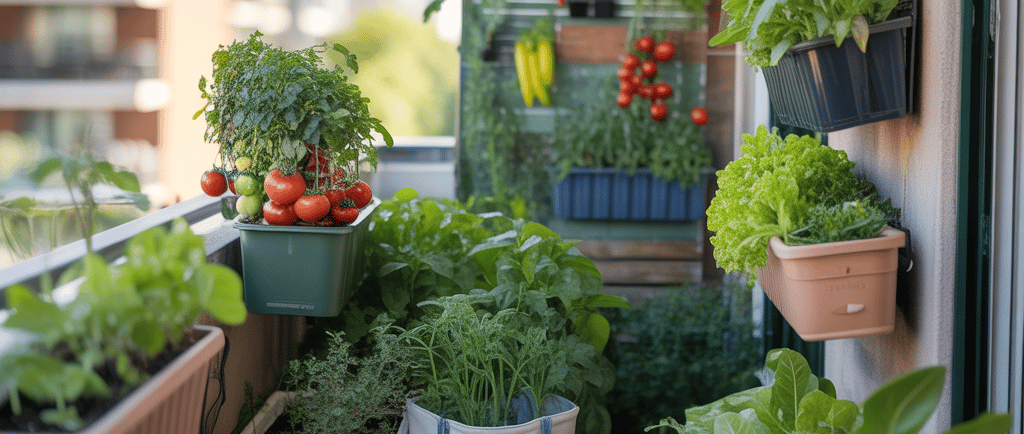
That was four years ago. Today, that same balcony feeds me fresh tomatoes, lettuce, peppers, herbs, and green onions from late spring through early fall. It's not a farm. It's not even particularly impressive-looking compared to some of the gorgeous balcony gardens I follow online. But it grows real food, in real quantities, and it cost me less than $150 to set up from scratch.
Balcony vegetable gardening is one of those things that sounds more complicated than it actually is. People get intimidated by the constraints — the limited space, the containers, the sun exposure questions, the weight concerns — and they never start. But the truth is, a balcony is actually a fantastic environment for growing food, once you know what to grow and how to set it up.
In this guide, I'm going to be completely real with you about what actually works on a balcony and what doesn't. No fluff, no "technically anything is possible if you try hard enough" — just practical, honest advice from someone who has grown a lot of vegetables in a very small space and made a lot of mistakes along the way. Let's get into it. 🌱
Why Balcony Vegetable Gardening Works Better Than You Think
The first time I told someone I was growing vegetables on my balcony, they gave me this polite, skeptical smile. Like, "Good for you, that's a cute little hobby." And I get it. Most people picture vegetable gardens as these sprawling backyard affairs — raised beds, garden hoses, maybe a little greenhouse. The idea that a 60-square-foot balcony could produce meaningful amounts of food feels kind of implausible.
But here's the thing about container gardening: it's incredibly efficient when done right. You control every variable. The soil is exactly what you choose — no rocks, no clay, no compaction. The drainage is perfect because you've set it up that way. The nutrients are dialed in because you're fertilizing intentionally. In-ground gardens have to deal with all kinds of soil issues, competition from weeds, drainage problems, and unpredictable soil conditions. Container gardens don't have any of those problems.
The biggest myth about balcony gardening is that you need a lot of space to grow meaningful amounts of food. You really don't. A single five-gallon container of cherry tomatoes, properly managed, can produce literally hundreds of tomatoes over a growing season. A window box of cut-and-come-again lettuce can supply salad greens for weeks on end. Three pots of herbs can eliminate your need to ever buy fresh herbs from the grocery store again. The productivity per square foot, when you're strategic about it, is genuinely impressive.
There's also the mental health angle, which I don't think gets talked about enough in the context of balcony gardening. There's something profoundly grounding about growing your own food — even a small amount of it — when you live in an urban environment. Tending to plants, watching things grow, harvesting something you grew yourself and eating it that night. It connects you to a cycle that city living tends to disconnect you from completely, and that matters more than most people realize until they experience it.
And then there's the food independence piece. It's not like you're going to feed your whole family from a balcony garden — let's be realistic. But reducing your grocery bill by even $20-30 a month in fresh herbs and salad greens adds up. And knowing you can grow at least some of your own food feels good in a way that's hard to quantify but very real.
The key — and I cannot stress this enough — is being strategic about what you grow. Not every vegetable belongs on a balcony. But the ones that do? They absolutely thrive there.
Best Vegetables for Balcony Container Gardening
Okay, this is the section most people come for, and I'm going to give it to you straight — not just a list of "things that technically can grow in containers," but the vegetables that actually do well on a balcony, produce food you'll actually eat, and are worth the container space they take up.
Cherry Tomatoes are the undisputed champions of balcony vegetable gardening. Hands down, no contest. A single cherry tomato plant in a five-gallon (or larger) container, given full sun and regular water, will produce more tomatoes than you can eat over a season. Varieties like Tumbling Tom, Sweet 100, and Patio Princess are bred specifically for container growing — they stay compact, they fruit heavily, and they don't need as much staking and support as full-sized tomato varieties. I grew two cherry tomato plants last summer and gave bags of tomatoes to neighbors because I literally couldn't eat them fast enough.
Lettuce and Salad Greens are perfectly designed for container growing. They have shallow roots, they grow fast, and most varieties are cut-and-come-again — meaning you harvest the outer leaves and the plant keeps producing new ones from the center. I use long rectangular window boxes for my lettuce and basically have a continuous salad garden from April through October. Mesclun mixes, arugula, spinach, and loose-leaf lettuce varieties all do brilliantly in containers.
Radishes are the secret weapon of balcony gardening. They're ready to harvest in as little as 25 days, they grow in almost any container, and you can succession plant them every two weeks for a continuous harvest. They're great for impatient gardeners (guilty) who want to see results fast. I plant radishes in the gaps between other containers just to keep things interesting.
Peppers — both sweet and hot varieties — are excellent balcony plants. They're compact, they're prolific producers, and they love the warm, reflected heat that balconies often generate from surrounding walls and railings. I've grown bell peppers, banana peppers, jalapeños, and cayennes on my balcony and they've all done really well. Use at least a three-gallon container, give them full sun, and they'll reward you all season.
Green Onions and Chives are almost embarrassingly easy to grow in containers. They take up minimal space, they're cut-and-come-again, and fresh green onions from the garden are genuinely better than anything from the grocery store. I keep a dedicated pot of chives and a pot of green onions on my balcony year-round in mild weather.
Herbs — basil, parsley, mint, oregano, thyme — deserve their own section really, but I'll mention them here because they're absolutely essential to a productive balcony garden. Fresh herbs are expensive at the grocery store and incredibly easy to grow in small containers. Basil especially loves the warm conditions of a sun-exposed balcony. Keep mint in its own container because it will aggressively take over everything else if given the chance. Ask me how I know.
Bush Beans are underrated for balcony growing. Unlike pole beans, bush varieties don't need staking or trellising — they grow as compact, self-supporting plants about 18 inches tall. They produce prolifically over several weeks, and a single large container of bush beans can yield enough for multiple meals. Provider and Contender are great varieties for containers.
Compact Cucumbers work well on a balcony if you have vertical space. Bush varieties like Spacemaster and Patio Snacker stay compact and produce well in containers, especially if you give them a small trellis or cage to climb. Full-sized vining cucumbers are a bit ambitious for most balconies, but the compact varieties are genuinely worth trying.
What Vegetables Don't Work Well on a Balcony
Okay, this section is important and I'm not going to sugarcoat it. Part of being strategic about balcony gardening is knowing what not to grow — and avoiding the frustration of spending time, money, and container space on something that was never going to work.
Corn is the most obvious one. Corn needs to be grown in large blocks for pollination — not rows, but actual dense blocks — because it's wind-pollinated. On a balcony, you'd need dozens of plants in close proximity for successful pollination, which is obviously not happening. Plus, corn plants are tall and their root systems are extensive. Even if you somehow solved the space problem, the yields would be pitiful. Skip it entirely.
Large Squash and Pumpkins — the big vining varieties like butternut, acorn, or Halloween pumpkins — are a space disaster on a balcony. Those plants need serious real estate. The vines alone can run six to eight feet or more, and the root systems are extensive. I tried growing butternut squash on my balcony in my first year of balcony gardening, mainly because I didn't know better. The vine basically took over the entire space, produced two sad small squashes, and spent three months making me feel guilty about the space it was taking from things that would have actually produced well. Compact bush squash varieties like Bush Pattypan or Eight Ball Zucchini are a different story — those can work in large containers. But the big vining types? No.
Watermelons fall into the same category as large squash — they need extensive root space, long vines, and a long, hot growing season with consistent water. Even the "small" watermelon varieties need much more space than most balconies can realistically provide, and the yield-to-space ratio just doesn't make sense. If you really love watermelons, grow a cantaloupe instead — some compact varieties do okay in large containers.
Artichokes are perennial plants that need significant space, deep soil, and often two growing seasons before they start producing well. They're also large plants — easily three to four feet tall and wide at maturity. The investment of space and time versus the yield just doesn't make sense for a balcony garden. Beautiful plant, though. Just not for here.
The general rule is this: if the plant produces something large and heavy, needs deep or extensive root space, requires cross-pollination from multiple plants, or needs a very long growing season to produce anything at all — it probably isn't the right fit for a balcony. Instead, focus on plants that are compact, quick-producing, and high-yield relative to their space requirements. Cherry over beefsteak. Bush beans over pole beans. Compact cucumbers over full-sized vining varieties. Lettuce over cabbage.
How to Choose the Right Containers for Balcony Gardening
Container selection is one of those things that seems like a small detail but actually makes a significant difference in how well your vegetables grow. I spent way too long using whatever containers I happened to have lying around before I understood why certain containers work better than others for specific plants.
Size and depth matter enormously. Different vegetables have different root depth requirements, and giving a plant too small a container is one of the fastest ways to stunted growth and poor yields. Here's my basic guide: herbs and lettuce are happy in containers as shallow as six inches. Radishes, green onions, and shallow-rooted plants need eight to ten inches. Peppers and bush beans want at least ten to twelve inches of depth and a three-to-five-gallon volume. Tomatoes need at least five gallons, and bigger is better — I've seen people grow cherry tomatoes in seven and ten-gallon containers with noticeably better results than five-gallon setups.
Fabric pots are genuinely excellent for balcony vegetable gardening and my personal preference for tomatoes, peppers, and larger plants. They air-prune the roots, which means roots don't circle and become root-bound the way they do in plastic or ceramic pots. They also drain perfectly and are lightweight, which matters a lot on a balcony. The only downside is they dry out faster — but for vegetables that want consistent moisture, that just means you check them more regularly.
Plastic containers are lightweight, cheap, and retain moisture better than fabric or terracotta. For balconies with weight concerns, plastic is often the practical choice. The quality varies enormously — cheap thin plastic will crack and degrade quickly in sun exposure, so look for thicker, UV-resistant options.
Weight is a serious consideration that a lot of balcony gardeners don't think about until they've already set things up. Soil is heavy. Water-saturated soil is even heavier. A ten-gallon fabric pot of moist soil can weigh 50 pounds or more. Before you set up a full balcony garden, find out your balcony's weight limit — most apartment building managers can tell you, and it's usually listed in building documentation. Distribute weight around the perimeter of the balcony rather than concentrated in one spot, and use lightweight potting mixes rather than heavy garden soil.
Self-watering containers are worth the investment for tomatoes and peppers especially. They have a reservoir at the bottom that wicks water up to the roots as needed, which keeps moisture more consistent and reduces how often you need to water. For someone who works long hours or travels occasionally, self-watering containers can be the difference between a thriving balcony garden and a dead one.
Maximizing Space With Vertical Gardening on a Balcony
The moment my balcony garden went from "cute little hobby" to "genuinely productive" was when I stopped thinking horizontally and started thinking vertically. Floor space on a balcony is limited. Vertical space, on the other hand, is largely untapped — and that's where the magic happens.
Trellises for climbing vegetables are the most obvious and effective vertical strategy. A simple bamboo trellis or metal cage gives cucumbers, pole beans, and even compact squash varieties something to climb, turning a single container footprint into several feet of productive growing space. I have a six-foot bamboo trellis secured against my balcony railing that my cucumber plant climbs every summer. It takes up maybe two square feet of floor space and produces cucumbers at a genuinely impressive rate.
Railing planters are brilliant for balconies with railings — which is most of them. These hook-mounted planters attach directly to the railing, taking up zero floor space whatsoever. I use railing planters for herbs and lettuce along the full length of my balcony railing. It's probably an additional eight to ten feet of growing space that would otherwise be completely unused.
Wall-mounted planters work well on solid balcony walls for lighter plants like herbs, lettuce, and strawberries. You can use pressure-mounted systems to avoid drilling if you're renting. I have a fabric pocket wall planter on the interior wall of my balcony that grows chives, parsley, and mint. It looks great and uses wall space that was doing absolutely nothing before.
Tiered plant stands let you stack multiple containers vertically while using minimal floor space. A three-tier stand might hold six to nine small pots in the footprint of one or two. I use a tiered stand specifically for herb pots — it looks organized, it keeps them all in one manageable spot, and it frees up floor space for larger tomato and pepper containers.
Think about the sun as you go vertical. Taller plants and structures can cast shade on shorter ones below, which you need to account for. I keep my tall trellised cucumber at the back of my balcony (the end that casts shade away from the balcony) and shorter containers in front. It took a season of trial and error to figure out that arrangement, but it's made a real difference in the productivity of the whole space.
Watering and Feeding Your Balcony Vegetable Garden
Watering is where a lot of balcony gardeners struggle — not because it's complicated, but because containers behave very differently from in-ground gardens. I underwatered my first balcony tomatoes badly and got a condition called blossom end rot because of inconsistent moisture. That was an expensive and frustrating lesson.
Containers dry out much faster than ground soil, especially on a balcony where wind and sun exposure is often greater. During hot summer weather, I water my tomatoes and peppers every single day — sometimes twice if it's really hot. Herbs might need water every other day. Lettuce in window boxes needs checking daily. The rule is simple: stick your finger into the soil. If the top inch is dry, water. If it's still moist, leave it.
Water deeply and thoroughly every time you water. Don't just splash some water on the surface — water until it flows freely from the drainage holes at the bottom. This encourages roots to grow deep rather than staying shallow, which makes plants more resilient and productive. Shallow watering equals shallow roots equals plants that stress out every time it gets hot or windy.
Drip irrigation systems for balconies exist and they're wonderful if you can set one up. Basic drip systems can be connected to an outdoor tap with a timer and deliver consistent moisture to each container automatically. I installed a basic drip system on my balcony two summers ago and it genuinely changed my relationship with balcony gardening — no more guilty vacations worrying about my tomatoes, no more coming home from work to wilted plants.
Fertilizing container vegetables is non-negotiable. Unlike in-ground plants that can access nutrients from the surrounding soil, container plants only have access to what's in their pot. Every time you water, you flush some of those nutrients out through the drainage holes. I use a balanced liquid fertilizer at half strength every two weeks during the growing season, and I switch to a lower-nitrogen, higher-potassium formula once tomatoes and peppers start flowering, which encourages fruit production over leafy growth. It makes a noticeable difference.
Signs of underwatering include wilting during the day, dry and pulling-away-from-the-pot soil, crispy leaf edges, and generally sad-looking plants. Signs of overwatering include yellowing leaves, mushy stems at the base, and soil that stays wet for days on end. Underwatering is more common on balconies; overwatering is more common for beginners who are anxious about their plants. Both are fixable — just adjust and keep going.
Balcony Gardening Challenges and How to Solve Them
I want to be upfront: balcony gardening isn't without its challenges. There are some real issues specific to balcony environments that you'll need to navigate. But every single one of them has a workable solution, and knowing about them in advance means you can set things up to avoid most of the problems before they happen.
Wind is probably the biggest underestimated challenge. Balconies — especially on higher floors — can be significantly windier than ground level, and wind does real damage to vegetable plants. It desiccates leaves, snaps stems, blows over containers, and stresses plants constantly. I lost an entire cherry tomato plant to a windstorm in my first balcony gardening year. Now I stake everything, use heavier containers that don't tip easily, and position tall plants against the wall rather than near the railing edge. A bamboo windbreak screen attached to the railing can also reduce wind exposure significantly.
Reflected heat is a real issue on balconies surrounded by brick, concrete, or dark-colored walls and railings. Those surfaces absorb heat during the day and radiate it back, creating temperatures that can be significantly higher than the surrounding air. This is actually great for heat-loving plants like tomatoes and peppers — they love it. But it can stress out lettuce and other cool-season crops. I manage this by putting my heat-lovers in the warmest spots and my cool-season crops in the shadier, cooler areas of the balcony.
Weight limits need to be taken seriously. I touched on this in the containers section, but it bears repeating. Overloading a balcony is a genuine structural safety concern, not just a theoretical one. Know your limits, use lightweight potting mixes, and distribute your containers around the perimeter where balconies are structurally strongest rather than concentrated in the center.
Limited sunlight is the challenge that stops a lot of people before they even start. Most vegetables need at least six hours of direct sun for good production. South and west-facing balconies usually get enough. East-facing balconies get morning sun, which works for many crops but may limit tomato and pepper yields. North-facing balconies are the hardest — you can still grow leafy greens and herbs, but fruiting vegetables will struggle without supplemental grow lighting.
Pest management without a yard feels weird at first — balconies seem like they should be too isolated for pests, but aphids, spider mites, and fungus gnats find their way up regardless. I manage pests organically with neem oil spray, insecticidal soap, and just keeping my plants healthy and well-watered (stressed plants attract pests much more readily than healthy ones). Check the undersides of leaves regularly and deal with problems early before they get out of hand.
Conclusion
Here's the honest truth about balcony vegetable gardening: it works. It really, genuinely works — not in a "if you squint and lower your expectations" way, but in a real, productive, actually-feeding-yourself way. You just have to be smart about what you grow, how you set things up, and realistic about the constraints you're working with.
Start small. Two or three containers is a completely legitimate balcony garden. A cherry tomato plant, a window box of lettuce, and a pot of mixed herbs will give you more fresh produce than you might expect, and the experience will teach you everything you need to know to expand from there.
The vegetables that will serve you best on a balcony are cherry tomatoes, lettuce, radishes, peppers, herbs, green onions, bush beans, and compact cucumbers. The ones to avoid are corn, large squash, watermelons, and anything with a very large root system or long growing season. Get vertical wherever you can. Use self-watering containers for your thirstiest plants. Fertilize consistently. Watch for wind and heat. Deal with pests early.
That's really the whole formula. It's not complicated — it just takes a little intention and a willingness to learn as you go.
Now I want to hear from you! What are you growing on your balcony this season? What's worked brilliantly and what's been a total disaster? Drop your stories in the comments below — the balcony gardening community is one of the most helpful and enthusiastic groups of people on the internet, and your experience might be exactly what someone else needs to hear. And if this guide helped you, share it with someone who has a balcony and a dream of growing their own food. 🍅🌿