Minimalist Cactus Garden: The Complete Design and Care Guide
Create a stunning minimalist cactus garden with expert design tips, the best cactus varieties, container ideas, and low-maintenance care advice — everything you need in one complete guide.
INDOOR TINY PLOTS: FRESH FOOD & GREENERY ALL YEAR
Introduction
Cactus and succulent plants have become the most searched houseplant category on the internet for three consecutive years running — and if you spend any time looking at interior design content, architecture photography, or garden design portfolios, it's immediately obvious why. There is something about a well-placed cactus — its clean geometry, its self-contained stillness, its almost prehistoric patience — that works with minimalist design in a way that almost no other plant does. A single tall columnar cactus in a concrete pot says more, visually, than a dozen fussy flowering plants in mismatched containers. That economy of impact is exactly what minimalism is about.
I came to cactus gardening through the back door of a design obsession rather than a gardening one. I was trying to figure out how to make my apartment feel more intentional and less cluttered, and plants kept showing up in the interior design references I was saving. Specifically, cacti kept showing up — in clean, spare rooms with concrete floors and neutral walls, in Japanese-influenced spaces with extraordinary attention to negative space, in Scandinavian interiors where every object earned its place through beauty and function. I started with three cacti in three concrete pots on a windowsill, and eight years later I have a considered collection that spans three rooms and a balcony and that I've thought about, adjusted, and refined more than probably any other element of my home.
What I've learned over those eight years is that a truly excellent minimalist cactus garden is both simpler and more deliberate than most people expect. Simpler because cacti genuinely need very little — minimal watering, minimal intervention, minimal fuss. More deliberate because every element of a minimalist display carries more visual weight than it would in a busier context. The container matters. The substrate matters. The spacing matters. The choice between one plant and three plants matters. In minimalist design, there's nowhere to hide a thoughtless decision. This guide is everything I know about making those decisions well — the design principles, the plant selection, the containers, the care, and the troubleshooting. Let's build something beautiful.
Why Cacti Are the Perfect Plants for a Minimalist Aesthetic
Minimalism as a design philosophy is fundamentally about intentionality — the idea that everything in a space should be there for a reason, that quality matters more than quantity, that restraint and considered curation create more beauty than abundance and variety. When you look at what minimalism values and then look at a cactus — really look at one — the alignment is almost uncanny. Cacti embody minimalist principles in their very biology. They have evolved to do more with less, to survive through efficiency rather than excess, to express extraordinary complexity through apparently simple forms. That's not a metaphor for minimalist design. That's actually what minimalism is.
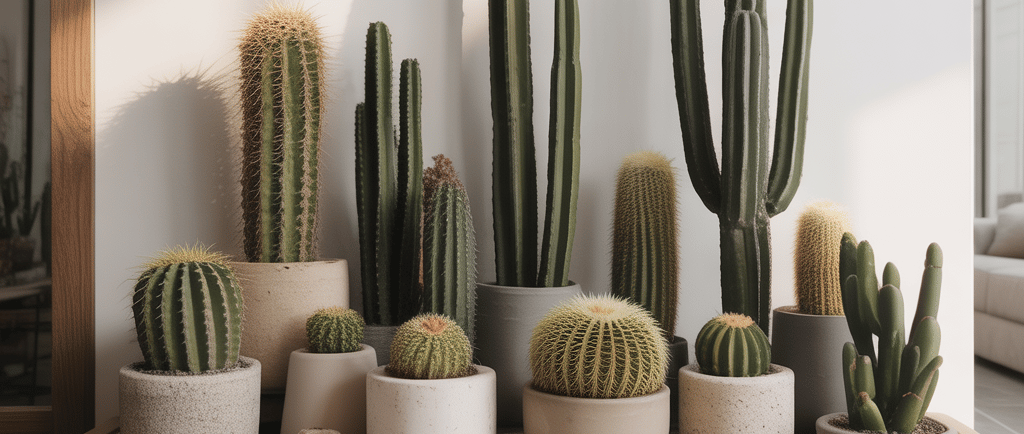
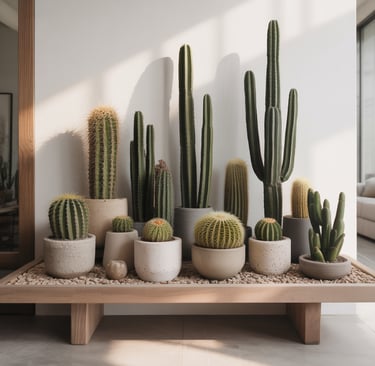
The geometric quality of cacti is what draws most design-minded people to them first. The perfect sphere of a Gymnocalycium, covered in mathematically precise rows of spines. The soaring vertical column of a Cereus, its ridges casting shadow lines that shift through the day as light moves. The clustered columns of an Echinopsis, each stem identical to its neighbors, the group creating a kind of natural repetition that feels almost designed. These forms have an architectural quality — a precision and clarity — that gives cacti visual authority in a space far beyond what their size would suggest. A twelve-inch cactus in the right spot has more visual presence than a three-foot fern. That efficiency of presence is deeply compatible with minimalist thinking.
Negative space — the deliberate use of empty space as a design element — is one of the most important tools in minimalist design, and it's where cacti excel in ways that other plants simply don't. A bushy, full plant occupies its space visually and fills the negative space around it. A cactus occupies its space precisely and leaves the surrounding negative space intact and visible, which actually makes the negative space more intentional and more beautiful by contrast. The spare arrangements that define the best minimalist cactus displays — three cacti in three pots with significant empty space between and around them — work because the emptiness is part of the composition, not an absence of content. This is a concept borrowed directly from Japanese design philosophy, where ma — the concept of meaningful negative space — is considered as important as the objects themselves.
The longevity of cacti is an underappreciated design advantage. Trends come and go. Plants that look fashionable today and peak quickly feel dated quickly. Cacti are genuinely timeless — they've appeared in serious design contexts for over a century and they continue to look right across changing aesthetic movements, from mid-century modern to contemporary minimal to wabi-sabi to Japandi. A well-chosen cactus in a quality container is an investment that doesn't go out of style. My oldest cactus is a Cereus I've had for eight years — it's significantly taller and more impressive than when I bought it, and it looks better in my space now than it did the day I brought it home. That kind of improving-with-time quality is rare in any design object.
Designing Your Minimalist Cactus Garden — Core Principles
Design principles for minimalist cactus gardens aren't rules to follow rigidly — they're frameworks for making decisions that result in compositions with visual coherence and intention. Understanding why these principles work helps you apply them creatively rather than mechanically, and adapt them to your specific space and aesthetic preferences.
The rule of odd numbers is probably the most practically useful design principle for plant arrangements of any kind, and it applies with particular force to minimalist cactus displays. Groupings of one, three, or five plants read as intentional and visually balanced in a way that even numbers — two, four, six — typically don't. Even numbers tend to create symmetry, which in minimalist contexts can read as static and lacking tension. Odd-numbered groupings create natural hierarchy — usually one dominant plant, one secondary, one accent — that gives a composition movement and interest. My core windowsill display is three cacti: one tall columnar variety as the anchor, one medium globular variety as the secondary, one small compact variety as the accent. That relationship between the three creates a composition that works from any viewing angle.
Form contrast is what separates a visually interesting cactus display from a collection of similar-looking plants that happens to occupy the same space. The most effective minimalist cactus arrangements combine fundamentally different plant forms — typically tall and vertical with rounded and compact, or spreading and horizontal with upright and narrow. The visual tension between contrasting forms creates interest without requiring pattern, color, or complexity. Think columnar alongside globular. Angular alongside rounded. Densely spined alongside smooth or minimally armed. These contrasts work because they're opposites — and in a spare, minimalist context, opposites create the visual dialogue that keeps a composition engaging.
Color palette management in minimalist cactus gardens operates on a different principle than in colorful garden contexts. The goal is harmony rather than contrast — a limited palette of complementary tones across plants, containers, substrate, and the surfaces the display sits against. I work with a palette of grey-green and blue-green plant tones, matte concrete and unglazed terracotta container tones, and pale grey or warm white substrate tones. The consistency of this palette across every element of the display is what creates the sense of coherence and intentionality that characterizes good minimalist design. Introducing a bright color — a red pot, a yellow substrate — disrupts the palette and fragments the composition. Restraint with color is not timidity. It's a design choice that serves the overall aesthetic.
Scaling is something beginners often get wrong in both directions — either cramming too many plants into too small a space, or placing small plants in a large space where they read as lost and insignificant. A minimalist cactus display should feel appropriately scaled to the surface it occupies and the room it's in. A windowsill arrangement should feel like it fills and owns that windowsill without crowding it. A floor display should feel substantial enough to register as a design element from across the room. The classic mistake is buying plants that are visually appropriate for the space when small and not considering what they'll look like in three or five years when they've grown significantly. Think ahead — a cactus that looks slightly large for its pot today will look perfectly proportioned in twelve months.
The Best Cactus Varieties for a Minimalist Garden
Variety selection in a minimalist cactus garden is a more consequential decision than in a more eclectic plant collection, because each plant carries more visual weight and the overall number of plants is deliberately limited. Choose varieties that have genuine architectural presence, clear and interesting form, and the kind of visual staying power that improves over time as the plants mature.
Columnar cacti are the architectural backbone of most serious minimalist cactus displays, and for good reason. Their vertical form provides height, scale, and the kind of bold geometric statement that anchors a composition. Cereus hildmannianus — often sold simply as Cereus — is my personal favorite for indoor minimalist displays. It grows as a blue-green column with pronounced ridges and relatively few spines, giving it a clean, almost contemporary look that photographs beautifully and holds its form with age. It's also reasonably fast-growing for a cactus, gaining meaningful height over several years. San Pedro cactus — Echinopsis pachanoi — is another excellent columnar variety with a particularly beautiful blue-green color and a classic, clean columnar form. Cleistocactus strausii, the silver torch cactus, is extraordinary for its covering of white hair-like spines that give the column an almost ethereal quality — dramatic without being busy.
Globular cacti provide the contrast to columnar varieties that makes a composition work, and the range of forms within this category is remarkable. Gymnocalycium species are favorites of design-conscious cactus growers because they're compact, geometrically precise, and come in a range of colors from dark green to almost grey to slightly purple-tinted. They're also unusually tolerant of lower light conditions than most cacti, making them genuinely practical for indoor displays away from direct sun. Mammillaria forms perfect spheres or cylinders covered in symmetric spiral patterns of tubercles and spines — the mathematical precision of the arrangement is extraordinarily beautiful at close range. Astrophytum asterias — the sand dollar cactus — is one of the most distinctive and design-forward cactus species available, a flat disc covered in white flecking on a grey-green surface that looks almost like a designed object rather than a living plant.
Rare and unusual varieties have become increasingly accessible through specialist cactus nurseries and online growers, and for the design-forward cactus gardener they offer the opportunity to build a collection with genuine botanical interest beyond the visually obvious. Lophophora williamsii — the peyote cactus, which is legal to grow in most jurisdictions outside the US — is a soft, spineless, rounded cactus with an almost sculptural quality. Ariocarpus species are extraordinarily slow-growing, tuberculate cacti with rock-like textures that look ancient and archaeological. Copiapoa — Chilean coastal cacti — have a dark, brooding quality with almost black spines and grey-green bodies that looks intensely moody in a minimalist display. These varieties reward the patient grower who appreciates botanical rarity as much as visual impact.
Containers and Vessels — The Foundation of Minimalist Design
The container is not secondary to the plant in minimalist cactus design — it's an equal partner. I'd argue that container choice is actually the most impactful single design decision in a minimalist cactus display, because the container determines the color palette, sets the visual tone, and defines the relationship between the plant and the space around it. A magnificent cactus in a poor container is a missed opportunity. A modest cactus in an extraordinary container is a design success.
Concrete containers are my personal first choice for minimalist cactus displays, and they've become something of a signature element in contemporary plant design for good reason. The matte, textured surface of concrete has a quiet, substantial quality that recedes visually without disappearing — it supports the plant rather than competing with it. The grey tones of concrete complement the grey-green and blue-green of most cactus foliage with a naturalness that feels almost inevitable. Concrete also has genuine weight and solidity that communicates permanence and intention — a quality that plastic and resin containers simply can't replicate. The practical benefit of concrete for cactus growing is its porosity — like unglazed terracotta, it breathes and dries relatively quickly, which suits the low-moisture requirements of cacti perfectly.
Unglazed terracotta is the classic cactus container material for good reason — it's beautiful, it's practical, and its warm ochre tones work harmoniously with most cactus color palettes. The key distinction in a minimalist context is between standard terracotta pots — which are fine but visually ordinary — and artisan or architectural terracotta that has genuine design presence. Look for terracotta vessels with clean lines, considered proportions, and a surface quality that shows craft rather than mass production. Hand-thrown terracotta has an irregularity and warmth that machine-made versions lack, and that human quality actually enhances a minimalist composition by introducing organic variation within an otherwise austere aesthetic.
Glazed ceramic works beautifully in minimalist cactus displays when the glaze is muted, matte, and carefully chosen. I've used containers in celadon green — a soft, grey-green glaze — that complements the blue-green of my Cereus with a subtlety that's genuinely pleasing. Matte white ceramic is perhaps the most versatile option for indoor displays because it's clean, neutral, and allows the plant's form and texture to be the sole focus without any container competition. What to avoid is anything with a high-gloss finish, bright color, or decorative surface treatment — these compete with the plant and introduce visual noise that undermines the minimalist aesthetic.
Sizing containers correctly is both a design decision and a horticultural one, and fortunately the design preference and the growing preference align. Minimalist design favors containers that are proportionate to the plant — not dramatically oversized, not uncomfortably tight. Cactus horticulture similarly favors containers that are just large enough for the root system with a small amount of growing room — oversized containers hold excess moisture and invite root rot. A container with two to three inches of space around the root ball in all directions is both visually proportionate and horticulturally appropriate. As the plant grows, repotting into the next size up maintains both aesthetic and practical balance.
Substrate, Top Dressing, and the Details That Elevate Design
The difference between a good minimalist cactus display and a great one often comes down to the details — and nowhere is this more true than in the substrate and top dressing choices. The material covering the soil surface in a cactus container is visible, prominent, and deeply consequential for the overall visual quality of the display. Getting this right is one of those things that seems minor until you see the before and after, at which point the difference is obvious.
Mineral top dressings are what separate intentional cactus displays from ordinary ones. The standard look — dark brown potting soil visible around the base of a cactus — is fine horticulturally but visually flat and at odds with the desert-inspired aesthetic that minimalist cactus design evokes. Replacing that dark soil surface with a carefully chosen mineral material transforms the display. Fine white or pale grey grit creates a clean, contemporary look that reads as deliberate and designed. Crushed granite in warm tones — buff, rose, grey — has a textural richness that complements earthier container colors. Black lava gravel provides a dramatic, high-contrast surface that works particularly well with pale-bodied cacti. River pebbles in graded sizes create a naturalistic but considered surface that references desert wash aesthetics.
The color relationship between the top dressing, the container, and the plant deserves deliberate attention. My general principle is to choose a top dressing that's either closely related in tone to the container — a pale grey grit in a concrete pot, warm buff gravel in a terracotta vessel — or that creates a single clean contrast. What to avoid is introducing a third distinct color through the substrate choice, which fragments the limited palette that makes minimalist compositions work. In practice, pale mineral materials — white grit, pale grey gravel, silver sand — work harmoniously with the widest range of container and plant combinations, which is why I default to them when uncertain.
Natural objects used as accents in minimalist cactus displays can be extraordinarily effective when used with restraint — and completely counter-productive when overdone. A single interesting rock placed at the base of a cactus container, chosen for its form and color relationship to the plant, can add depth and naturalistic authenticity to a display. Three rocks carefully placed in the substrate of a larger container creates a landscape-like quality that references desert terrain. That's roughly where restraint ends and clutter begins. The minimalist principle is that each element in a composition should earn its place through genuine visual contribution — and each additional rock, stone, or object competes for attention with the plant that should be the star. When in doubt, remove rather than add.
The growing substrate beneath the top dressing is primarily a horticultural consideration but it does affect the visual outcome through drainage and plant health. Cacti need a fast-draining mix that prevents moisture retention at the roots. The standard recommendation — roughly fifty percent mineral material (perlite, coarse sand, or grit) mixed with fifty percent quality potting mix — provides the drainage cacti need without being completely nutrient-free. Pre-made cactus and succulent mixes are generally adequate but vary significantly in quality. The best perform consistently — they drain fast, don't compact over time, and support healthy root development. Avoid mixes that are mostly peat or coir without significant mineral amendment — these retain too much moisture for cactus roots.
Indoor Minimalist Cactus Gardens — Room by Room
Indoor placement of minimalist cactus displays is both a design decision and a growing decision, and the best placements serve both purposes simultaneously — they're in spots that look right visually and that provide the light and environmental conditions the plants need to stay healthy and well-formed. Understanding these dual requirements for each room in your home helps you make placements that are beautiful and sustainable.
The living room is where most people put their most significant indoor cactus displays, and it's where the design impact is often greatest. A tall columnar cactus in a substantial concrete pot positioned in the corner of a living room against a neutral wall is one of the most powerful plant-as-design-element statements available — it has genuine presence and commands attention without introducing busyness or color complexity. The practical requirement is adequate light — a south or west-facing wall that receives several hours of direct or very bright indirect light daily is ideal. If your living room doesn't have natural light in an appropriate location, a quality grow light positioned above and slightly in front of the cactus, suspended from the ceiling or on a floor-mounted arm, can provide both the light the plant needs and a design element in its own right.
The bedroom is an underused location for cactus displays, and I think it's actually one of the best rooms in the home for a considered cactus arrangement. The calm, geometric quality of cacti is deeply compatible with the restful aesthetic most people seek in a bedroom — they add visual interest without stimulation, presence without busyness. A pair of small, perfectly formed cacti on a bedside table — a globular Gymnocalycium beside a small Mammillaria, for instance — in matching simple containers creates a quiet, considered moment that suits a bedroom perfectly. Light is typically more limited in bedrooms than living rooms, which argues for the more shade-tolerant varieties like Gymnocalycium and certain Haworthia species if natural light is insufficient.
Kitchen and bathroom placements are often dismissed for cacti on the assumption that these rooms don't have suitable light — and while light can indeed be limited in these spaces, the visual reward of a small, perfect cactus arrangement in a bathroom window or on a kitchen shelf is worth solving the light problem for. In bathrooms, the additional humidity from showers and baths is actually not problematic for most cacti in the quantities a normal bathroom produces. A single extraordinary cactus — a beautifully formed Astrophytum or a spiny Ferocactus — in a perfect container on a bathroom shelf is a design moment that elevates the entire room. In kitchens, a windowsill arrangement of small compact varieties positioned to catch maximum light creates the kind of curated, intentional look that the best-designed kitchens have.
Lighting for indoor cactus displays deserves treatment both as a growing consideration and as a design element. Natural light from a south-facing window is ideal for most cacti — supplementing it with a full-spectrum LED grow light during winter months or in rooms with limited natural light maintains plant health and prevents etiolation. Modern grow lights designed for residential use have improved dramatically in aesthetic quality — pendant-style fixtures with clean, minimal profiles that hang above plants like a considered design choice rather than a growing apparatus. When supplemental light is presented as deliberately and thoughtfully as the plants themselves, the whole display reads as a complete, designed composition rather than a collection of plants with an awkward light fixture attached.
Outdoor Minimalist Cactus Gardens — Patios, Balconies, and Yards
Taking a minimalist cactus aesthetic outdoors opens up design possibilities that indoor growing can't fully replicate — larger plant scales, integration with hardscaping materials, the play of natural light across spines and textures through the day, and the ability to use in-ground planting for a more permanent, landscape-level design statement. The principles are the same as for indoor minimalist cactus design, but the scale, materials, and maintenance considerations shift in important ways.
Container-based outdoor cactus gardens — the appropriate format for balconies and patios — bring the same design principles to an outdoor context with a few practical adjustments. Outdoor containers need to be frost-resistant if you're in a climate with winter temperatures below about 25°F (-4°C) — many desert cacti are surprisingly cold-tolerant but freezing-and-thawing cycles can crack terracotta and damage plant tissue through freeze damage in the roots. Large, thick-walled concrete containers are excellent for outdoor use — they're naturally frost-resistant, their weight provides stability against wind, and their material quality improves with weathering, developing the kind of patina that only outdoor exposure creates. A small number of large-scale containers on a patio or balcony — perhaps three substantial pots with significant specimens — makes a more powerful minimalist statement than many small containers of smaller plants.
In-ground cactus gardens in appropriate climates — the American Southwest and similar arid climates globally — allow for the most architecturally ambitious minimalist cactus design. A planting of three large Cereus cacti of slightly different heights, spaced with deliberate negative space between them, in a bed of pale decomposed granite against a rendered wall is one of the most beautiful garden compositions I've ever seen. The restraint of that arrangement — three plants, one substrate, one wall — achieves something that a more complex planting never could. The key design principle for in-ground minimalist cactus gardens is the same as for containers: odd numbers, form contrast, consistent material palette, and generous negative space between plants.
Hardscaping elements in outdoor minimalist cactus gardens should be treated with the same restraint as accessory elements in indoor displays. The ideal hardscaping supports and frames the plant composition without competing with it. Poured concrete paths, pale decomposed granite ground cover, rendered or whitewashed walls, and weathered steel edging all work harmoniously with the desert aesthetic that minimalist cactus design evokes. What to avoid is anything visually busy — patterned pavers, decorative edging, colorful gravel — that introduces complexity incompatible with the minimalist ethos. The simplicity of the hardscaping should amplify the visual impact of the plants by providing a clean, uncluttered backdrop.
Seasonal management of outdoor cactus gardens in non-arid climates requires planning for winter protection of plants that aren't fully cold-hardy. Container plants can be moved indoors or into a protected frost-free space for winter — a garage, an unheated shed with some light, or a covered porch. In-ground plantings of less cold-hardy cacti can be protected with frost cloth during brief cold spells, though extended periods below their cold tolerance threshold require either accepting some winter damage or choosing varieties that genuinely suit your climate. Hardy cactus species — Opuntia humifusa in the east, Escobaria species in the central and western US — extend the range of realistic outdoor cactus gardening significantly further north than most people realize.
Caring for Your Minimalist Cactus Garden
Cactus care has a reputation for being simple — and it is, relative to many other plants — but simple doesn't mean thoughtless. The small number of things cacti actually need, they need consistently and correctly. Getting those few things right is the difference between a minimalist cactus garden that stays beautiful for decades and one that slowly declines despite appearing easy to keep.
Watering is the most misunderstood aspect of cactus care, and the misunderstanding goes in both directions. "Cacti don't need water" is a myth that kills plants through neglect — cacti do need water, especially during their active growing season, and a completely parched cactus shows it through shriveling, dull color, and slowed growth. The opposite myth — "they're easy, I just water them occasionally" with no system or attention — kills plants through overwatering and root rot. The correct approach is seasonal and deliberate. During the growing season — roughly March through September in the northern hemisphere — water when the soil has completely dried out, which typically means once every ten to fourteen days for most indoor cacti. Water thoroughly, until water flows from the drainage holes, then allow complete drying before watering again. In winter — the natural dormancy period for most cacti — reduce watering dramatically, to perhaps once a month or even less for very cold situations. That seasonal rhythm mirrors what cacti experience in their native habitats and supports healthy growth cycles.
Light requirements for healthy, well-formed cacti are higher than most indoor environments naturally provide, and addressing this honestly prevents the etiolation — stretched, distorted growth toward a light source — that ruins the geometric forms that make cacti beautiful in a minimalist context. Most cacti want a minimum of four to six hours of direct sun daily, which in practice means a south-facing window is the appropriate indoor placement, with supplemental grow lighting in any situation where natural light is inadequate. The indicator of sufficient light is compact, proportionate new growth that matches the form and color of existing growth. The indicator of insufficient light is pale, elongated new growth that stretches visibly toward the light source — a problem that's much easier to prevent than to reverse.
Soil and drainage are the non-negotiables that underpin everything else. No amount of correct watering overcomes poor drainage — a cactus sitting in soil that retains moisture has root rot in its future regardless of how carefully you manage watering frequency. Use a proper cactus and succulent mix or a DIY mix of roughly equal parts quality potting compost and coarse mineral material — perlite, pumice, or coarse grit. Every container must have drainage holes. Never allow containers to sit in saucers of standing water. If you're uncertain whether your soil mix drains well enough, add more mineral material — it's almost impossible to make a cactus mix too fast-draining.
Fertilizing cacti is an area where the minimalist principle of less-is-more applies directly to horticultural practice. Cacti in their native habitats grow in nutrient-poor soils and are adapted to low-fertility conditions. Heavy fertilizing produces soft, rapid growth that looks out of proportion with the plant's overall form and is more susceptible to pests and disease. A single application of a balanced, low-nitrogen fertilizer in spring — diluted to half the recommended strength — is genuinely sufficient for most indoor cacti. Some experienced growers add a second application in midsummer. Beyond that, the benefits are marginal and the risks of overstimulated soft growth outweigh them.
Troubleshooting Common Cactus Problems
Cacti get the reputation of being impossible to kill, which paradoxically makes people complacent about the specific things that do kill them. The problems that affect cacti are fewer than those affecting most other plants — but when they occur, they can progress quickly to irreversible damage if not addressed promptly. Knowing what to look for and how to respond is what separates a grower whose cacti thrive for decades from one who cycles through plants every year wondering what went wrong.
Root rot is the single most common cause of cactus death in indoor cultivation, and it's almost always caused by one of three things: overwatering, poor drainage, or cold and wet conditions in combination. The insidious thing about root rot is that its early stages are invisible — by the time the symptoms appear at the above-ground part of the plant, significant root damage has already occurred. Early warning signs include unusual softness at the base of the stem, color changes from healthy green to yellow or brown at the base, and a plant that feels unstable in its pot rather than firmly anchored. If you suspect root rot, unpot the plant immediately and examine the roots. Healthy cactus roots are firm and pale. Rotted roots are black, brown, mushy, and may smell faintly unpleasant. Remove all rotted material with clean, sharp scissors or a knife, dust the cuts with powdered sulfur or cinnamon as a natural fungicide, allow the plant to dry completely for several days, and replant in fresh, fast-draining mix. Caught early, root rot is survivable. Left unaddressed, it's fatal.
Etiolation — the stretched, weak, disproportionate growth that results from insufficient light — is the aesthetic problem that most affects minimalist cactus displays, because it directly destroys the geometric forms that make these plants beautiful. A Gymnocalycium that should be a perfect sphere develops an elongated, pale column of new growth reaching toward a distant light source. A columnar Cereus develops narrow, pale new growth atop otherwise healthy-looking older tissue. Unfortunately, etiolated growth cannot be reversed or restored — once a cactus grows in an etiolated form, that portion of the plant retains its distorted shape permanently. The solution is to address the light situation to prevent further etiolation and, if the distortion is severe enough to undermine the plant's aesthetic value, to take a cutting from a healthy portion and start fresh. This is an argument for getting the light situation right from the beginning rather than trying to fix etiolation after the fact.
Pests are less common on cacti than on most other houseplants, but they do occur and some can cause serious damage if left unaddressed. Mealybugs are the most frequent cactus pest — small, white, cottony insects that cluster in the protected areas between tubercles and at the base of spines. They're visible to the naked eye and respond well to treatment with isopropyl alcohol applied directly with a cotton swab — tedious but effective for small infestations, and the precision required suits the deliberate pace of minimalist cactus gardening rather well. Scale insects appear as small, flat, armored bumps on stems and can be mistaken for part of the plant's natural texture on first inspection. They respond to the same alcohol treatment as mealybugs. Spider mites are more insidious — tiny, nearly invisible, detectable by the fine webbing they produce and the stippled surface damage on cactus tissue. They thrive in hot, dry conditions and are best treated with a neem oil spray applied to all surfaces, repeated weekly for several weeks.
Discoloration — patches of yellow, brown, black, or corky tissue on cactus surfaces — can indicate several different problems with different solutions. Yellow patches combined with soft tissue usually indicate rot, either from overwatering or pest damage. Brown, corky patches at the base of older plants are often simply corking — a natural process where older tissue toughens and browns as the plant ages, entirely harmless and in fact an indication of a plant that's been growing for a long time. Black patches, especially combined with soft tissue or spreading discoloration, indicate fungal or bacterial infection, often following physical damage or pest damage. Brown, bleached, or orange patches on the side of a plant facing a window indicate sunburn from too-intense direct sun — particularly common when plants are moved from lower light conditions into full sun without gradual acclimatization. Each of these has its own response, and accurate diagnosis — based on where on the plant the discoloration appears, the texture of the affected tissue, and any recent changes in the plant's environment — is the first step toward effective treatment.
Conclusion
There is something genuinely enduring about a well-designed minimalist cactus garden — something that doesn't apply to most other design trends or plant fashions. A single extraordinary cactus in a perfect concrete pot, positioned with intention in a space it genuinely suits, will look right for years and decades in a way that more complicated, trend-dependent arrangements simply won't. The forms of cacti are timeless. The principles of minimalist design are timeless. The combination is one of those rare design alignments where the aesthetic and the practical reinforce each other completely.
Start with three plants. Choose one tall and architectural, one rounded and compact, one small and textural. Put them in containers that genuinely please you — not the cheapest available, but something with real material quality and considered form. Cover the soil with pale mineral grit. Place them where they get sufficient light. Water them carefully and seasonally. And then leave them alone to do what they do naturally — grow slowly, beautifully, with the patient self-sufficiency that makes them unlike almost any other living thing you can bring into your home.
I'd genuinely love to see what you're creating — whether it's a single perfect cactus on a windowsill or a full-scale patio arrangement that took months to plan and plant. Drop your photos, your variety questions, your container finds, or your troubleshooting challenges in the comments below. The minimalist cactus gardening community is full of people who think carefully about these things and share generously, and every good question and every beautiful photo adds something to the collective conversation. Now go find yourself a perfect cactus and an even better pot to put it in. 🌵