
Indoor Plants That Purify the Air: What the Science Actually Says and Which Plants Are Worth Growing
Do indoor plants really purify the air? Get the honest science behind air-purifying plants, which species perform best, and how to build an indoor garden that genuinely improves your home environment.
INDOOR TINY PLOTS: FRESH FOOD & GREENERY ALL YEAR
Introduction
In 1989, NASA published a study that changed how millions of people think about houseplants. Working with the Associated Landscape Contractors of America, researchers found that certain common houseplants could remove volatile organic compounds — benzene, formaldehyde, trichloroethylene, and other pollutants — from the air in sealed test chambers. The findings were genuine, the methodology was sound, and the study launched three decades of enthusiastic houseplant marketing built around the phrase "air-purifying plants." You've seen it on plant tags, in home décor articles, in wellness content of every description: these plants clean your air, reduce toxins, improve your health.
The reality is more complicated and more interesting than that simple claim, and it's worth understanding honestly — because the honest version still makes a compelling case for filling your home with plants, just for reasons that are more nuanced than the "plants are nature's air purifiers" shorthand suggests. The NASA study was conducted in small, sealed chambers, not in typical homes with ventilation systems, open windows, and normal human activity. The quantities of plants required to replicate those results at the scale of a real room are larger than most people have or want. And there are other air quality interventions — ventilation chief among them — that are more immediately effective than plants alone.
But here's what's also true: plants do remove pollutants from indoor air. They do improve humidity. They do support a soil microbiome that processes certain compounds effectively. They do contribute to the complex, layered air quality picture of a healthy indoor environment in ways that matter, even if they're not the singular solution that three decades of marketing has suggested. And the plants that perform best on air quality metrics are also, almost universally, genuinely beautiful and well-suited to indoor growing. You don't need to choose between scientifically motivated plant selection and an aesthetically wonderful indoor garden.
This guide gives you the honest science, the genuinely best-performing plants, the realistic picture of how many plants it actually takes to make a difference, and everything you need to build an indoor garden that's beautiful, healthy, and as good for your air as plants can realistically be. Let's start with what the research actually says.
The Science Behind Air-Purifying Plants — What Research Actually Shows
Understanding the NASA Clean Air Study properly — what it actually measured, under what conditions, and what those findings do and don't imply for real homes — is the foundation for thinking clearly about plants and air quality.
The 1989 study placed individual plants in sealed chamber environments of roughly the size of a small room and measured their ability to remove specific volatile organic compounds from the air over a twenty-four-hour period. The results were genuinely impressive within those conditions — certain plants removed measurable percentages of benzene, formaldehyde, trichloroethylene, and other compounds from the sealed chamber air. The study identified which plant species performed best for which compounds, establishing the ranking of air-purifying plants that has been cited and recited in houseplant content ever since.
The critical limitation of the study is the gap between a sealed test chamber and a real home. A typical home has air exchange rates — the rate at which indoor air is replaced with outdoor air through ventilation, infiltration, and normal human activity — many times higher than those in the NASA test chambers. In a real home with normal ventilation, pollutants introduced into the air dilute and disperse far faster than in a sealed chamber, which means the concentration-reduction effect of plants is proportionally smaller relative to the total air volume being managed. A 2019 study published in the Journal of Exposure Science and Environmental Epidemiology — led by Michael Waring of Drexel University — reanalyzed the available data and concluded that you would need somewhere between ten and one thousand plants per square meter of floor space to achieve the same VOC removal rates in a real room that the NASA study achieved in sealed chambers. That's not a practical number of plants for most living spaces.
This doesn't mean plants don't improve indoor air quality — it means the mechanism and the scale of their contribution is different from what the sealed-chamber research implies. More recent research has focused on the soil microbiome's role in processing VOCs — the bacteria and fungi living in plant growing medium process certain compounds more effectively than the plants themselves — and on the broader physiological and psychological benefits of indoor plants that contribute to healthy indoor environments even when direct pollutant removal is modest. Plants genuinely contribute to indoor humidity through transpiration, which affects air quality in ways that extend beyond pollutant removal. And the psychological evidence for plants improving perceived air quality and overall wellbeing is robust — which itself has measurable health consequences regardless of the direct chemical air-cleaning mechanism.
The honest bottom line: plants are a genuine and worthwhile component of a healthy indoor air strategy, but they work best as part of a layered approach that includes adequate ventilation, reduction of pollution sources, and appropriate mechanical air filtration. They're not a substitute for those interventions, and the plant quantities required for meaningful standalone air cleaning in real homes are larger than most houseplant guides acknowledge. With realistic expectations, the plants covered in this guide contribute genuinely to a healthier indoor environment while also being beautiful, beneficial for mental health, and worth growing for the full range of reasons indoor plants are worth growing.
The Best Air-Purifying Plants — Foliage Champions
The plants that performed best in the NASA study and in subsequent research share several characteristics: large or numerous leaf surfaces that maximize the plant-air interface, vigorous growth that sustains active gas exchange, and compatibility with normal indoor growing conditions. The foliage plants in this category are also, not coincidentally, among the most beautiful and practical indoor plants available.
Spider plant — Chlorophytum comosum — appears on virtually every air-purifying plant list for good reason. The NASA study found it effective at removing formaldehyde and carbon monoxide from sealed chambers, and its practical characteristics make it one of the most sustainable long-term air quality contributors available. It grows vigorously and prolifically — producing cascading plantlets that can be rooted to expand the collection — in a wide range of light conditions from bright indirect to moderately low light. It's virtually impossible to kill through normal indoor neglect. And it's one of the very few plants confirmed safe for cats, addressing the common conflict between air quality goals and pet safety. A spider plant that's actively growing and producing plantlets is doing the most air-purifying work it can do — vigorous, healthy growth correlates directly with photosynthetic activity and gas exchange.
Peace lily — Spathiphyllum — was one of the top performers in the NASA study and is notable for removing a broader range of pollutants than most plants — benzene, formaldehyde, trichloroethylene, xylene, and ammonia all showed meaningful removal rates in the study. Its practical appeal for indoor growing includes tolerance of lower light conditions than most flowering plants — it blooms reasonably well in bright indirect light without direct sun — and a dramatic visual communication system when it needs water, wilting visibly and recovering completely within hours of watering. The important caveat covered in the cat-safe article is relevant here: peace lily is toxic to cats and dogs and should not be grown in pet households or must be placed in genuinely inaccessible positions.
Boston fern — Nephrolepis exaltata — was identified in the NASA study as one of the most effective plants at removing formaldehyde from test chamber air, and its contribution to indoor humidity through transpiration is among the highest of any common houseplant. The lush, arching fronds create enormous leaf surface area for gas exchange, and the plant actively transpires moisture into the air throughout its growing season — a meaningful contribution to indoor humidity that affects air quality and comfort in dry indoor environments, particularly in winter when forced-air heating reduces indoor humidity significantly. Boston fern requires consistent moisture and humidity to perform well — it drops leaves in dry conditions, which signals that it's not actively growing and therefore not actively purifying. A thriving, lush Boston fern in a humid bathroom or kitchen is performing at its air quality best.
English ivy — Hedera helix — showed strong performance in the NASA study for airborne mold reduction alongside VOC removal, making it particularly relevant for environments with dampness or mold concerns. It's a vigorous grower with significant leaf surface area that adapts to a wide range of indoor light conditions. The care note worth making explicitly: English ivy can be invasive when grown outdoors in many regions and should never be planted outside in areas where it's not native. Indoors in a container, it's contained and manageable. It's also toxic to cats and dogs — an important consideration for pet households.
Rubber plant — Ficus elastica — brings a significant advantage to the air-purifying plant conversation through sheer leaf size. The large, glossy, deep-green or burgundy-variegated leaves create substantial individual surface area for gas exchange, and the plant's vigorous growth in bright indirect light produces an ongoing supply of new leaves that maximize active photosynthetic surface. Studies have found rubber plants effective at removing formaldehyde specifically, and the visual impact of a well-grown rubber plant — a dramatic, architectural specimen plant that grows to ceiling height in favorable conditions — makes it one of the best reasons to prioritize air quality as a plant selection criterion.
Air-Purifying Palms and Tropical Statement Plants
Palms and large tropical plants bring the highest individual specimen contribution to indoor air quality because their size, vigorous growth, and high transpiration rates create significant continuous gas exchange — and they also happen to be among the most beautiful and impactful plants for interior design.
Areca palm — Dypsis lutescens — was identified in multiple studies including work by Dr. BC Wolverton, who was involved in the original NASA research, as one of the highest-performing air-purifying plants available. Its particular strength is formaldehyde and xylene removal, and its high transpiration rate — it releases significant moisture into the air daily — contributes substantially to indoor humidity management. A mature areca palm in a bright indoor space is actively and continuously exchanging gases at a rate that smaller-leaved plants can't match. The practical considerations for areca palm include its preference for bright indirect light and consistent moisture — it doesn't tolerate drought as well as some palms — and its eventual size of six to eight feet indoors, which requires a substantial container and floor space but creates a dramatic interior statement.
Bamboo palm — Chamaedorea seifrizii — offers similar air-purifying characteristics to the areca palm in a somewhat more compact form and with notably better tolerance of lower light conditions. The NASA study identified it as effective at removing benzene, trichloroethylene, and formaldehyde, and its ability to thrive in the bright indirect to moderate light conditions of typical indoor environments makes it one of the most practical large air-purifying plants for real living spaces. It grows in clumps of multiple slender stems with bamboo-like segmentation — a distinctive visual characteristic — and is completely non-toxic to cats and dogs, making it one of the few large, high-performing air-purifying plants that works in pet households.
Dracaena species collectively represent one of the most important genera for indoor air purification, with multiple species showing strong performance across different pollutant categories. Dracaena marginata — the dragon tree, with its spiky, colorful-edged narrow leaves on slender trunks — showed strong formaldehyde removal performance and adapts to lower light conditions than most air-purifying plants. Dracaena reflexa 'Song of India' and 'Song of Jamaica' — with their dramatically variegated yellow-and-green striped leaves — combine strong visual impact with documented air-purifying performance. Dracaena fragrans — the corn plant — is one of the most widely available and most forgiving dracaenas, tolerating lower light and irregular watering while consistently appearing on air-purifying plant performance lists. All dracaenas are toxic to cats and dogs — an important caveat for pet households — but in homes without pets they represent some of the most effective and practically manageable air-purifying plants available.
The lady palm — Rhapis excelsa — deserves specific mention for broad-spectrum pollutant removal performance across benzene, formaldehyde, ammonia, and xylene, making it one of the more comprehensively effective air-purifying palms available. It's also one of the most shade-tolerant palms — genuinely growing well in lower light conditions — and it's non-toxic to cats and dogs. Its fan-shaped fronds on slender, bamboo-like stems create a visually distinctive presence that's both elegant and unusual.
Air-Purifying Succulents and Low-Maintenance Options
The low-maintenance air-purifying category is worth specific attention because the most sustainable long-term air quality contribution from plants comes from plants that remain healthy and actively growing over years with realistic levels of care — not from high-maintenance specimens that decline when their specific requirements aren't consistently met.
Aloe vera appeared in the NASA study as effective at removing benzene and formaldehyde — compounds found in cleaning products, paints, and building materials — from test chamber air. Its practical characteristics make it one of the most accessible air-purifying plants for beginners: it tolerates drought extremely well, prefers the bright indirect to direct light conditions that many indoor spaces provide, and requires minimal care beyond occasional watering and bright light. The important caveat is its toxicity to cats and dogs — aloe vera cannot be kept in a pet household without placing it genuinely out of animal reach. For homes without pets, aloe is an excellent, low-maintenance air purifier that also provides the practical benefit of its soothing gel for minor burns and skin irritation.
Snake plant — Sansevieria trifasciata, now reclassified as Dracaena trifasciata — has a specific air quality characteristic that distinguishes it from most other houseplants and has made it a particular favorite for bedroom air quality recommendations. Most plants perform photosynthesis during the day and respire at night — they absorb carbon dioxide and release oxygen during daylight hours and reverse this during darkness. Snake plants, like aloe vera and a few other CAM photosynthesis plants, absorb carbon dioxide and release oxygen at night rather than during the day, making them theoretically more beneficial for bedroom air quality during sleeping hours. The NASA study found snake plants effective at removing benzene, formaldehyde, trichloroethylene, xylene, and toluene. Their tolerance of low light and infrequent watering makes them among the most forgiving indoor plants available. The toxicity note: snake plant is toxic to cats and dogs.
For households that need both low-maintenance air-purifying plants and pet safety, haworthia is the answer — a safe succulent that provides similar visual characteristics to aloe and snake plant without the toxicity risk. While haworthia doesn't appear as prominently in air-purifying plant research as aloe or snake plant, its active growing nature and succulent physiology contribute to indoor gas exchange, and its complete safety for cats and dogs makes it the appropriate recommendation for pet households wanting low-maintenance options.
The sustainability argument for low-maintenance air purifiers is worth making explicitly: a plant that's actively growing contributes to air quality through photosynthesis, transpiration, and the soil microbiome around its roots. A plant that's stressed, declining, or barely surviving contributes essentially nothing to air quality regardless of its theoretical performance rating in sealed chamber studies. The snake plant that's thriving in a neglect-tolerant position in your home is doing more for your air than the high-maintenance palm that's been slowly declining for months.
Flowering Plants That Purify the Air
Flowering plants bring an air quality dimension that foliage plants don't provide: fragrance and the psychological benefits of flowers, which contribute to the perception of air quality and overall environmental wellbeing in ways that are measurable even when the direct chemical air-cleaning effect is modest.
Gerbera daisy — Gerbera jamesonii — was one of the standout performers in the NASA study specifically for benzene removal, and its high transpiration rate contributes to indoor humidity in a way that extends its air quality contribution beyond the specific pollutant removal the study measured. The large, brightly colored flowers — in red, orange, yellow, pink, and white — bring genuine chromatic impact to indoor spaces in a way that few other air-purifying plants can match. The practical requirements are significant: gerbera daisies need substantial bright light — a very bright south or east window, or supplemental grow light — to bloom reliably indoors, and they prefer cooler temperatures and careful watering to prevent root rot. For indoor gardeners who can meet these requirements, gerbera daisy combines the highest visual impact in the flowering air-purifier category with documented pollutant removal.
Chrysanthemum — Chrysanthemum morifolium — was among the highest-performing plants in the original NASA study for benzene removal and showed strong results across multiple pollutant categories. Available in an extraordinary range of colors and flower forms, chrysanthemums bring seasonal flowering impact alongside air purification performance. The indoor chrysanthemum is typically purchased in bloom — it flowers for four to six weeks indoors — and can be planted outdoors in the garden after blooming if your climate supports it, or composted if not. As an air-purifying plant it's most effective during its active blooming phase when the plant is growing vigorously.
Anthurium — Anthurium andraeanum — combines the long-lasting, glossy flowers in red, pink, or white that make it a popular decorative plant with documented effectiveness at removing formaldehyde and ammonia from indoor air. Ammonia specifically — produced by cleaning products and off-gassing from certain building materials — is less commonly addressed by other air-purifying plants, making anthurium a useful addition to an air-purifying collection in homes where cleaning product use or new furniture off-gassing is a concern. Anthurium is toxic to cats and dogs — an important caveat.
Lavender — Lavandula species — occupies a unique position in the air quality discussion because its contribution operates through a different mechanism than the gas exchange and VOC removal of the other plants on this list. Lavender's fragrance compounds — primarily linalool and linalool acetate — have documented effects on the autonomic nervous system that reduce physiological stress markers, improve sleep quality, and lower anxiety. These are air quality effects in a broad sense — the aromatic compounds in the air genuinely affect human physiology — and the evidence for their benefits is more robust than the evidence for most plants' VOC removal at practical indoor quantities. Growing lavender on a sunny windowsill and using the fragrance intentionally — in a bedroom before sleep, in a workspace during demanding tasks — delivers air quality benefits through a mechanism that has genuine, well-researched support.
How Many Plants Do You Actually Need?
This is the section where honest guidance diverges most dramatically from typical houseplant marketing, and where the 2019 reanalysis of the NASA data is most relevant. The question of how many plants you actually need to meaningfully improve air quality in a real room has a specific, somewhat sobering answer that's worth knowing.
The Waring and Siegel 2019 meta-analysis concluded that to achieve VOC removal rates comparable to normal building ventilation through plants alone, you would need between one hundred and one thousand plants per square meter of floor space — depending on the specific plant, the specific pollutant, and the ventilation rate of the space. This is not a practical number of plants for any normal living space. A more recent 2022 study by researchers at the University of Technology Sydney confirmed that while individual plants do remove VOCs from air, the rate at which they do so is generally too slow relative to the volume of air in a real room to produce measurable improvements at the plant densities most people maintain.
What this means practically is that one peace lily on your coffee table or a snake plant in your bedroom is not meaningfully improving your air quality in a chemically measurable way — not because the plant isn't doing anything, but because the scale of what it's doing is small relative to the volume of air in a real room with normal ventilation. The plant is removing some pollutants. Those pollutants are simultaneously being diluted by air exchange, replaced by ongoing off-gassing from sources in the room, and processed by other mechanisms. The net effect of one or two plants on air chemistry is too small to measure reliably.
What density of plants produces genuinely measurable air quality improvement? Research by Wolverton and others suggests that one reasonably large plant per one hundred square feet of floor space — as a minimum — produces measurable contributions to indoor air quality when combined with other air quality strategies. For a typical four-hundred-square-foot apartment or a two-hundred-square-foot living room, this means four to ten substantial plants throughout the space, not as a ceiling but as a floor — the minimum for any measurable contribution.
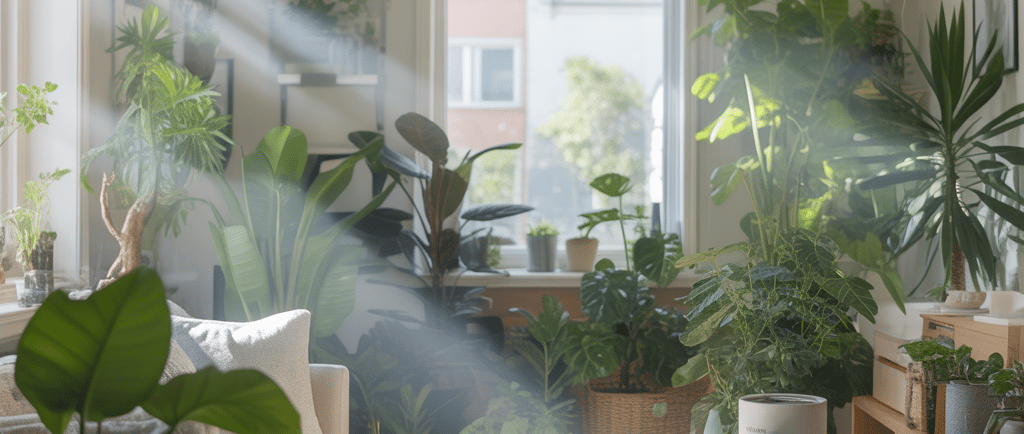
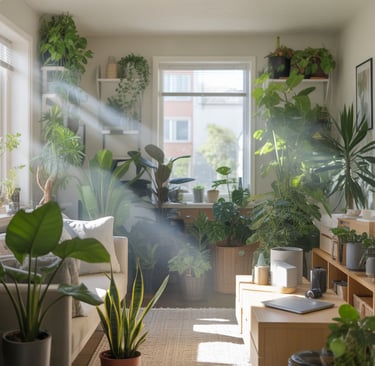
This number is achievable and doesn't require a botanical garden aesthetic. It means building a real indoor garden rather than maintaining one or two accent plants. A five-plant living room collection — a large areca palm in the corner, a rubber plant near the window, a spider plant in a hanging basket, a peace lily on the coffee table, and a Boston fern on a plant stand — meets this threshold and creates a genuinely beautiful, plant-rich indoor space. The goal of building an indoor garden with real air quality impact and the goal of creating a beautiful living space with significant plant presence are the same goal.
Maximizing Air Purification from Your Indoor Plants
Given that plant density and plant health are the primary determinants of how much any plant collection contributes to indoor air quality, strategies that increase effective leaf surface area and maintain plant health through the year are the highest-leverage practices for air quality-motivated indoor gardeners.
Leaf surface area is the most direct physical determinant of a plant's air exchange capacity — more leaf surface means more stomata through which gas exchange occurs and more surface across which VOC absorption happens. This is why large-leaved plants like rubber plants, peace lilies, and palms appear so consistently on air-purifying plant lists — their individual leaf size creates more effective surface area per plant than small-leaved alternatives. For equivalent air quality contribution, a collection of large-leaved plants requires fewer individual specimens than a collection of small-leaved ones. When building an air-purifying collection with density constraints, prioritizing species with large individual leaves or dense multi-frond growth like palms and ferns maximizes air contact per plant.
Keeping leaves clean is the most commonly overlooked maintenance factor in air-purifying plant care. Dust accumulation on leaf surfaces physically blocks gas exchange through the stomata — a dusty plant is a less effective air purifier than a clean one, independent of its growth vigor. Wiping large leaves with a damp cloth monthly, or rinsing smaller-leaved plants in the shower, maintains the clean leaf surface that maximizes photosynthetic efficiency and gas exchange. This is particularly important for large-leaved plants like rubber plants and peace lilies in dusty urban environments where surface accumulation is rapid.
Healthy, actively growing plants perform measurably better at air quality improvement than stressed or declining ones — a point worth emphasizing because it implies that plant care quality directly affects air quality contribution. A plant receiving appropriate light, consistent watering, adequate nutrition, and appropriate humidity is photosynthesizing at full capacity, transpiring actively, and supporting a robust soil microbiome. The same plant under stress — insufficient light, irregular watering, root bound in a too-small container — is performing all of these functions at reduced capacity. The investment in appropriate care — proper potting mix, right-sized containers, consistent watering, adequate light — pays air quality dividends beyond the immediate plant health benefit.
The soil microbiome contribution to air quality is an underappreciated dimension of the total plant air quality effect. Research since the original NASA study has increasingly identified the bacteria and fungi living in plant growing medium as significant processors of certain VOCs — potentially more significant than the plants themselves for some compounds. Healthy, biologically active growing medium — compost-rich potting mix, occasional worm casting amendments, avoidance of synthetic pesticides that damage soil biology — supports the microbial communities that contribute to this effect. This is another argument for quality potting mix and for growing healthy, well-established plants rather than perpetually replacing stressed ones.
Indoor Air Quality Beyond Plants — The Complete Picture
Plants are one component of a comprehensive indoor air quality strategy, and understanding the other components — both for their direct effectiveness and for how they interact with plants — produces the most accurate picture of what plants actually contribute in context.
Ventilation is the single most effective indoor air quality intervention available in most homes, and its effectiveness dwarfs that of plants at normal densities. Opening windows regularly — even for twenty minutes daily — exchanges the accumulated VOCs, carbon dioxide, and other pollutants of indoor air with fresh outdoor air in a way that dozens of plants can't replicate. Modern buildings are built tightly enough to trap pollutants, and the simple act of regular deliberate ventilation addresses this at the source more effectively than any number of air-purifying plants can compensate for. The relationship between ventilation and plants is not competitive — plants contribute most meaningfully when ventilation is already adequate, adding to a healthy air exchange foundation rather than trying to compensate for a poorly ventilated space.
Reducing pollution at the source is a higher-leverage intervention than attempting to remove pollutants after they've been introduced into indoor air. The main indoor VOC sources — new furniture off-gassing formaldehyde and other compounds, paints and finishes emitting volatile compounds, cleaning products releasing various chemicals, synthetic carpeting and flooring materials — can be managed through material choices, airing new purchases outdoors before bringing them inside, choosing low-VOC paints and finishes, and using cleaning products with simpler, less volatile chemistry. Addressing pollution at the source is fundamentally more effective than attempting to remediate it after release.
Mechanical air purifiers with HEPA filtration and activated carbon filters remove both particulate matter and gaseous pollutants from indoor air at rates that genuinely exceed what plants achieve at realistic densities. A quality air purifier in a bedroom or main living area continuously processes the room's air volume and removes pollutants including the fine particulates — PM2.5 — that plants don't address. For anyone seriously concerned about indoor air quality, a mechanical air purifier is a more direct and reliably effective intervention than plants alone — but the two are complementary rather than competitive. Plants add biological and psychological dimensions to indoor air quality that mechanical purifiers don't provide, and mechanical purifiers provide particle and gas removal at rates that plants don't achieve.
The layered strategy that makes the most sense combines all available approaches: regular ventilation as the foundation, pollution source reduction where possible, mechanical air filtration for particulates and VOCs, and a meaningful collection of healthy, actively growing air-purifying plants for the biological, humidity, psychological, and aesthetic contributions they uniquely provide. Plants in this framework are not redundant — they're a genuinely valuable layer in a strategy that no single intervention fully covers alone.
Building an Air-Purifying Indoor Garden — Practical Setup
Translating the science and plant recommendations into a practical indoor garden setup involves the same considerations as any indoor garden — light assessment, space planning, container selection — with the additional dimension of plant selection weighted toward documented air-purifying performance.
For a beginner starting an air-purifying indoor garden with no existing plant collection, the most accessible and practical starting collection combines plants that perform well across different pollutant categories, tolerate a range of indoor light conditions, and are genuinely manageable for someone developing their indoor plant care skills. A five-plant starter collection might include: a snake plant for the bedroom and its CAM photosynthesis night oxygen production — tolerates low light and irregular watering; a spider plant in the living area — adaptable to most light conditions, non-toxic to pets, proven air performer; a peace lily for a shadier corner — strong NASA study performer, dramatic visual impact, blooms in moderate light; a Boston fern in a humid bathroom or kitchen — high transpiration and VOC removal; and a rubber plant near the brightest window — maximum leaf surface area for gas exchange. This collection addresses a range of pollutant categories, works across different light conditions in a typical home, and creates genuine visual impact as a starting point for a larger garden.
For cat and dog households, the collection adjusts to exclude peace lily, snake plant, and English ivy, substituting bamboo palm for large tropical presence, spider plant and Boston fern for proven performance, and calatheas and peperomias for visual interest in the foliage category. The cat-safe air-purifying collection has fewer headline performers than the unrestricted list but remains genuinely effective at the plant densities where any indoor plant collection makes a meaningful contribution.
Scaling up toward the one plant per one hundred square feet minimum threshold for measurable air quality impact is a gradual process that most plant enthusiasts find natural — each successful plant encourages the next addition, and the visual transformation of a space as the plant collection grows creates its own momentum. The key is maintaining plant health as the collection grows — each new plant deserves appropriate light, appropriate container size, and consistent care rather than being crowded into conditions that compromise growth and therefore air quality contribution. An active, healthy collection of ten to fifteen plants in a five-hundred-square-foot apartment is genuinely doing something for air quality and creating a living indoor garden that transforms the quality of the space in ways that go far beyond the measurable chemistry.
Conclusion
The honest answer to whether indoor plants purify the air is: yes, genuinely, but not as dramatically as three decades of marketing has suggested, and not as a substitute for ventilation and pollution source management. The NASA Clean Air Study findings are real — plants do remove VOCs from air. The gap between sealed chamber studies and real home conditions is also real — the densities required for standalone air quality management are impractical. The honest middle ground is that a meaningful collection of healthy, actively growing air-purifying plants contributes genuinely to a layered indoor air quality strategy, adds biological and humidity dimensions that mechanical purifiers don't provide, and delivers psychological and aesthetic benefits whose health value is independently well-supported.
The plants worth growing for air quality are also simply worth growing — areca palms and rubber plants and Boston ferns and peace lilies are beautiful, interesting, and rewarding to tend regardless of their VOC removal rates. Building an indoor garden around species that happen to be among the best documented air purifiers is a strategy that delivers on multiple dimensions simultaneously: cleaner air by meaningful if modest degrees, more beautiful and plant-rich living spaces, and the full range of wellbeing benefits that contact with living plants consistently produces in research.
Start with a spider plant and a snake plant if you're beginning. Add a peace lily and a Boston fern when those are thriving. Keep building from there, one healthy plant at a time, toward a collection dense enough to make a real difference — and beautiful enough to make a difference to your daily life that goes beyond what any air quality measurement can capture.
Share your air-purifying plant collections, your favorite species discoveries, your questions about the science, or your indoor garden setups in the comments below. The intersection of plant science and home environment is one of the most genuinely interesting topics in indoor gardening — and every real-world experience shared here adds to the practical knowledge that helps everyone grow better. 🌿