Indoor Plants Safe for Cats: The Complete Guide to Beautiful, Pet-Friendly Houseplants
Discover the best indoor plants safe for cats — from lush tropical foliage to flowering beauties — plus which popular plants to avoid and how to create a stunning cat-friendly home garden.
INDOOR TINY PLOTS: FRESH FOOD & GREENERY ALL YEAR
Introduction
Of the hundreds of species commonly sold as houseplants in garden centers and home stores, a startling number — well over a hundred by the ASPCA's accounting — are toxic to cats to some degree. Some cause mild mouth irritation. Some cause serious gastrointestinal distress. And a small but important number — lilies most prominently — are capable of causing rapid kidney failure and death in cats who ingest even small quantities. The gap between the cheerful, unlabeled plant display at a garden center and this toxicological reality is wide enough that well-intentioned cat owners inadvertently bring genuinely dangerous plants into their homes regularly, often without any idea that the beautiful pothos trailing from their bookshelf or the elegant peace lily on their windowsill poses a real risk to their cat.
I've shared my home with cats for most of my life and I've been a serious indoor plant person for nearly as long. The intersection of those two things — which plants can I actually grow, which ones have to stay out of the house entirely, and how do I create the lush, beautiful indoor garden I want within the constraint of cat safety — is something I've navigated through real experience rather than theory. Some of that experience involved mistakes I'm not proud of, including the time I learned that my otherwise plant-indifferent cat would make an exception for the leaves of a philodendron I'd placed on a low shelf. Fortunately nothing serious happened, but the scare was enough to make me genuinely thorough about plant safety in a way I hadn't been before.
The good news — and it's genuinely good news — is that the constraint of cat-safe plant selection is far less limiting than most cat owners fear. The range of beautiful, interesting, design-forward houseplants that are completely non-toxic to cats is extraordinary. You can build a full, lush, visually stunning indoor garden using exclusively safe species. You don't have to choose between plants and cats. You do have to choose your plants carefully, and this guide gives you everything you need to do that confidently — the best cat-safe species across every category, an honest account of the plants to avoid, and the strategies for living happily with both. Let's start.
Why Plant Safety Matters for Cat Owners — The Real Risk
Understanding how cats interact with plants — and what the actual risk landscape looks like — is the foundation for making sensible decisions about which plants to keep in a home with cats. The risk isn't uniform across species or across cats, but it's real enough to take seriously regardless of your individual cat's behavior.
Cats interact with plants in multiple ways beyond the obvious chewing. A cat brushing past a plant repeatedly may ingest small quantities of plant material on their fur, which gets groomed off later. Digging in plant soil can expose roots, which are sometimes more toxic than the above-ground portions of certain species. Drinking water from a plant saucer that has collected drainage from a toxic plant can be a subtle exposure route. And kittens — with their higher curiosity and lower body weight making the same dose proportionally more dangerous — interact with plants in ways that adult cats with established habits don't. The "my cat never bothers plants" reassurance is particularly unreliable because cat behavior changes with age, boredom, new plants introduced at lower heights, the presence of a second cat, and simple opportunity when the usual patterns are disrupted.
The toxicity spectrum across houseplants ranges widely. At the mild end, plants like spider plants cause at most gastrointestinal upset — vomiting and brief discomfort — that resolves without treatment. At the moderate end, plants like pothos and philodendron cause oral irritation, excessive drooling, vomiting, and difficulty swallowing that typically require veterinary attention. At the severe end, true lilies — Easter lily, tiger lily, Asiatic lilies — cause acute kidney failure in cats that is rapidly fatal without aggressive veterinary intervention. The dose, the cat's size and health, and how quickly veterinary care is sought all affect outcomes, but some plant exposures are so serious that prevention is genuinely the only safe strategy.
If your cat has eaten or chewed on an unknown plant, the ASPCA Animal Poison Control Center — reachable at 888-426-4435 in the United States — and your veterinarian are the appropriate first contacts. Having the plant identified, or having a photograph to share, dramatically speeds the assessment of risk and the appropriate response. Acting quickly is more important than certainty — if you suspect exposure to a potentially toxic plant, contact the poison control center immediately rather than waiting to see if symptoms develop.
The Best Foliage Houseplants Safe for Cats
The foliage houseplant category is where most indoor gardeners spend their plant budget, and the cat-safe options within it are genuinely some of the most beautiful and interesting plants available — not consolation prizes for owners who can't have the toxic favorites, but excellent plants in their own right.
Spider plants — Chlorophytum comosum — are the plant I recommend first to any cat owner who asks where to start, and not just because of their safety record. Spider plants are legitimately excellent houseplants: fast-growing, architecturally interesting with their arching striped foliage and cascading plantlets, adaptable to a wide range of light conditions from bright indirect to fairly low light, and almost impossible to kill through normal household neglect. They're completely non-toxic to cats according to the ASPCA, and while some cats do chew on the cascading plantlets — something about their movement seems to attract feline attention — the worst outcome is a mildly upset stomach and a somewhat ragged plant. The only important note is mild: spider plants contain compounds with a very slight hallucinogenic effect similar to catnip, which explains why some cats are attracted to them. The effect and any consequent stomach upset are minor and self-limiting.
Calathea and Maranta species — the prayer plant family — are among the most visually spectacular cat-safe houseplants available and a category I'd highlight for any plant lover who prioritizes interesting foliage. The range of patterns within the Calathea genus alone is extraordinary: Calathea orbifolia with its broad silver-green striped leaves, Calathea medallion with its purple undersides and intricate oval patterning, Calathea lancifolia with its long narrow leaves marked in alternating dark green ovals, and dozens of other species each with distinct and beautiful markings. All are non-toxic to cats. They do require some care — they prefer consistent humidity, filtered water when possible, and bright indirect light rather than direct sun — but their visual impact in an indoor garden is unmatched within the safe-for-cats category.
Peperomia is the genus that best delivers variety and adaptability within the cat-safe foliage category. With over a thousand species showing an enormous range of leaf shapes, textures, and colors — the textured, deeply ridged leaves of Peperomia caperata, the round succulent-like leaves of Peperomia rotundifolia, the striking watermelon pattern of Peperomia argyreia — peperomias provide the kind of collection depth that plant enthusiasts love while remaining completely non-toxic to cats. They're also compact, slow-growing, and tolerant of the slightly drier conditions and lower light that sometimes characterize indoor environments, making them genuinely practical as well as beautiful.
Haworthia is the cat-safe succulent answer to the aloe problem — aloe vera is toxic to cats, which disappoints many plant owners who keep it for household first aid purposes, but haworthia provides the same sculptural, geometric succulent aesthetic in a completely non-toxic package. The distinctive white-striped or warty-textured rosettes of various haworthia species are genuinely beautiful and distinctive, and their tolerance of lower light than most succulents makes them more practical for indoor growing than many other succulent genera. Haworthia attenuata — the zebra plant — with its white horizontal banding on dark green leaves is the most commonly available species and one of the most attractive.
Boston fern — Nephrolepis exaltata — is the classic hanging basket plant that many cat owners avoid assuming it's toxic. It isn't — it's on the ASPCA's non-toxic list and is completely safe for cats. Its lush, arching fronds create a dramatically different visual texture from the smooth-leaved tropical plants that dominate cat-safe collections, and the pendant habit makes it ideal for hanging positions that are both visually dramatic and naturally elevated away from cat access. Other safe fern varieties include the button fern, the staghorn fern, and the maidenhair fern — all ASPCA-confirmed non-toxic.
Cat-Safe Tropical and Statement Plants
Statement plants — the large, architecturally significant plants that anchor a room's design and create the sense of an indoor garden rather than just a collection of houseplants — are available in genuinely excellent cat-safe options that provide the visual impact of their toxic counterparts without the risk.
Parlor palm — Chamaedorea elegans — is the cat-safe answer to the desire for a graceful, elegant indoor palm. Growing slowly to two to four feet in typical indoor conditions, with arching fronds of fine-textured leaflets that bring a tropical softness to interiors, the parlor palm is completely non-toxic to cats and highly adaptable to indoor conditions. It tolerates lower light than most palms — surviving and growing reasonably well in bright indirect light that would stress other palm species — and its compact eventual size suits apartment and indoor growing better than many palms. The areca palm — Dypsis lutescens — is a second cat-safe palm option that grows somewhat larger and faster, with a more vigorous tropical character and similar confirmed safety.
Ponytail palm — Beaucarnea recurvata — is a sculptural oddity that's both completely safe for cats and genuinely distinctive as a houseplant. Despite its common name it's not a true palm but a succulent-stemmed plant with a characteristic swollen base and long, narrow, strappy leaves cascading from the top in a ponytail shape. Its extreme drought tolerance — it stores water in its swollen stem base — makes it one of the most forgiving indoor plants available, and its highly unusual silhouette makes it a genuine conversation piece in any indoor space. Completely non-toxic to cats.
Cast iron plant — Aspidistra elatior — earns its common name through genuine near-indestructibility and provides a deep green, architectural statement that survives the conditions — low light, irregular watering, temperature fluctuations — that challenge more sensitive species. The broad, lance-shaped leaves in deep glossy green are elegantly simple and create a design presence that more complex foliage sometimes doesn't achieve. Completely safe for cats, tolerant of essentially any indoor condition that doesn't include direct hot sun, and available in variegated forms with cream-striped leaves that are particularly striking.
Money tree — Pachira aquatica — is a popular indoor plant whose braided trunk and distinctive hand-shaped compound leaves have made it a consistent bestseller in the houseplant market, and it's one of the few large, statement-making tropical plants that is completely non-toxic to cats. It grows well in bright indirect light with consistent watering and reasonable humidity — conditions that suit most indoor tropical plant setups — and its eventual indoor height of three to six feet gives it the room-anchoring presence that's otherwise hard to achieve with cat-safe species.
Cat-Safe Flowering Indoor Plants
Flowering houseplants add color, fragrance, and seasonal dynamism to indoor gardens that foliage plants alone don't provide — and the cat-safe options in this category are genuinely beautiful rather than compromised alternatives to toxic favorites.
African violet — Saintpaulia — is the classic flowering houseplant that's been gracing windowsills for generations, and its complete non-toxicity to cats makes it one of the most reliable recommendations in this guide. The velvety, rounded leaves and continuous clusters of flowers — available in purple, pink, white, and bicolored varieties — create a charming, slightly formal beauty that suits both traditional and contemporary interiors. African violets bloom most reliably in bright indirect light — an east-facing windowsill is ideal — with consistent moisture at the root zone and watering from below rather than onto the leaves. Cats generally show little interest in African violets, possibly because the slightly textured, fuzzy leaves are less appealing than smoother-leaved species.
Orchids — specifically Phalaenopsis, the moth orchid that dominates the consumer orchid market — are completely non-toxic to cats and provide the premium flowering plant experience that no other safe species fully matches. The long-lasting flower spikes with multiple large blooms in white, pink, purple, yellow, and complex patterns, the elegant arching flower structure, and the sophisticated aesthetic that orchids bring to interior spaces are all available without any toxicity concern. Phalaenopsis care has a slightly intimidating reputation but is genuinely manageable: bright indirect light, watering approximately weekly by submerging the pot in water for fifteen minutes, and occasional fertilizing produces reliable reblooming. A Phalaenopsis in bloom on a windowsill or sideboard is one of the most beautiful things a cat-safe indoor garden can offer.
Bromeliads — the broad family that includes many houseplant favorites — are generally non-toxic to cats and provide some of the most dramatic color available in the flowering houseplant category. The central "tank" of a bromeliad — the water-holding cup formed by the leaf bases — supports the often spectacularly colored flower spike while the surrounding foliage provides architectural interest. Guzmania, Vriesea, and Neoregelia bromeliads are the most commonly available and all are confirmed safe for cats. The flowers last for months rather than weeks, providing an extended color contribution that flowering houseplants often don't.
Gerbera daisies in containers bring the cheerful, boldly colored daisy flower indoors in a cat-safe package — the ASPCA confirms gerbera as non-toxic to cats. Their large, simple flowers in red, orange, yellow, pink, and white create immediate visual impact and bring a warmth of color to indoor spaces that the more subtle flowering plants don't match. They're somewhat more demanding than the other flowering plants on this list — they want significant bright light to bloom reliably indoors and prefer cooler temperatures than most tropical houseplants — but in a bright indoor space they reward the extra care with generous blooming.
Cat-Safe Herbs and Edible Plants
The herb and edible plant category deserves specific attention in a cat-safety guide because it's where the most counterintuitive safety picture exists — some plants we think of as benign kitchen herbs have real toxicity concerns for cats, while others are completely safe or even actively beneficial.
Basil — Ocimum basilicum — is completely safe for cats according to the ASPCA and is one of the most useful cat-safe plants you can grow indoors. While most cats ignore basil entirely, some find the scent mildly interesting and may occasionally brush against or sniff a basil plant without any harmful effect. The safety of basil means it's a genuinely worry-free addition to a kitchen herb garden in a cat household, and the culinary value of fresh basil grown on a sunny windowsill makes it one of the best reasons to maintain an indoor herb garden regardless of pet status.
Catnip — Nepeta cataria — is not only safe for cats but is one of the few plants that provides cats with direct positive benefit. The nepetalactone compound in catnip triggers a euphoric response in roughly sixty to seventy percent of cats — a brief, harmless behavioral excitement that typically lasts ten to fifteen minutes and leaves the cat calm and relaxed afterward. Growing catnip indoors requires some containment strategy since cats will aggressively seek out and roll in accessible catnip plants — a hanging position or a room the cat only accesses with permission works well. Fresh catnip has a more intense effect than the dried commercial version, and most cats' reactions to a fresh plant are dramatically more enthusiastic than to dried catnip toys.
Cat grass — typically wheatgrass grown from Triticum aestivum seeds, or oat grass from Avena sativa — is not toxic to cats and is often intentionally grown for cats as a digestive aid and behavioral enrichment. Cats instinctively seek grass to eat, which is thought to aid digestion and provide fiber. Providing a dedicated pot of cat grass gives cats a safe and appropriate outlet for this instinct, which may reduce their interest in other houseplants. Growing cat grass is simple — seeds germinate quickly in moist potting mix on a bright windowsill, producing harvestable grass within a week to ten days, and cats show immediate enthusiastic interest in the fresh growth.
Rosemary — Salvia rosmarinus — occupies a nuanced position in the herb safety discussion. The ASPCA lists rosemary as non-toxic to cats, and small incidental contact or nibbling is unlikely to cause serious harm. However, the essential oils in rosemary are concentrated enough that large quantities could cause gastrointestinal upset. For practical purposes in a household where cats might occasionally nibble a herb plant, rosemary is reasonably safe — but it's not in the same unqualified safety category as basil or catnip.
Important cautions within the herb category: oregano and marjoram contain essential oils that are more concentrated and more potentially irritating than rosemary and should be kept away from cats who chew plants. Mint is similarly cautious — while not severely toxic, the menthol compounds can cause gastrointestinal upset and should not be freely accessible to plant-chewing cats. Chives, garlic, and onion are genuinely toxic to cats and should never be grown in a cat-accessible location regardless of their culinary value.
Popular Houseplants That Are Toxic to Cats — What to Avoid
Knowing which plants to avoid is as important as knowing which plants are safe, and the most important plants to know about are the ones that appear on toxic lists despite being among the most popular and widely recommended houseplants — because these are the ones most likely to already be in your home or to be gifted without any toxicity warning.
Lilies are in a category of their own for cat toxicity severity and deserve explicit, emphatic emphasis. True lilies — the genus Lilium, including Easter lily, tiger lily, Asiatic lily, Oriental lily, and stargazer lily — are acutely nephrotoxic to cats, meaning they cause rapid, severe kidney damage. Ingestion of even a small amount of any part of a true lily — including pollen falling onto fur that is then groomed, or water from a vase containing lilies — can cause kidney failure in cats within twenty-four to seventy-two hours. This is not a "causes stomach upset" warning — this is a "your cat may die" warning. True lilies have absolutely no place in a home with cats, full stop. Note that daylilies (Hemerocallis species) and peace lily (Spathiphyllum) are different plants — daylilies share the kidney toxicity risk while peace lily causes a different, less immediately life-threatening toxicity profile — but none of these should be in a cat household.
Pothos — Epipremnum aureum — and philodendron species together represent the most significant safety gap between popularity and safety awareness in the houseplant world. Both are among the most widely sold, most commonly recommended, and most visually recognizable houseplants in existence. Both are toxic to cats, causing oral irritation, excessive drooling, vomiting, and difficulty swallowing through their calcium oxalate crystal content. They're not in the same severity category as true lilies, but the ubiquity of pothos recommendations in beginner houseplant guides — combined with the near-total absence of cat toxicity warnings in those same guides — means that pothos is probably the plant most commonly causing preventable harm to cats in the homes of well-intentioned plant lovers.
Peace lily — Spathiphyllum — carries a particularly ironic name given its toxicity profile for cats. The elegant white spathe flowers and glossy foliage make it one of the most visually appealing plants on this list, and its tolerance of low light makes it a popular recommendation for challenging indoor spaces. For cat households, it must be excluded entirely — the calcium oxalate crystals cause significant oral irritation, drooling, vomiting, and difficulty swallowing.
Aloe vera is the wellness-culture houseplant whose cat toxicity catches many owners by surprise. Its reputation as a soothing, beneficial plant — justified for topical use on humans — leads people to assume it's similarly benign for household animals. For cats, ingestion causes vomiting, diarrhea, lethargy, and in larger quantities more serious symptoms. Aloe vera cannot be kept in cat-accessible positions.
Snake plant — Sansevieria/Dracaena trifasciata — and ZZ plant — Zamioculcas zamiifolia — are two more widely recommended beginner houseplants that are toxic to cats. Snake plant causes nausea, vomiting, and diarrhea. ZZ plant contains calcium oxalate crystals causing similar irritation to pothos and peace lily. Both should be excluded from cat households or placed in genuinely inaccessible positions.
Strategies for Living with Both Plants and Cats
Even within a commitment to growing only cat-safe species, practical strategies for managing the coexistence of curious cats and indoor plants improve the experience for both the plants and the humans who tend them.
Physical separation is the most reliable strategy for any plants about which you have safety doubts — a room the cats don't access, a bathroom or spare bedroom that stays closed, or a dedicated plant room. For households committed to exclusively cat-safe plants, physical separation is less critical but still useful for protecting plants from cats who chew, dig, or knock things over for entertainment rather than for any toxicological reason. A high shelf, a wall-mounted planter, or a hanging position eliminates access for cats who don't jump to high surfaces — though this underestimates the athleticism of most cats in practice.
Hanging and elevated placement works most reliably for cats who are not ambitious jumpers or climbers — older cats, less athletic individuals, cats with no jumping history. For the athletically gifted cat who treats the top of the refrigerator as a casual transit point, hanging and elevation may simply create a more interesting challenge rather than a genuine barrier. Honest assessment of your specific cat's jumping and climbing behavior is the starting point for any elevation-based strategy.
Deterrent strategies that genuinely work include physical barriers like decorative stones or pebbles covering the soil surface — which prevents digging and makes the container less interesting as a toilet alternative — double-sided sticky tape on the surface around containers for cats who like to rub against plants, and citrus peel placed around plants since most cats find citrus scent aversive. Commercial cat deterrent sprays applied to pot surfaces can discourage investigation, though reapplication is needed as the scent fades. These deterrents work best as supplements to a cat-safe plant selection rather than as the primary safety strategy.
Creating a dedicated cat plant corner with safe, cat-attractive species — catnip, cat grass, valerian, silver vine — gives cats a legitimate destination for their plant-related curiosity and behavioral needs. A corner or shelf with these plants, positioned at cat-accessible height with a comfortable spot for lounging nearby, channels plant-investigation behavior toward safe and appropriate targets. Many cat owners find that providing this kind of dedicated safe plant access significantly reduces interest in other houseplants.
Designing a Beautiful Cat-Safe Indoor Garden
The creative challenge of building a beautiful indoor garden using exclusively cat-safe species is more interesting and more achievable than it might initially seem — and approaching it as a creative constraint rather than a limitation produces better design outcomes.
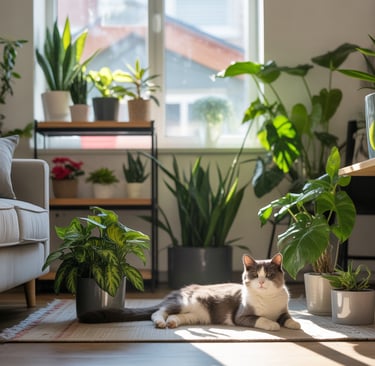
Building a complete indoor garden around safe species starts with selecting plants that provide variety across the key design dimensions: scale, from small desktop peperomias to large statement palms; texture, from the fine-textured fronds of a parlor palm to the broad, smooth leaves of a money tree to the intricate patterning of a calathea; and color, from the deep glossy greens of the cast iron plant to the silver and green variegation of certain peperomias to the purple undersides of calathea medallion leaves. A collection that addresses all three dimensions creates visual depth and interest that a single-species collection doesn't achieve regardless of specimen quality.
For light-limited spaces — north-facing rooms, rooms with small windows — the cat-safe palette includes excellent performers: cast iron plant tolerates deep shade better than almost any houseplant; calathea and maranta perform well in bright indirect light without direct sun; Boston fern, pothos alternatives like heartleaf philodendron — wait, philodendron is toxic. The key adjustment for low-light cat-safe design is leaning into the cast iron plant, calathea, peperomia, and prayer plant options that genuinely perform in lower light conditions.
Color in a cat-safe indoor garden is primarily delivered through flowering plants — African violet, orchid, bromeliad, gerbera — and through the remarkable leaf coloration of calathea and maranta varieties. The pinstripe calathea with its fine white lines on deep green, the rattlesnake plant with its wavy-edged leaves in two-tone green, and the tricolor stromanthe with its cream, green, and pink variegation provide color interest without any flower required. Combining these with the solid greens of parlor palm, money tree, and peperomia creates the kind of layered, complex indoor garden that most people achieve only with the help of toxic species.
Resources, Verification, and Keeping Up With Plant Safety**
Plant safety information for pets is available from authoritative sources and knowing how to use those sources — and what their limitations are — is the most valuable long-term skill for any cat owner who keeps plants.
The ASPCA's Animal Poison Control database at aspca.org/pet-care/animal-poison-control is the most comprehensive and authoritative English-language resource for plant toxicity to cats, dogs, and horses. The database is searchable by plant name and returns a clear toxic or non-toxic designation alongside a description of the toxic components and expected symptoms for toxic species. Before purchasing any new houseplant, checking the ASPCA database takes less than a minute and provides authoritative safety information rather than the inconsistent and sometimes incorrect information found in general plant guides and social media.
Common names create dangerous confusion in plant safety research because the same common name is often applied to completely different plant species with completely different toxicity profiles. "Lily" is the most dangerous example of this confusion — the term is applied to true lilies (acutely toxic to cats), daylilies (similarly toxic), peace lily (toxic but differently), calla lily (toxic), and lily of the valley (extremely toxic), as well as various other plants with "lily" in their name that have no relation to these species. Always search by scientific name — genus and species — when checking toxicity, and if you don't know a plant's scientific name, that's the first thing to establish before making any safety assessment.
When you can't identify a plant — something bought without a label, inherited from another household, or growing in an uncertain location — the safest default is to treat it as potentially toxic until identification is confirmed. Plant identification apps like iNaturalist and PlantNet can provide a likely identification from a photograph, which can then be verified in the ASPCA database. If identification isn't possible with confidence, keeping the plant out of cat access until it's identified is the appropriate precaution.
Maintaining a simple list of the plants in your home — common name, scientific name, and ASPCA safety status — takes an afternoon to establish and gives you a reference document that's instantly useful when a cat has been near an unfamiliar plant or when you're considering a new purchase. Updating it whenever a new plant enters the home maintains its usefulness as your collection grows.
Conclusion
A beautiful, lush, full indoor garden that's completely safe for cats is not a compromise — it's simply a garden built with deliberate, informed choices. Spider plants, calatheas, peperomias, parlor palms, African violets, orchids, bromeliads, money trees, Boston ferns, haworthias, and dozens of other genuinely excellent plants are available to cat owners without any toxicity concern. The aesthetic range across these species is extraordinary — from dramatic tropical statement plants to delicate flowering beauties to architectural succulents — and the design possibilities they create together are limited only by the same factors that constrain any indoor garden: light, space, and the gardener's imagination.
The plants to avoid are specific and learnable: true lilies above all, then pothos and philodendron, peace lily, aloe, snake plant, and ZZ plant — all popular, all genuinely toxic, all completely replaceable with beautiful safe alternatives. Knowing these clearly is what makes it possible to shop confidently, accept plant gifts without anxiety, and build an indoor garden that genuinely serves both the visual ambition and the genuine safety it should.
Start this week with one plant from the safe list that appeals to you most. A spider plant for easy confidence. A calathea for spectacular foliage. An African violet for continuous flowers. An orchid for something genuinely beautiful on a windowsill. The collection grows from there, plant by plant, and the cat shares the home safely with every one of them.
Share your cat-safe plant collections, your creative solutions for living with both plants and cats, your species recommendations, or your questions in the comments below. The community of cat-owning plant lovers has figured out extraordinary things about making these two great loves coexist happily — and every experience shared here makes the next person's journey a little easier. 🐱