How to Grow Food on a Shaded Balcony: The Complete Guide to Low-Light Edible Gardening
Think your shaded balcony can't grow food? Think again. Discover the best edible plants, smart setup strategies, and grow light tips that make shaded balcony gardening genuinely productive.
BALCONY TINY PLOTS: TURN YOUR OUTDOOR SPACE INTO A MINI FARM
Introduction
More than half of urban apartment balconies receive fewer than four hours of direct sunlight daily — blocked by neighboring buildings, overhead structures, surrounding trees, or simply facing the wrong direction. If you live in one of those apartments, you've probably been told, directly or indirectly, that serious food growing isn't really possible for you. Gardening content overwhelmingly assumes full sun. Seed packets describe light requirements in terms of six to eight hours of direct sun. And the most productive and photogenic balcony gardens you see online are almost always bathed in light.
Here's what that narrative misses: shade is a growing condition, not a growing prohibition. It limits some things — fruiting vegetables, sun-hungry herbs, anything that needs intense light to flower and produce — but it actively suits others. Lettuce is better in shade than in full sun. Mint thrives in conditions that would stress basil. Spinach, arugula, bok choy, mizuna, cilantro, parsley, chives, and alpine strawberries all grow productively in the partial shade that most north and east-facing balconies provide. And with a small investment in supplemental lighting, the range of what's achievable expands significantly even on the most light-limited balcony.
I grew food on a north-facing balcony for three years — genuinely north-facing, with an overhang above and a building across the street that reduced direct sun to essentially zero most of the year. It was one of the most instructive growing experiences I've had, because it forced me to genuinely understand which plants need light and which ones are better described as light-tolerant. I ate well from that balcony. Not tomatoes and peppers, but lettuces, salad greens, herbs, mint in abundance, and alpine strawberries that fruited consistently through the season. This guide is what I learned: the honest picture of what shade means for food growing, which plants to grow, how to maximize your light, and how to build a genuinely productive food garden from a balcony that most gardening advice would write off entirely. Let's start.
Understanding Shade — What You Actually Have and What It Means
Before choosing plants or buying containers, spend time genuinely understanding what kind of shade your balcony receives — because shade is not a single condition but a spectrum, and the difference between deep shade and dappled partial shade is the difference between a dramatically limited growing environment and one that's suitable for a wide range of productive food crops.
The standard shade classifications used in horticulture distinguish between full shade — less than two hours of direct sun daily, typically receiving only ambient reflected light — partial shade — two to four hours of direct sun daily, or indirect bright light for a longer period — and dappled or filtered light, where sunlight is broken up by overhead structures, leaves, or architectural elements to create a shifting pattern of sun and shadow across the day. Full shade is the most limiting condition and the one where grow light supplementation becomes essentially necessary for food production. Partial shade is where the widest range of shade-tolerant crops can perform genuinely well without supplementation. Dappled light, while inconsistent, often provides more total photosynthetically active radiation than the term implies and can support more productive growing than pure partial shade.
Measuring your balcony's actual light levels removes the guesswork from assessing your growing conditions. The simplest approach is time-based observation: spend a clear day on your balcony noting when direct sunlight is actually falling on your growing surface and for how long. Do this at different times of year — the angle of the sun and the shadow patterns from surrounding buildings change significantly between summer and winter, often making spring and autumn conditions more favorable than peak summer on balconies shaded by buildings. A more precise measurement uses a lux meter — inexpensive smartphone apps perform adequately for this purpose — to measure light intensity at different points on your balcony at different times of day. Values above 10,000 lux indicate full sun conditions. Values between 3,000 and 10,000 lux indicate bright indirect or partial shade. Values below 3,000 lux indicate shade conditions where grow light supplementation becomes increasingly useful.
The direction your balcony faces determines the character of its shade as much as the quantity of it. North-facing balconies in the northern hemisphere receive no direct sun at any time of year — they receive only ambient sky light, which varies with weather but averages far lower intensity than any direct sun exposure. These are the most light-limited balconies and the ones most likely to benefit from grow light supplementation. East-facing balconies receive morning sun — generally gentler and lower in intensity than afternoon sun, but genuine direct light that can range from two to four hours daily depending on the season and surrounding obstructions. West-facing balconies receive afternoon and evening sun — warmer and more intense than morning sun, and potentially adequate for a wider range of crops than east-facing equivalents receive. Understanding your balcony's directional character helps you choose plants appropriately and set realistic expectations for what each position can support.
Seasonal light changes are significant on shaded balconies and worth factoring into annual planning. The sun's lower angle in autumn and winter can actually increase light on balconies shaded by neighboring buildings' upper floors — what blocks direct summer sun at a steep angle may not block the lower winter sun that comes in at a shallower angle. Conversely, trees that provide filtered shade in summer are bare in winter, allowing more light through. Observe how your balcony's light changes through the year and plan accordingly — a balcony that's too shaded for productive summer growing may be perfectly suited for cool-season crops in spring and autumn when light angles are more favorable and cool-weather crops are at their best.
The Best Vegetables to Grow in Shade
The vegetables that perform well in shade are almost all leafy crops — and that's not a coincidence. Leafy vegetables evolved in the understory of forests and woodland edges where direct sunlight is filtered and interrupted, and their physiology reflects that adaptation. They're optimized to capture available light efficiently at lower intensities rather than requiring the intense direct sun that fruiting plants need to power flower and fruit development.
Lettuce is the definitive shade crop and the plant I recommend without hesitation as the starting point for any shaded balcony food garden. It not only tolerates partial shade — it actively benefits from it in ways that make shaded growing genuinely superior to full sun growing for this crop during warm weather. Lettuce bolts — sends up a flower stalk and becomes bitter — in response to heat and long day length. Full sun accelerates both heat buildup and day-length perception, causing summer lettuce in full sun to bolt within weeks of planting. The same lettuce in partial shade experiences lower temperatures and less heat stress, extending its productive leaf-producing phase by weeks. The flavor of shade-grown lettuce is often better than sun-grown equivalents — less bitter, more tender — because the compounds that cause bitterness in lettuce are produced in response to stress, and shade reduces that stress. Loose-leaf varieties like 'Oak Leaf', 'Red Sails', and 'Salanova' types are particularly well-suited to partial shade and cut-and-come-again harvesting from a shaded balcony.
Spinach is another crop that actively prefers cooler, shadier conditions to full sun exposure. Like lettuce, spinach bolts in heat and direct sun, and the partial shade of a north or east-facing balcony can extend the productive season for spring and autumn spinach significantly beyond what full-sun growing allows. Spinach in partial shade produces larger, more tender leaves with better flavor than heat-stressed full-sun spinach, and it often continues producing through weather that would have terminated a full-sun planting weeks earlier. The limitation is that spinach is a cool-season crop — it doesn't grow well in summer heat regardless of shade — so its shaded balcony growing is best focused on the spring and autumn windows when temperatures are genuinely cool.
Arugula is one of the fastest and most reliably productive salad crops for shaded balcony growing, and it surprises many gardeners with how well it performs in low light. Like spinach and lettuce, it bolts in heat and full sun, and shade moderates both heat stress and bolting tendency, extending its productive window. The flavor of shade-grown arugula is actually milder and more nuanced than the peppery bite of heat-stressed arugula — some people who find full-sun arugula too intensely peppery discover they love the more balanced flavor of shade-grown leaves. Arugula grows quickly even in partial shade — harvestable baby leaves within three to four weeks from seed — and cut-and-come-again harvesting keeps a single planting productive for two months or more in good conditions.
Asian greens are the category that most surprises gardeners new to shade growing, because the range of productive, fast-growing, genuinely delicious crops available is extraordinary. Bok choy, mizuna, tatsoi, pak choi, komatsuna, and mibuna all grow vigorously in partial shade — in fact, the delicate texture and mild flavor that make these greens so appealing in cooking is better maintained in shade than in full sun, where they can become tough and slightly bitter. These crops grow quickly — many are harvestable as baby greens within three to four weeks, with full-size plants ready in six to eight weeks. They respond well to the same cut-and-come-again harvesting approach as lettuce, making them ideal for continuous production from a small shaded balcony. Mizuna in particular is extraordinarily shade-tolerant, producing delicate feathery leaves prolifically in conditions where other crops struggle.
Kale deserves mention as a brassica green that performs adequately in partial shade, though it grows more slowly in low light than in full sun. The trade-off is worthwhile because kale leaves grown in partial shade tend to be more tender and less tough than full-sun kale — the intensity of sun hardens leaf tissue, and shade-grown kale is noticeably more pleasant to eat raw than sun-grown equivalents. 'Red Russian' and 'Lacinato' varieties tolerate partial shade better than curly types. Expect slower growth than full-sun kale and harvest baby leaves rather than waiting for full-size leaves to develop.
Herbs That Thrive in Shaded Balcony Conditions
The herb category is one of the genuine bright spots for shaded balcony growing, because several of the most useful culinary herbs are not only tolerant of partial shade but actively prefer it — performing better in lower light than they would in the intense full sun that Mediterranean herb guides typically prescribe.
Mint is the herb that most thoroughly embodies shade tolerance — it evolved in moist, partially shaded woodland margins and riparian zones, and the full sun growing conditions that many guides recommend are actually less ideal for mint than the partial shade that most north-facing balconies provide. Mint in full sun produces smaller leaves, runs faster and more aggressively, and dries out more quickly than mint in partial shade, where the larger, more tender, more flavorful leaves grow lushly in consistently moist soil. If you have a shaded balcony and want one herb that will genuinely thrive and provide abundant harvests, mint is it. The practical cautions about mint — its vigorous spreading habit, its ability to take over mixed containers — apply regardless of light conditions, so growing it in its own dedicated container remains the right approach even in shade.
Chives are another herb whose shade tolerance is better than their reputation suggests. They need some light — less than two hours of direct or bright indirect light daily is a genuine minimum — but in the two to four hour range of partial shade, chives grow steadily and produce flavorful leaves throughout the season. The growth rate is slower than in full sun but the flavor quality is comparable, and chives in partial shade benefit from cooler temperatures that reduce the tendency toward hollow, coarse leaves that full-sun summer chives sometimes develop. The purple flowers that chives produce are a bonus ornamental feature and edible garnish — they appear somewhat later in shade than in full sun but are just as attractive.
Parsley is an interesting case because it's actually better suited to partial shade in summer than to full sun — a fact that most herb guides underplay because they're written for garden bed growing where partial shade is harder to arrange than on a balcony. In full summer sun, parsley can bolt and become coarse in flavor. In partial shade, it grows steadily with finely flavored, tender leaves through a longer productive season. Both flat-leaf Italian parsley and curly parsley perform well in partial shade, with flat-leaf types generally considered to have better flavor. Start parsley from transplants rather than seed in a shaded balcony context — parsley seed germinates slowly and erratically even in ideal conditions, and the head start of a transplant makes better use of the productive season.
Cilantro is one of the most notorious bolting herbs in full sun growing — a warm day, a little stress, and cilantro shoots up its flower stalk and stops producing the leaves you planted it for. Shade dramatically improves this situation. The cooler temperatures and reduced light intensity of a partially shaded balcony slow the bolting trigger substantially, extending cilantro's leaf production phase by weeks compared to full-sun growing. For anyone who cooks frequently with cilantro and has been frustrated by rapid bolting on a sunny windowsill or full-sun balcony, a shaded balcony is actually an asset for this herb. Succession plant every three to four weeks for continuous supply, since even shade-grown cilantro eventually bolts.
Lemon balm is a member of the mint family that shares mint's genuine shade preference and is underused in culinary herb gardens relative to how useful and easy it is. It produces lemon-scented leaves that are excellent in teas, cold drinks, desserts, and fish dishes, and it grows abundantly in partial shade with minimal care. Like mint, it can spread enthusiastically and is better grown in its own container. Unlike mint, it's generally less aggressive and easier to keep contained. Lemon balm in a shaded balcony corner, in a good-sized pot with reasonable soil, will provide harvests from spring through autumn with essentially no intervention beyond occasional watering.
Fruiting Plants — What's Realistic in Low Light
This is the section where I need to be genuinely honest rather than optimistically accommodating, because fruiting plants and shade are in real tension that positive thinking and clever workarounds can only partially resolve. Understanding what shade means for fruiting crops allows you to make decisions that produce genuine results rather than frustrating near-misses.
The reason fruiting plants need intense light is fundamental to their biology. Flowering and fruit development are energetically expensive processes that draw heavily on the sugars produced through photosynthesis. More photosynthesis requires more light. A plant that's photosynthesizing at fifty percent of its potential capacity because it's receiving fifty percent of its ideal light isn't just growing at fifty percent of its potential — its fruiting productivity falls far more than proportionally, because fruiting is the last thing the plant prioritizes when photosynthetic resources are limited. In low light, plants prioritize survival — maintaining existing leaves, supporting root function — over reproduction. Fruiting is reproduction. It gets deprioritized first.
Strawberries are the genuine exception to the shade-fruiting generalization and the one fruiting plant I recommend with genuine enthusiasm for shaded balcony growing. Cultivated strawberries perform adequately in as little as four hours of direct sun — far less than most fruiting crops. Alpine strawberries — the small-fruited, ever-bearing woodland strawberry that produces throughout the season rather than in one main flush — are genuinely adapted to partial shade conditions, having evolved in forest understories and woodland edges. They produce consistently in two to three hours of direct sun supplemented by bright indirect light, yielding small but intensely flavored fruits throughout the growing season. The flavor of ripe alpine strawberries is extraordinary — concentrated, aromatic, more intensely strawberry-flavored than most large-fruited cultivated varieties — and they produce from a compact container that fits comfortably on a shaded railing or shelf. 'Mignonette', 'Alexandria', and 'Yellow Wonder' are excellent alpine varieties for partial shade.
Cherry tomatoes in bright indirect light represent the edge case — the situation where favorable conditions at the better end of partial shade, combined with a grow light supplement, make some fruiting possible without full outdoor sun. I want to be specific about what "bright indirect light" means here: a west-facing balcony receiving two to three hours of afternoon direct sun plus several hours of bright reflected light, or a covered balcony with clear perspex roofing that transmits most available light, or a position that receives genuine bright sky light for most of the day even without direct sun. In these conditions, with a LED grow light providing supplemental intensity during daylight hours, compact cherry tomato varieties like 'Tumbling Tom' or 'Tiny Tim' can produce a modest yield. Expect significantly less than a full-sun setup would produce — perhaps a quarter to a third of potential yield — and be prepared to hand pollinate since shade-grown tomatoes set fruit less reliably.
The honest recommendation for most genuinely shaded balconies — north-facing, heavily overlooked, or with overhangs that block most sky light — is to accept that fruiting vegetables aren't the right crop for your outdoor space and focus your shaded balcony on the crops that genuinely thrive there. This isn't a consolation prize. A productive shaded balcony growing lettuce, arugula, Asian greens, mint, chives, parsley, cilantro, and alpine strawberries provides real, daily kitchen value that a sun-starved tomato struggling to produce a handful of undersized fruit doesn't match. Play to your conditions rather than fighting them, and your shaded balcony becomes genuinely productive rather than perpetually disappointing.
Maximizing Light on a Shaded Balcony
Before accepting the constraints of a shaded balcony entirely, there are genuine, practical strategies for increasing the effective light reaching your plants — some free, some involving modest investment, all worth implementing because even modest light increases can meaningfully expand what you can successfully grow.
Reflective surfaces are the most immediately impactful light-maximizing strategy and the one I'd implement first on any shaded balcony. Light that falls on a dark surface is absorbed as heat and lost to the plant. The same light falling on a white, silver, or highly reflective surface bounces back toward plants, effectively multiplying the light available in the growing space. Painting the wall behind your growing area white — if your lease permits, and if it wasn't already white — can visibly increase the brightness of the space. Lining the inside of a dark fence or partition with white corrugated plastic sheeting, aluminum foil secured to a board, or purpose-made reflective mylar creates a significant light boost for containers positioned in front of it.
Light-colored containers and growing surfaces compound the reflective benefit. A collection of white or pale containers sitting on a light-colored tray or surface reflects more light upward and onto plant foliage than dark containers on a dark surface. The individual effect of any one container color change is modest, but the cumulative effect of consistently light-colored containers, light-colored growing surfaces, and light-colored walls creates a noticeably brighter growing environment than the equivalent setup with dark elements throughout.
Strategic mirror placement is the most dramatic light-redirection strategy available for shaded balconies and the one that most dramatically surprises people when they first try it. An outdoor-rated mirror — or a piece of mirror film attached to a board or rigid backing — positioned to catch available light and redirect it toward growing areas can bring a meaningful beam of reflected light into a position that receives none directly. The practical setup involves positioning the mirror to catch whatever direct or bright sky light is available — often from above or to one side — and angling it to bounce that light toward the darkest growing positions. The effect is most dramatic early and late in the day when direct light is available at angles that the growing position itself doesn't receive. Mirror film is inexpensive, lightweight, and can be cut to any size and shape — a practical outdoor light-redirection solution that costs very little.
Moving containers seasonally and throughout the day to follow available light is a strategy that only container growing allows and that fixed garden beds don't. The brightest, most favorable light position on a shaded balcony shifts with the time of day and the season — what's brightest in the morning may not be brightest in the afternoon, and what's brightest in summer may not be the same as the brightest spot in spring. A weekly ten-minute assessment of where available light is falling and a rearrangement of containers to put the most light-hungry crops in the currently best positions makes a cumulative difference that adds up to meaningfully better growing outcomes over a season.
Supplemental Grow Lights for Shaded Balconies
At some point on a sufficiently shaded balcony, the honest assessment is that natural light maximization has reached its limit and supplemental artificial light is the most practical path to expanding what you can grow. This is especially true for anyone who wants to grow crops beyond the core shade-tolerant list — or who wants to grow those crops more productively and through a longer season than natural shade light allows.
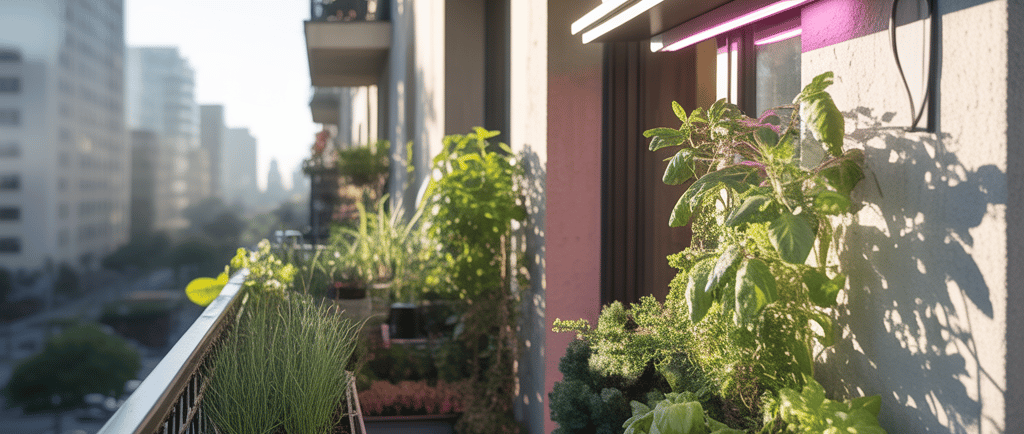
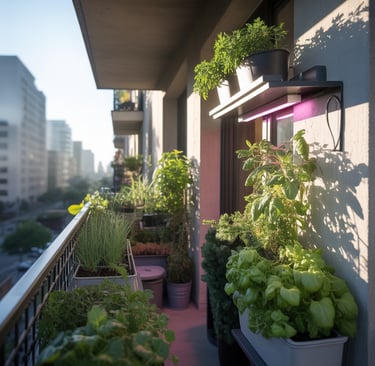
The outdoor grow light market has developed significantly in recent years, with weatherproof and outdoor-rated options that are genuinely suitable for covered balcony use. The key consideration that distinguishes outdoor balcony grow light use from indoor use is weather resistance — lights need to be rated for the moisture and temperature conditions they'll encounter. For covered balconies where the grow light is protected from direct rain, indoor-rated lights with good ventilation are often adequate, particularly if the balcony covering provides meaningful protection. For exposed balconies or any position where the light might be exposed to rain, IP65 or higher weather resistance ratings are essential — this rating indicates the light is protected against water jets from any direction.
Spider Farmer, Mars Hydro, and several other grow light brands now offer bar-style LED lights in outdoor or semi-outdoor configurations that provide excellent light quality for covered balcony use. The same bar lights recommended for indoor windowsill herb growing in the grow lights article earlier in this series work equally well on covered balconies when positioned appropriately — their slim profile mounts easily under balcony overhangs or from ceiling hooks, and their energy efficiency keeps operating costs manageable. For an exposed balcony, purpose-built outdoor horticultural LED floodlights — available from garden supply companies — provide weatherproof grow light functionality, though they tend toward less efficient and less spectrally optimized designs than the best indoor-focused LED bars.
Setting up a grow light system on a shaded balcony follows the same basic principles as indoor grow light setup, with some outdoor-specific adjustments. A timer is even more important outdoors than indoors because the outdoor light schedule — sunrise and sunset — provides a natural on/off cue that your grow light should supplement rather than replace entirely. Running the grow light for the daylight hours rather than for a fixed fourteen to sixteen hour period makes sense on a balcony where natural light, however limited, is still the primary source and the grow light is genuinely supplemental. Position lights as close to the plant canopy as the fixture and hanging system allow — the PPFD reduction with distance is as real outdoors as indoors. And ensure that power delivery is safe — outdoor-rated extension cords, GFCI-protected outlets, and appropriate cord management for a wet outdoor environment are all important electrical safety considerations.
The cost-benefit calculation for balcony grow lights is worth doing honestly. A basic LED bar light consuming forty to sixty watts runs for about fourteen hours daily — roughly 0.6 to 0.84 kWh per day, or around eighteen to twenty-five kWh per month. At average electricity rates this costs roughly two to three dollars per month — an entirely manageable operating cost for the expanded growing capacity it provides. The hardware investment — thirty to sixty dollars for a quality LED bar light plus ten dollars for a timer — pays back quickly in the value of additional food production and the extended growing season that supplemental lighting enables on a balcony that would otherwise be limited to a few shade-tolerant crops through a compressed season.
Container Setup and Soil for Shaded Balcony Growing
The container setup and soil choice for shaded balcony growing requires some specific adjustments compared to full-sun balcony growing — primarily because the conditions that plants experience in shade are different in ways that affect drainage needs, moisture management, and light reflection from the growing environment itself.
Container choice for shade growing should favor lighter colors and materials that reflect rather than absorb the limited available light. White or pale containers reflect light back toward plant foliage and onto the growing medium surface, making more of the available light accessible to plants. Dark containers absorb heat in full sun — sometimes to the point of damaging roots — but this heat-absorption effect doesn't apply in shade, where temperatures are cooler, making the light-reflection benefit of pale containers the primary consideration without the temperature-regulation trade-off that applies in sun.
Container sizing in shade should lean toward adequate root volume rather than the smallest possible pot, because larger containers buffer moisture and temperature fluctuations more effectively than small ones — and in shade, where plants are growing more slowly, maintaining consistent conditions over longer periods matters more than it does in fast-growing full-sun situations. Larger containers also allow more root development, which supports the uptake of the nutrients that shade-grown plants need to maintain productive growth despite lower photosynthetic rates.
Soil mix adjustments for shade growing focus primarily on drainage and aeration rather than on the moisture retention that full-sun growing often requires. In shade, evaporation from the soil surface is slower than in full sun, and overwatering becomes a more significant risk than in sun-exposed containers. A shade-appropriate mix incorporates more perlite than a standard potting mix — perhaps thirty to forty percent perlite in the mix — to ensure rapid drainage and good root zone aeration even when watering frequency is lower. The lower evaporation rate in shade means soil stays moist longer between waterings, and roots sitting in waterlogged conditions for extended periods is a common problem in shade containers that good drainage mitigates.
Grouping containers is a microclimate strategy that pays dividends in shade just as it does in sun. Grouped containers create a more humid microenvironment between them — transpiration from multiple plants raises humidity in the immediate vicinity of the group — and this higher humidity reduces moisture stress in conditions where plants might otherwise lose more water through transpiration than their shade-slowed roots can replace. Grouping also means that reflected light between pale containers in a group reinforces itself — light bouncing between neighboring pale containers creates a brighter microenvironment for the plants in the center of the group than the same plants would experience in isolation.
Seasonal Strategy for Shaded Balcony Food Gardening
The seasonal dimension of shaded balcony growing is where the relationship between shade and productivity is most interesting and most counterintuitive — because the seasons when a shaded balcony is most productive aren't the same as the peak season for a full-sun garden, and working with that difference rather than against it is what makes shaded balcony growing genuinely rewarding.
Spring and autumn are when shaded balconies shine — sometimes literally, as lower sun angles bring more direct light to north and east-facing positions that are shaded in summer by the high sun angle. More importantly, spring and autumn are when cool-season crops that constitute the shaded balcony's core productive range are at their absolute best. Lettuce, spinach, arugula, Asian greens, peas, and shade-tolerant herbs all grow most vigorously and with best flavor in the cool temperatures of spring and autumn. The mild temperatures that would limit fruiting crop productivity actually enhance the quality of leafy crops — sweeter lettuce, more tender spinach, less bitter arugula. A shaded balcony in April or September can be surprisingly and delightfully productive in a way that the same balcony in July is not.
The summer period on a shaded balcony is the most challenging from a food production standpoint, and adjusting expectations and strategy for this period produces better outcomes than trying to force full productivity from conditions that don't support it. Heat-tolerant Asian greens — certain bok choy varieties, mibuna, and heat-tolerant lettuce types like 'Jericho' or 'Nevada' — extend the productive leafy green season further into summer than cool-season types allow. Mint and other shade-tolerant herbs continue producing abundantly through summer regardless of heat. Alpine strawberries fruit through summer in partial shade. And supplemental grow lighting, if installed, supports more continuous productivity through the lower-light months without regard for the seasonal pattern.
Winter growing on a shaded balcony in mild climates — USDA zones 7 and above, where hard freezes are infrequent — is genuinely possible and often more productive than expected. Cold-hardy greens — kale, spinach, mâche, claytonia, and certain Asian greens — handle mild frosts well and continue producing slowly through the winter months even in low-light conditions. Growth slows significantly as temperatures drop and day length decreases, but continuous slow growth is still growth — regular small harvests of cold-hardy greens from a winter shaded balcony are entirely achievable in the right climate. Floating row cover over containers on cold nights extends the productive range by providing a few degrees of frost protection without blocking the limited available light during the day.
Succession planting is even more important on a shaded balcony than on a full-sun one because individual plants produce over a longer but lower-intensity period — having multiple plants at different stages of development ensures continuous harvest rather than a gap between one planting's end and the next's beginning. For lettuce and Asian greens, starting a new container every three to four weeks rather than every two to three provides an appropriate succession tempo for shade-pace growing. For herbs, maintaining multiple containers of the most-used varieties ensures that harvesting from one doesn't strip it below productive levels while it recovers.
Making the Most of a Shaded Balcony — Mindset and Strategy
The final and most important thing I want to address about growing food on a shaded balcony is the mindset that makes it genuinely rewarding rather than a constant experience of wanting more than the conditions can provide. This isn't about lowering standards or accepting mediocrity — it's about accurately understanding what a shaded balcony is genuinely excellent at and building a food growing system around those genuine strengths.
Reframing shade as a specialization rather than a limitation is the mindset shift that changes the experience of shaded balcony growing. A full-sun balcony is generalist — it can grow almost anything. A shaded balcony is specialist — it's particularly excellent at cool-season leafy crops, shade-tolerant herbs, and the extended-season growing that moderate temperatures enable. Specialists often outperform generalists in their specific domain. A shaded balcony growing lettuce, arugula, Asian greens, mint, parsley, chives, cilantro, and alpine strawberries is not a compromised version of a sun garden — it's a genuinely excellent leafy green and herb garden that happens to occupy a shaded space. That framing produces pride rather than apology about what your balcony can do.
Building a productive shaded balcony food garden step by step follows the same progressive logic as any apartment gardening practice. Start with the highest-confidence crops for your specific shade level — mint and lettuce for genuinely deep shade, adding arugula and Asian greens for partial shade, expanding to parsley and chives as the system develops. Get those crops working well — understand the watering rhythm, the succession planting timing, the harvesting technique. Then add complexity: a grow light for extended season and expanded variety range, a railing planter of alpine strawberries, a wall pocket system of shade herbs. Each addition builds on established success rather than risking the confidence that makes the practice sustainable.
Combining shaded balcony growing with indoor growing creates a more complete and more productive overall food system than either approach alone. The crops that work best on a shaded balcony — leafy greens and herbs — are also the crops most accessible to indoor growing under lights. Using the balcony for its genuine strengths — outdoor growing of cool-season crops with the fresh air and natural humidity that outdoor growing provides — while supplementing with indoor microgreens, windowsill herbs, and perhaps a hydroponic lettuce setup creates a year-round food production system that compensates for each environment's limitations with the other's strengths. The two systems complement each other rather than competing, and the total production from the combination significantly exceeds what either alone could achieve.
Tracking yields from your shaded balcony growing is the practice that most clearly demonstrates genuine productivity and provides the information needed to keep improving. A simple note of what you planted, when you harvested, and roughly how much you harvested from each container or planting position — even just a line in a notebook per harvest — builds a picture over one season that makes the next season demonstrably better. You discover that the northwest corner consistently outperforms the east corner in autumn, or that a specific lettuce variety grows twice as fast as another in your specific shade conditions, or that moving containers to the railing position in September adds two to three weeks to the productive season. That accumulated specific knowledge makes your shaded balcony progressively more productive over time in ways that no general guide — including this one — can fully predict for your specific conditions.
The unexpected pleasures of shaded balcony gardening are worth naming because they're real and genuinely distinguishing. A shaded balcony is a comfortable outdoor space for the gardener as well as the plants — you can tend your containers in summer heat without the direct sun exposure that makes full-sun balcony gardening physically challenging in warm weather. The cool, lush quality of a well-planted shaded balcony — ferns alongside lettuce, mint cascading from a railing planter, the dark greens of bok choy and kale in a wall pocket system — has an aesthetic character that's distinctively appealing in a way that's different from a sun-drenched productive vegetable garden. And the crops that a shaded balcony produces best — tender lettuce, flavorful fresh herbs, delicate Asian greens, fragrant alpine strawberries — are the crops that most reward freshness and that benefit most dramatically from being grown at home rather than purchased. The flavor of a lettuce cut minutes before eating is incomparably better than a bag of supermarket greens. That benefit — peak freshness, immediate from plant to plate — is available to every shaded balcony grower regardless of light level.
Conclusion
A shaded balcony is not a gardening liability — it's a growing environment with genuine strengths that, once understood and worked with rather than against, produces real, continuous, daily-use food from a space that most gardening advice would dismiss without a second look. Lettuce, arugula, Asian greens, mint, chives, parsley, cilantro, and alpine strawberries aren't a consolation prize for the gardener who couldn't get a sunny balcony. They're a genuinely excellent collection of productive, flavorful, useful crops that reward the grower who gives them the right conditions — conditions that a shaded balcony provides naturally.
Start this week with two things: a pot of mint and a container of mixed loose-leaf lettuce seed. Both cost almost nothing. Both will grow on virtually any balcony with any light level above near-total darkness. The mint will be harvestable in weeks and will continue providing for months. The lettuce will give you baby leaves in two to three weeks and full cut-and-come-again harvests in four to five. From that beginning, the path to a genuinely productive shaded balcony food garden is a series of small additions, each building on real success, until you're growing more fresh food from your shaded outdoor space than you'd have thought possible when you started.
Share your shaded balcony setup, your best shade-crop discoveries, your grow light configurations, or your questions in the comments below. Every shaded balcony grower who shares what's working in their specific conditions adds genuinely useful information for the thousands of other gardeners in similar situations — because shade varies, buildings vary, climates vary, and the collective experience of this community is more useful than any single guide can be. Your shaded balcony has more potential than you think. 🌿