How to Compost in an Apartment: The No Smell, No Mess Complete Guide for 2026
Learn how to compost in an apartment without the smell or mess — from worm bins to Bokashi systems. Real tips from someone who's been composting in small spaces for years.
INDOOR TINY PLOTS: FRESH FOOD & GREENERY ALL YEAR
Introduction
Here's a number that genuinely floored me when I first came across it: the average American household throws away about 32% of the food it buys — and in apartments, where people tend to cook less and buy more packaged food, that number can climb even higher. All of that wasted food ends up in landfills, where it doesn't break down cleanly like it would in a compost pile. Instead, it decomposes without oxygen and releases methane — a greenhouse gas that's roughly 80 times more potent than carbon dioxide over a 20-year period. That's a big consequence for something as ordinary as a wilted bag of spinach or a forgotten lemon.
I know what you're thinking, because I thought the same thing for years: "That's all well and good, but I live in an apartment. I don't have a backyard for a compost pile. I don't have the space. And the last thing I want is something smelly fermenting in my kitchen." I completely get it. I lived in a 600-square-foot apartment when I started composting, and the idea of adding another complicated, messy thing to my life felt genuinely unappealing. But I tried it anyway — out of curiosity more than anything — and what I discovered completely changed how I thought about it.
Apartment composting in 2026 is not the smelly, fruit-fly-infested nightmare most people imagine. There are multiple methods specifically designed for small indoor spaces, and when done correctly, a good apartment composting system produces zero odor, zero mess, and a surprisingly useful end product. In this guide I'm going to walk you through every option available, help you pick the one that fits your life, and give you everything you need to actually make it work. Let's stop sending food to the landfill and start doing something better with it.
Why Apartment Composting Is Worth It (And Easier Than You Think)
Let me start with the thing that actually motivated me to try composting in the first place, because environmental guilt alone wasn't quite enough to get me off the couch. It was this: I was spending real money on fertilizer for my container plants and simultaneously throwing away a constant stream of vegetable peels, coffee grounds, and fruit scraps that could have been making that fertilizer for free. Once I framed it that way — as a money thing as much as an environment thing — I was suddenly a lot more interested.
The environmental case is genuinely compelling though, and it's worth understanding. When food scraps go into your regular trash, they end up in a landfill packed tightly with other garbage. In that oxygen-deprived environment, organic matter doesn't decompose the way it would in a healthy compost pile or soil. It putrefies anaerobically and produces methane as a byproduct. Landfills are actually one of the largest human-caused sources of methane emissions in many countries. Composting diverts that organic material from landfills and instead converts it into something genuinely useful — rich, biologically active material that feeds soil. It closes a loop that industrial waste management leaves wide open.
The practical benefits stack up nicely too. Your trash smells better — a lot better — when there are no rotting food scraps in it. You take out the trash less often. You produce genuinely valuable compost that feeds your plants, improves soil structure, and reduces your need to buy fertilizer. And honestly, there's a satisfaction to composting that's a little hard to articulate. Every time I scrape vegetable peels into my compost system instead of the trash, there's a small but real sense of doing something right. It sounds corny but it adds up over time.
The biggest mental barrier is the assumption that composting requires space, outdoor access, and tolerance for mess and smell. None of that is actually true for modern apartment composting methods. Worm bins are compact, tidy, and odorless when maintained properly. Bokashi systems are completely sealed and smell-free. Electric composters sit on your counter like an appliance. Drop-off composting requires nothing more than a small container to collect scraps. There's an option for literally every living situation and every personality type — including people who, like me, are a little squeamish about the whole thing.
The Best Apartment Composting Methods — Compared
When I first started researching apartment composting, I was surprised by how many legitimate options there actually were. I'd assumed it was basically worm bins or nothing — which was slightly horrifying to me, since I wasn't sure how I felt about keeping a box of worms in my kitchen. Turns out there's a whole range of approaches, each with different trade-offs around cost, effort, space, and what you can compost. Let me walk you through the main ones so you can figure out which fits your life.
Worm composting — vermicomposting — is the classic apartment composting method and for good reason. A properly set-up worm bin is compact, produces no odor, and turns food scraps into arguably the best plant fertilizer you can get: worm castings. The ongoing effort is low once it's established. The main barrier for most people is the psychological one — keeping worms as pets isn't everyone's idea of a good time. Cost to get started is relatively low: a basic bin, bedding, and a pound of red wiggler worms will typically run you thirty to sixty dollars total.
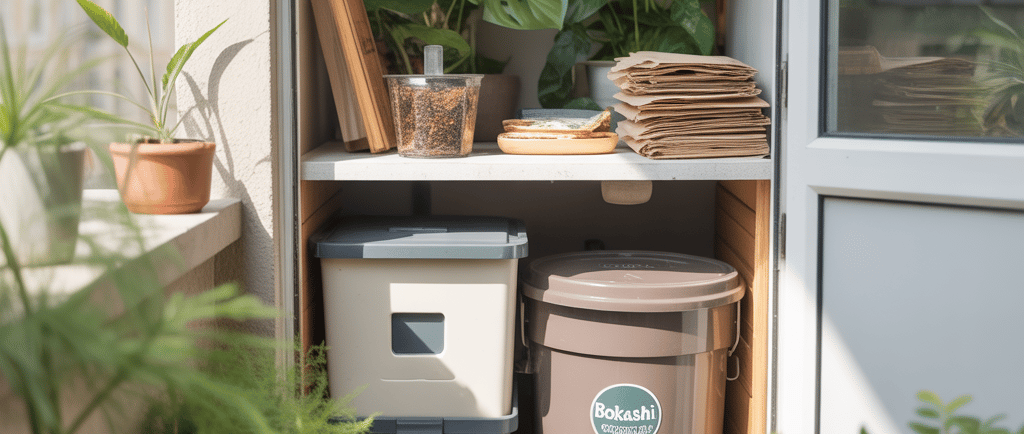
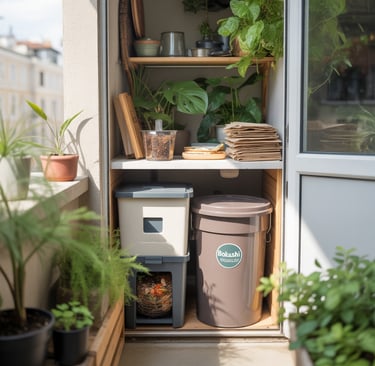
Bokashi composting uses fermentation rather than decomposition, which makes it fundamentally different from other methods. You layer food scraps with Bokashi bran — a carrier material inoculated with beneficial microorganisms — in a sealed bucket. The anaerobic fermentation process preserves the scraps rather than breaking them down, producing a pickled pre-compost that you then bury, give to a worm bin, or drop off at a composting site. The huge advantage of Bokashi is that it accepts almost anything — meat, dairy, cooked food — that other methods can't handle. Startup cost is around forty to sixty dollars for a bucket system.
Electric composters are the newest and most hands-off option. Machines like the Lomi or the Reencle use heat, aeration, and sometimes added microorganisms to break down food scraps into a dry, reduced-volume material in hours rather than weeks. They sit on your counter like a kitchen appliance, require almost no management, and produce very little odor during operation. The trade-off is cost — electric composters range from two hundred to five hundred dollars — and ongoing electricity use. They're genuinely great for people who want a completely effortless system and are willing to pay for it.
Community drop-off composting isn't really a composting method so much as a scraps-management strategy — you collect your food scraps at home and regularly drop them off at a municipal or community composting facility. You don't end up with finished compost yourself, but you divert your food waste from landfill with minimal setup and zero ongoing maintenance at home. All you need is a small airtight container to collect scraps between drop-offs. This is genuinely the lowest-barrier entry into apartment composting and a great place to start if the other methods feel overwhelming.
Worm Composting (Vermicomposting) — The Apartment Classic
I'll be real with you — I was nervous about my worm bin when I first set it up. I kept picturing worms escaping in the night and finding them all over my kitchen floor. That did not happen. In three years of vermicomposting in my apartment, I've had exactly zero worm escapes. They have no interest in leaving a well-maintained bin. Once I got past the initial "wait, I have a box of worms in my house" weirdness, I actually came to find the whole thing kind of fascinating.
The basic concept is simple. Red wiggler worms — a specific composting species, not the earthworms from your garden — live in a bedded bin and eat your food scraps. They process organic material through their digestive systems and produce worm castings, which is just a polite term for worm poop. Worm castings happen to be extraordinarily good for plants — rich in nutrients, beneficial microorganisms, and natural growth hormones. The worms also produce a liquid called leachate or worm tea that you can dilute and use as a powerful liquid plant fertilizer. The whole system, when maintained properly, smells like nothing more than fresh earth.
Setting up your first worm bin is straightforward. You can buy a purpose-built worm bin with multiple stacking trays — these make harvesting castings easier — or you can DIY one from a plastic storage bin for almost nothing. Start with damp bedding material: shredded newspaper, cardboard, or coco coir works great. The bedding should be moist but not dripping — about the consistency of a wrung-out sponge. Add your pound of red wiggler worms, give them a few days to settle in before adding much food, and then start feeding small amounts regularly. Bury food scraps under the bedding rather than leaving them on top — this prevents fruit fly access and keeps things tidy.
What to feed your worms: vegetable and fruit scraps, coffee grounds and filters, tea bags (remove staples), crushed eggshells, plain cooked grains in small amounts, and shredded paper. What to absolutely never feed them: meat, fish, dairy, oily or fatty foods, citrus in large quantities (the acidity stresses worms), onions and garlic in large quantities, anything salty or spicy, and pet waste. The forbidden list is shorter than it seems — most everyday kitchen scraps from cooking vegetables and fruit are completely fair game.
Harvesting worm castings happens every two to three months when the bin is full of dark, earthy-looking material. The easiest harvesting method is the migration technique: push all the existing material to one side of the bin, add fresh bedding and food scraps to the other side, and wait two to three weeks. The worms will migrate toward the fresh food, leaving the finished castings largely worm-free on the other side for you to scoop out and use. It's not 100% perfect but it's the least fussy method I've found.
H2 4: Bokashi Composting — Fermentation for Apartment Dwellers
Bokashi genuinely surprised me. When a friend first described it — essentially pickling your food scraps in a bucket — I thought it sounded bizarre and slightly disgusting. But I tried it, and now I keep a Bokashi bucket going alongside my worm bin specifically for the things my worms can't eat. Meat scraps, leftover pasta with cheese sauce, the occasional fish fillet — Bokashi handles all of it. That versatility is its killer feature.
The science behind Bokashi is actually pretty cool. Bokashi bran is a carrier material — usually wheat bran, rice bran, or sawdust — that's been fermented with a specific community of beneficial microorganisms called effective microorganisms, or EM. When you layer food scraps with Bokashi bran in a sealed, airtight bucket, those microorganisms get to work fermenting the scraps rather than allowing them to decompose. It's an anaerobic process (no oxygen), which is why the bucket must stay sealed. The result after two to four weeks is a pickled, preserved mass of pre-compost — not finished compost, but a biologically active material that breaks down very rapidly once it reaches soil or a secondary composting system.
The setup is simple: get a Bokashi bucket (they're specially designed with a spigot at the bottom to drain off liquid and an airtight lid to keep oxygen out), add your food scraps in layers no more than two to three inches deep, sprinkle Bokashi bran generously over each layer, press it down firmly to remove air pockets, seal the lid tightly, and repeat as you accumulate scraps. Drain the liquid from the spigot every few days — this liquid, diluted about 1:100 with water, is an excellent fertilizer and can also be poured undiluted down drains to help maintain them. When the bucket is full, seal it and let it ferment for two more weeks before dealing with the contents.
Here's the one thing about Bokashi that trips people up: the end product isn't finished compost that you can use directly on plants. It's pre-compost — pickled organic material that still needs to complete its breakdown. You have a few options for dealing with it. If you have access to a garden or outdoor soil, burying it six inches deep allows it to break down fully in two to four weeks, creating incredibly rich soil. You can also add it to a worm bin — worms actually love fermented Bokashi material and process it quickly. Or you can drop it at a community composting site. The smell of fresh Bokashi pre-compost is pickly and sour — not pleasant exactly, but not rotten either. Once it's buried or added to another system, that smell disappears quickly.
Electric Composters — The High-Tech No-Fuss Option
I'll say right upfront that electric composters are not for everyone, mainly because of the price. But for the right person — someone who values complete convenience, has no interest in managing worms or fermentation buckets, and is willing to invest upfront for an effortless ongoing experience — they're genuinely impressive pieces of technology. I've used a couple of different models over the past few years and the improvement in the category has been noticeable.
How they work varies slightly by model, but the general principle is: you add food scraps, close the lid, press a button, and the machine does the rest. The Lomi, probably the best-known model, uses a combination of heat, mechanical grinding, and aeration to reduce food scraps to a dry, compost-like material in anywhere from three to twenty hours depending on the mode you use. The Reencle takes a different approach, using a bed of proprietary microorganisms that continuously break down scraps — you just keep adding food and periodically scoop out finished material. Both are countertop appliances that look reasonably at home in a modern kitchen.
The results from electric composters are generally described as "compost-like material" rather than true finished compost, and that distinction matters. The heat and speed of the process doesn't allow for the full biological transformation that makes traditional compost so extraordinarily rich. The output is more like a dry, reduced-volume soil amendment — useful, but not quite the microbially diverse powerhouse that a worm bin produces. For apartment dwellers who want a simple way to reduce food waste volume and produce something useful for their plants, it's genuinely good enough. Just go in with realistic expectations about what you're getting.
The practical advantages are real. No worms to manage. No fermentation buckets. No smell (most models have carbon filters). Accepts a wide range of food scraps including some meat and dairy depending on the model. Takes up one spot on your counter. Requires maybe thirty seconds of interaction per use. If you can get past the price — and two hundred to five hundred dollars is a significant ask — it's the most frictionless composting experience available. I'd recommend it most for people who cook a lot, generate significant food waste, and want a completely passive solution.
Community Composting and Drop-Off Programs
This is the option I recommend to people who are curious about composting but feel genuinely intimidated by every other method. Community composting requires no equipment investment, no ongoing management, no worms, no fermentation — just a small container in your kitchen and the habit of dropping scraps off periodically rather than throwing them in the trash. It's the lowest-barrier version of apartment composting, and for a lot of people it's the perfect permanent solution.
Community composting programs have expanded significantly in recent years. Many cities now run municipal food scrap collection programs where you can drop off organic material at designated sites — farmers markets, community gardens, transfer stations, and even some grocery stores and coffee shops participate. Some cities have gone further with curbside food scrap pickup, though this is more common in single-family homes than apartments. A quick search for "food scrap drop off [your city]" or checking your city's waste management website will tell you what's available where you live. Apps like ShareWaste help connect people who have food scraps with neighbors who have compost bins or gardens that can use them.
The main practical challenge of drop-off composting is storing scraps between visits without creating a smell problem. The most effective solution I've found — and this genuinely changed the game for me — is keeping a small airtight container in your freezer for scraps. Frozen scraps don't decompose, don't attract fruit flies, and don't smell at all. When your container is full or it's time for your regular drop-off trip, you pull out the frozen scraps and take them along. The container rinses out easily afterward. This approach works for any composting method, actually — freezing scraps between additions to any system keeps odor completely under control.
The downside of drop-off composting is that you don't end up with any finished compost yourself. You're contributing your scraps to a communal system and the resulting compost either stays with the site or gets distributed in ways you may not benefit from directly. For some people that's completely fine — the goal is diverting waste from landfill, not necessarily producing fertilizer for home use. For others, getting usable compost back is part of the appeal. Know which camp you're in before settling on drop-off as your permanent approach.
What to Compost and What to Avoid (The Master List)
Getting this right makes the difference between a composting system that hums along smoothly and one that smells, attracts pests, or just doesn't work well. I've made mistakes in both directions — thrown in things I shouldn't have and avoided things that were actually fine — and the list I'm sharing here is the result of real trial and error rather than just repeating what I read somewhere.
Green materials are nitrogen-rich inputs that fuel the decomposition process. For apartment composting, these are mostly food scraps: vegetable and fruit peels and cores, coffee grounds, tea leaves, fresh herb trimmings, eggshells (technically neutral but useful), bread and grains in small amounts, and cooked plain vegetables. These are your main input materials and they'll make up the majority of what goes into most apartment composting systems.
Brown materials are carbon-rich inputs that balance out the greens, prevent smell, and create the structure that allows air and moisture to move through a compost pile or bin. In an apartment context, browns are mostly paper products: shredded newspaper, torn cardboard, paper bags, paper towels and napkins (unbleached), and paper egg cartons. Browns are something apartment composters often forget about and then wonder why things smell. If your system smells, adding more browns is almost always the first fix to try.
Things to avoid in most apartment composting systems: meat, fish, and poultry scraps (attract pests, create odor — Bokashi is the exception), dairy products (same issues — again, Bokashi handles these), oily and fatty foods, pet waste, diseased plants, anything treated with pesticides, and glossy or coated paper. Citrus peels and onion scraps are controversial — they're fine in small amounts in most systems, but large quantities can be too acidic for worm bins and may slow decomposition. The worms especially don't appreciate a lot of citrus or alliums, so I add these sparingly and make sure there are plenty of other scraps alongside them.
Cooked food is a special case. Plain cooked grains, pasta, and vegetables are generally fine in small amounts in worm bins and break down well in Bokashi. Cooked food with lots of salt, oil, sauce, or dairy is trickier — Bokashi handles it best. If you're using a worm bin, be conservative with cooked food, keep quantities small, and bury it well under bedding. If you're using a drop-off program, most municipal composting facilities accept cooked food without restriction, so don't overthink it for that method.
Keeping Your Apartment Compost Smell-Free and Pest-Free
This is the section that addresses the fear that stops most apartment dwellers from ever starting. The smell concern is real — badly managed compost absolutely can smell terrible. But "badly managed" is the key phrase. A properly set up and maintained apartment composting system genuinely does not smell. I've had guests in my apartment who had no idea I kept a worm bin three feet from the kitchen until I told them. That's not magic — it's just knowing why smell happens and preventing it.
Compost smell is almost always caused by one of three things: too many nitrogen-rich green materials relative to carbon-rich browns, anaerobic conditions created by too much moisture or compacted material, or simply adding the wrong things. The fix for the first two is the same: add more browns. Shredded newspaper or torn cardboard is cheap and always available. Whenever I add a batch of food scraps to my worm bin, I cover them with a generous layer of shredded paper. It's become automatic — scraps go in, paper goes on top. No smell, ever.
The freezer trick is genuinely the most practical tip I can pass along for apartment composting. Instead of leaving a container of food scraps sitting on your counter between additions to your composting system, keep a small airtight container in the freezer. Toss scraps in as you cook, keep the lid on, and when it's full or when you're ready to add to your system, use it frozen or let it thaw first. Frozen scraps don't smell, don't ferment prematurely, and don't attract fruit flies. They also break down slightly faster after thawing because the freezing and thawing process breaks down cell walls. This one change eliminates probably 90% of the smell concern people have about kitchen composting.
Fruit flies are the most common pest issue in apartment composting, and they're almost always a result of exposed food scraps — whether in a countertop scrap collection container or buried too shallowly in a worm bin. The prevention: always bury scraps under bedding in a worm bin, keep scrap collection containers tightly lidded or use the freezer method, and don't let food scraps sit exposed anywhere in your kitchen. If fruit flies have already appeared, apple cider vinegar traps (a small glass with a drop of dish soap and a splash of apple cider vinegar) catch adults effectively while you address the source. Yellow sticky traps work for fungus gnats, which can also show up around moist composting systems.
Using Your Finished Compost — Closing the Loop
This is my favorite part — the payoff for all the small daily habits that go into apartment composting. When your worm bin produces a beautiful batch of dark, crumbly, earth-smelling worm castings, or your Bokashi bucket has done its work and the contents have broken down into rich pre-compost, you've got something genuinely valuable on your hands. Using it well closes the loop in a satisfying way that makes the whole effort feel worthwhile.
Finished worm castings are arguably the most potent organic plant fertilizer you can get, and the amounts produced by an apartment worm bin are perfect for container plants and balcony gardens. Mix a small amount into your potting soil when repotting — roughly one part castings to four or five parts potting mix. Use it as a top dressing by spreading a thin layer on the surface of existing container soil, where it will release nutrients gradually every time you water. Or make a simple worm casting tea by soaking a handful of castings in water for twenty-four hours, straining, and using the liquid as a fertilizer drench. Plants respond to worm castings in genuinely noticeable ways — growth picks up, color deepens, and general vigor improves. I've had plants that were kind of limping along perk right up after a dose of worm casting tea.
If you produce more finished compost than your own plants can use, there are good options for sharing it. Community gardens almost always welcome donations of quality compost — just reach out to the organizers. Neighbors who garden are often genuinely grateful for worm castings, which can be hard to find and expensive to buy commercially. Online platforms and local Facebook groups for gardeners are another avenue. Giving away compost feels surprisingly good — you're passing along something useful that you made from what would have been trash.
For drop-off composters who don't produce finished compost at home, some community composting programs actually offer finished compost back to participants, either free or at reduced cost. It's worth asking your local program whether this is an option — it adds a nice material benefit to what might otherwise feel like a purely altruistic habit.
The bigger picture, though, is this: every food scrap you divert from the trash and turn into compost represents a small but real choice to participate in a different relationship with food and waste. Food goes into the ground, plants grow, food comes out again, scraps go back into the ground. That cycle is as old as agriculture itself, and apartment composting is just a very compact modern version of it. There's something genuinely right-feeling about being part of it, even from a small apartment kitchen. And once you've grown a plant in soil that your own composting helped create — that's a feeling worth working for.
Conclusion
Here's the thing I want you to remember after reading all of this: apartment composting is not a sacrifice or a complicated lifestyle overhaul. It's a small system adjustment that, once it's running, takes maybe a few minutes a week and delivers real benefits — environmental, practical, and honestly psychological. You'll feel better about your kitchen waste. Your plants will grow better. Your trash will smell better. And you'll have the quiet satisfaction of knowing that the food scraps from last night's dinner are becoming something useful rather than something that generates greenhouse gas in a landfill.
Pick one method — just one — that fits your life and your comfort level. If you're curious and hands-on, try a worm bin. If you cook a lot of meat and dairy, try Bokashi. If you want zero effort and have the budget, try an electric composter. If you want to start with literally no investment or commitment, find a drop-off site near you and start freezing your scraps tonight. You don't have to do this perfectly. You just have to start.
I'd genuinely love to hear what method you choose and how it goes — drop your experience, questions, or composting wins in the comments below. Whether you're a worm bin veteran or someone who just froze their first bag of vegetable peels, you're part of a community of people doing something simple but meaningful. Now go close that loop. 🌱