Container Gardening Eggplant: The Complete Guide to Growing Beautiful, Productive Eggplant in Pots
Learn everything about container gardening eggplant — best varieties, right containers, soil, watering, and harvesting. Real, tested advice from someone who grows eggplant in pots every season.
CONTAINER TINY PLOTS: CROPS, SOIL & CLEVER HACKS
Introduction
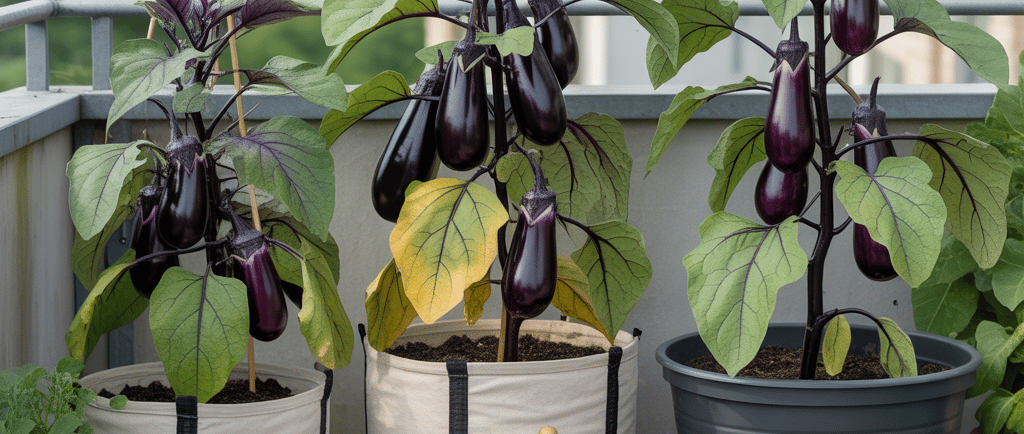
Here's something that surprises most gardeners the first time they see it: a well-grown container eggplant is one of the most beautiful things you can put on a patio or balcony. Not beautiful in a "practical vegetable plant" kind of way — beautiful in the way that makes people stop and ask what the plant is. The deeply lobed leaves are architectural and dramatic. The flowers — star-shaped, in shades of purple and lavender — bloom continuously through the growing season and look genuinely exotic. And the fruit, depending on variety, ranges from deep glossy purple to pale lavender to ivory white to vivid striped purple-and-white, hanging like ornaments from the plant's branches. Eggplant is one of those rare vegetables that would earn its container space on looks alone even if it never produced a single edible thing.
The reputation that eggplant carries — fussy, difficult, demanding, better suited to experienced gardeners — is at least partly undeserved and almost entirely a product of growing it in the wrong conditions. Eggplant wants heat, warmth, and consistent moisture. It rewards exactly the conditions that container growing specializes in providing: control over soil quality, the ability to place the plant in the warmest available spot and move it as conditions change, and the intensive attention that container growing naturally encourages. In a container on a sun-baked south-facing patio, a compact eggplant variety thrives in a way that the same plant in an average temperate garden bed doesn't always match.
I've grown eggplant in containers for years — compact Japanese varieties, ornamental-edible striped types, the remarkably productive Fairy Tale variety that produces clusters of small fruit relentlessly from midsummer to frost — and the combination of visual beauty, genuine productivity, and the cooking versatility that fresh homegrown eggplant provides makes it one of my most consistently rewarding container crops. This guide covers everything you need to get from seed or transplant to a beautiful, productive container eggplant this season. Let's get into it.
Why Eggplant Is One of the Best Container Vegetables
The case for container eggplant as an underrated growing choice deserves to be made explicitly, because most container vegetable guides lead with tomatoes and peppers and treat eggplant as an afterthought when it genuinely deserves equal billing — and for several reasons that become clear once you understand the plant's characteristics.
Eggplant's natural growth habit suits container growing particularly well. Unlike indeterminate tomatoes that keep growing indefinitely and require increasingly elaborate staking systems, most eggplant varieties grow to a predictable, manageable size — typically two to four feet tall and similar in spread — and stop. They're shrub-like in their growth habit, which means a single plant fills a container proportionately rather than outgrowing it continuously. Compact varieties bred specifically for container growing stay even smaller — eighteen to twenty-four inches — while remaining fully productive. This predictable, bounded growth makes container eggplant easier to manage than container tomatoes in several practical ways.
The ornamental value is genuinely significant and worth emphasizing because it changes the calculus of where you'd place an eggplant container. Most vegetables are grown in utilitarian growing areas and don't earn space in decorative planting positions. Container eggplant is different. The combination of the purple-veined leaves, the continuous purple star-flowers that resemble potato flowers — eggplant is a member of the nightshade family and the family resemblance is visible in the blooms — and the dramatic hanging fruit creates a plant that's actively beautiful in a way that justifies prominent placement. A large container of Fairy Tale eggplant — with its clusters of small purple-and-white striped fruit hanging beneath its foliage — is legitimately stunning as a patio display plant.
The heat-loving nature of eggplant is the characteristic that most directly explains why container growing often produces better results than in-ground growing in temperate climates. Eggplant originates from tropical and subtropical South and Southeast Asia, and its preference for warmth is deep in its genetics — it needs soil temperatures above 65°F to grow vigorously, performs best at air temperatures between 70°F and 90°F, and sulks visibly when temperatures drop below 55°F. Container growing allows you to position the plant against a heat-absorbing south-facing wall, on sun-baked paving that radiates warmth upward, or in any microclimate that offers more heat than the general garden. The mobility advantage — moving the container to the warmest available spot and adjusting placement as conditions change — is more valuable for eggplant than for almost any other common container vegetable.
Choosing the Right Container for Eggplant
Container selection for eggplant follows the same principle as for other large container vegetables — bigger is better, within reason — but eggplant has some specific characteristics that make certain container choices particularly appropriate.
Minimum container size for eggplant is five gallons for compact varieties and seven to ten gallons for standard varieties. This is a genuine minimum rather than a conservative suggestion — eggplant develops a substantial root system that needs adequate volume to support the plant's fruiting demands through a long productive season. A container that's too small for the root system produces a plant that's perpetually root-bound, requiring twice-daily watering in summer heat, depleting available nutrients within weeks, and producing a fraction of the fruit it would in an appropriately sized container. For compact varieties like Patio Baby and Fairy Tale, five gallons is workable with attentive management. For Japanese and Italian varieties that grow larger, ten gallons is the sweet spot where the plant can develop properly without the container becoming impractically heavy.
Depth matters alongside volume for eggplant because the root system grows predominantly downward rather than spreading widely. A container that provides twelve to fourteen inches of rooting depth supports better root development than a shallow container of equivalent volume. This depth consideration favors taller, narrower container shapes over wide, shallow ones — a standard twelve-inch-diameter, fourteen-inch-deep plastic nursery pot outperforms a wider but shallower planter of similar volume for eggplant.
Container material has practical implications for heat-loving eggplant that differ from its implications for cool-season crops. Dark-colored containers — black plastic, dark fabric grow bags — absorb heat from sunlight and warm the root zone, which eggplant actively benefits from in spring and in cool summers. In peak midsummer heat, the same heat absorption can warm root zones to damaging temperatures — above 85°F to 90°F in the root zone stresses even heat-loving eggplant. Managing this means either choosing lighter-colored containers in climates with very hot summers, wrapping dark containers in light-colored material during heat waves, or positioning dark containers where they receive morning sun but are shaded from the intense afternoon heat that causes the most extreme soil warming.
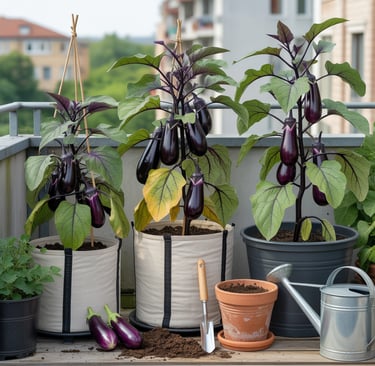
Fabric grow bags have become my preferred container for eggplant for the same reasons they work well for tomatoes and peppers — air pruning of roots prevents the root circling that reduces nutrient and water uptake in rigid containers, drainage is excellent, and the flexibility of the material makes end-of-season soil removal and container storage straightforward. A ten-gallon black fabric grow bag for a standard eggplant variety or a five-gallon bag for a compact variety delivers consistently excellent results.
The Best Eggplant Varieties for Container Growing
Variety selection is the most consequential decision in container eggplant growing — more consequential than for some other vegetables because the difference between a compact container-appropriate variety and a large vigorous standard variety in the same container is the difference between a manageable, productive plant and a chronically stressed one.
Patio Baby is the variety most explicitly bred for container growing and the one I'd recommend to any first-time container eggplant grower as the lowest-risk starting point. It's a hybrid variety that stays genuinely compact — twelve to eighteen inches tall — while producing prolifically: small, deep purple, glossy oval fruit that form in clusters and ripen steadily from midsummer through frost. The flavor is mild and sweet — better raw in salads than many standard eggplant varieties — and the plant is more tolerant of cooler conditions than many eggplants, which extends its productive season in temperate climates. It's beautiful in a five-gallon container and frankly remarkable in a ten-gallon one, where the unconstrained root system allows the plant to produce more fruit than its size would suggest possible.
Fairy Tale is the compact eggplant variety that most consistently converts people who thought they didn't particularly like eggplant. The fruit — small, cylindrical, striped in purple and white in a pattern that's genuinely beautiful — has an exceptionally mild, almost sweet flavor without the bitterness that larger standard eggplants can develop. The plant stays compact at eighteen to twenty-four inches and produces clusters of fruit at multiple points simultaneously — when it's in full production, a Fairy Tale plant has dozens of fruit at various stages of development visible at once, creating a display that looks almost theatrical. Five to seven gallons suits Fairy Tale well and the variety's compact habit makes it genuinely ideal for balcony and patio container growing.
Hansel and Gretel are sibling hybrid varieties — Hansel producing slender dark purple fruit, Gretel producing creamy white fruit — that share Fairy Tale's compact habit and prolific production. Both are consistently among the top-performing small eggplant varieties in container trials, combining ornamental visual appeal with exceptional eating quality. Gretel in particular is striking in a container — the pale ivory white fruit against the deep green foliage creates a color contrast that most people haven't seen in a vegetable plant before. The two varieties grown in neighboring containers or in a large shared container create a beautiful color composition.
Japanese eggplant varieties — long, slender, deep purple, with thinner skin and sweeter flesh than standard globe types — perform extremely well in containers because their growth habit is naturally more upright and manageable than globe varieties, their fruit is produced in larger numbers of smaller individual pieces rather than fewer large ones, and their flavor is superior for most cooking applications. 'Ichiban', 'Orient Express', and 'Ping Tung Long' are excellent Japanese varieties for container growing. Their upright habit makes staking simpler, and the slender fruit is visually distinctive and elegant hanging from the plant's stems.
White and striped ornamental-edible varieties deserve specific mention because they represent the fullest expression of eggplant's dual ornamental-edible identity. 'Rosa Bianca' — a traditional Italian heirloom with lavender-and-white streaked fruit — is among the most beautiful vegetables you can grow in a container, full stop. 'Turkish Italian Orange' produces bright orange fruit that's completely unexpected on what most people think of as a purple-fruited vegetable. These varieties require slightly larger containers — seven to ten gallons — than the most compact hybrids, but the visual impact justifies the size.
Soil Mix and Planting for Container Eggplant
Soil mix for container eggplant follows the same principles as for other heavy-feeding, moisture-demanding fruiting vegetables — rich in organic matter, well-draining, and appropriately fertile — with a few eggplant-specific adjustments.
The ideal mix for container eggplant is a high-quality, compost-rich potting mix with additional perlite for drainage and aeration. A starting mix of roughly fifty percent quality bagged potting mix, twenty-five percent additional compost, and twenty-five percent perlite produces excellent results — the extra compost pushes fertility above what most bagged mixes provide alone, and the perlite ensures drainage and aeration even as organic particles break down through the season. Incorporating a slow-release fertilizer at planting — mixed thoroughly through the soil rather than placed in a concentrated layer that roots might contact directly — provides baseline nutrition through the first six to eight weeks without requiring immediate liquid supplementation.
Starting from seed requires significantly more lead time than most vegetables — eggplant is slow from seed and needs eight to ten weeks of indoor growing before it's ready to transplant outside. Start seeds indoors under grow lights at soil temperatures of 75°F to 85°F for germination — eggplant germinates poorly at cooler temperatures and the warmest position you can find indoors is worth using for the germination tray. Once germinated, eggplant grows vigorously under lights at typical indoor temperatures, though it benefits from supplemental bottom heat if available. For most home gardeners, purchasing transplants from a garden center eliminates the seed-starting complexity and is entirely appropriate — the range of varieties available as transplants has expanded significantly in recent years.
Transplanting into the final container requires careful handling of the root ball because eggplant is sensitive to root disturbance — transplant shock in eggplant is real and can set the plant back by two to three weeks if the root system is significantly disturbed. Water the transplant thoroughly several hours before transplanting so the root ball is fully hydrated and cohesive. Remove the plant from its nursery container by inverting it and catching the root ball rather than pulling from the stem. Lower it into a pre-formed planting hole in the center of the container at the same depth it was growing in the nursery pot — eggplant doesn't benefit from the deep planting that helps tomatoes, and planting too deep can cause crown rot. Fill in around the root ball with soil mix, firm gently without compacting, and water thoroughly.
Temperature requirements at transplanting are the most commonly violated guideline for container eggplant and the source of most early-season disappointment. Eggplant transplanted outside when nighttime temperatures are still regularly below 55°F won't die immediately but will sit in sullen stasis — barely growing, vulnerable to stress, and often not recovering full vigor even after temperatures warm. Wait until nighttime temperatures are consistently above 55°F and soil temperatures in the container are above 60°F. This is later than most people want to plant — often two to three weeks after the last frost date in temperate climates — but the difference between a plant put out at the right temperature and one rushed out too early is dramatic and irreversible for that season.
Sunlight and Temperature Requirements
Eggplant has the most demanding sunlight and temperature requirements of the common container vegetables, and meeting those requirements is the single factor that most determines whether a container eggplant produces prolifically or struggles through the season with modest results.
Full sun is genuinely necessary for productive eggplant — six hours is a minimum, eight is better, and a position that receives sun from morning through late afternoon produces the most vigorous plants and the largest fruit set. Unlike some container vegetables that tolerate partial shade reasonably well, eggplant in less than six hours of direct sun produces slow growth, poor fruit set, and disappointing yield regardless of how well every other aspect of its care is managed. If your best available container position provides only four to five hours of direct sun, shade-tolerant greens and herbs are a better use of that space than eggplant.
The heat-loving character of eggplant is more profound than just sun preference — the plant needs warmth in the root zone as well as warmth in the air and from sunlight. Container growing's ability to exploit warm microclimates is the primary reason container eggplant often outperforms in-ground eggplant in temperate climates. The best container positions for eggplant are against south or southwest-facing walls that absorb heat and radiate it back onto the plant, on concrete or paving surfaces that absorb heat through the day and release it overnight, and in corner positions sheltered from cool winds while receiving maximum direct sun. These positions can be significantly warmer than the open garden — sometimes five to ten degrees warmer in the immediate microclimate — and that temperature difference translates directly into earlier fruit set, faster fruit development, and extended productive season at the end of the year.
Managing heat stress in peak summer is the other side of the heat management equation. While eggplant loves warmth, temperatures consistently above 95°F — or root zone temperatures above 90°F from sun-heated dark containers — cause flower drop, poor fruit set, and reduced vigor. When heat waves arrive, moving containers to a position that receives morning sun but afternoon shade prevents the most extreme heat stress while maintaining the warmth the plant needs. Mulching the container surface with a light-colored organic mulch reduces soil temperature in dark containers significantly. And consistent watering — never letting the soil dry completely in peak heat — maintains the evaporative cooling that helps plants regulate temperature through transpiration.
Watering Container Eggplant Correctly
Eggplant is a plant of contradictions when it comes to water — it wants consistent moisture throughout its root zone, but it absolutely cannot tolerate waterlogged conditions that cut off oxygen to roots. Getting watering right for container eggplant means understanding this balance and adjusting technique and frequency to maintain it across the full range of seasonal conditions.
Watering frequency for container eggplant changes significantly through the season and with plant size. A small transplant in cool spring conditions may need watering every two to three days. The same plant at full size in peak summer heat may need daily watering or more — a large eggplant at full fruit load in a ten-gallon container on a hot patio is drawing and transpiring substantial quantities of water, and checking soil moisture daily is the only reliable approach to maintaining appropriate hydration. The finger test — pressing a finger an inch into the soil to check moisture level — remains the most reliable watering gauge regardless of weather conditions or plant size.
Deep watering when you water encourages the deep root development that improves drought tolerance and nutrient uptake throughout the season. Add water until it flows freely from the drainage holes — the entire root zone has been moistened and the soil column is fully hydrated. This encourages roots to develop downward through the full container depth rather than concentrating near the surface where frequent shallow watering keeps the top few inches consistently moist while the deeper root zone remains underserved.
Mulching the surface of a container eggplant dramatically reduces watering frequency and moderates the temperature fluctuations that stress plants on hot patios. A half-inch to one-inch layer of fine straw, shredded leaves, or fine bark mulch over the soil surface reduces evaporation significantly — often by thirty to fifty percent compared to bare soil — extends the interval between necessary waterings, and keeps the soil surface temperature more consistent than unmulched containers. Apply mulch after the plant is established and the soil has warmed, keeping the mulch clear of the stem base to prevent crown rot.
Overwatering symptoms in eggplant include yellowing lower leaves, wilting that persists even when soil is moist, soft or darkened stem at the base, and soil that remains wet for days between waterings. These symptoms indicate poor drainage or excessive watering and require backing off watering frequency, checking that drainage holes are clear, and in severe cases repotting into fresh, better-draining soil. Underwatering shows as wilting that responds immediately to watering, crispy leaf margins, and soil that pulls away from the container walls. Fruit on underwatered plants becomes bitter and may drop before fully ripening.
Fertilizing Container Eggplant Through the Season
Eggplant is a heavy feeder — one of the most nutritionally demanding common container vegetables — and consistent, well-timed fertilizing through the season is necessary for the vigorous growth and prolific fruiting that makes container eggplant so rewarding. Inadequate fertility is among the most common reasons container eggplant underperforms, and the symptoms of nutrient deficiency are common enough in container-grown plants that recognizing them is a useful skill.
The nutritional needs of eggplant shift through its growth stages in a pattern that informs the fertilizing schedule. In the vegetative phase — from transplanting through first flower bud development — nitrogen is the primary nutritional need, supporting the leaf and stem growth that builds the plant structure from which fruiting will occur. A balanced fertilizer with meaningful nitrogen content — a 5-5-5 or 10-10-10 slow-release formula incorporated at planting, or a balanced liquid fertilizer applied every two weeks during vegetative growth — provides appropriate support. Once flower buds appear and fruiting begins, the balance shifts: continued high nitrogen at this stage produces excessive vegetative growth at the expense of fruit development. Switching to a lower-nitrogen, higher-phosphorus and potassium fertilizer — a tomato or fruiting plant fertilizer formula — at the flowering and fruiting stage supports fruit set, development, and continuous production.
The practical fertilizing schedule for most container eggplant growers combines a slow-release fertilizer incorporated at planting — providing baseline nutrition for the first six to eight weeks — with liquid fertilizer applications every two to three weeks from planting through the end of the season. During vegetative growth, a balanced liquid fertilizer at the manufacturer's recommended rate. From flowering onward, a tomato-specific or high-potassium liquid fertilizer that supports fruiting. Worm castings top-dressed monthly provide a gentle, consistent nutrition supplement that improves soil biology alongside basic mineral nutrition.
Calcium deficiency is worth watching for specifically in container eggplant because it produces blossom end rot — the dark, sunken, leathery patch at the blossom end of developing fruit that also affects tomatoes and peppers in containers. The cause is not necessarily calcium-deficient soil but inconsistent watering that interrupts calcium uptake even when calcium is present — calcium moves into the plant only through continuous water flow, and boom-and-bust watering cycles interrupt this movement. Consistent watering is the primary prevention. A calcium supplement — crushed eggshells worked into the soil surface, or a calcium-containing liquid fertilizer — addresses actual calcium deficiency in soils where it exists.
Pruning, Staking, and Supporting Container Eggplant
Eggplant is more amenable to pruning than many container vegetable growers realize, and the right pruning approach — combined with appropriate staking for fruit-laden branches — significantly improves both productivity and plant health through the season.
Pinching the growing tip of a young eggplant transplant — removing the central growing shoot just above a leaf node when the plant is six to eight inches tall — encourages the plant to branch from low on the stem, producing a bushier, more compact growth habit that suits container growing better than the tall, single-stem growth of an unpinched plant. The pinching delays the first flowers by a week or two but the increased branching that follows produces more fruiting nodes than the unpinched plant would have developed, improving total season yield. This is worth doing for all compact container varieties — Patio Baby, Fairy Tale, Hansel and Gretel — and is particularly beneficial in smaller containers where managing overall plant size matters.
As the plant develops through the season, removing any yellowed or diseased leaves as they appear maintains good airflow around the plant and reduces disease pressure. In mid to late season, if the plant is producing more vegetative growth than fruit — common when fertility is high and temperatures are optimal for growth — pruning back some of the newer vegetative shoots redirects the plant's energy toward ripening existing fruit rather than developing new growth that won't have time to fruit before the season ends.
Staking is necessary for most standard and semi-compact eggplant varieties by midsummer, when the weight of developing fruit on multiple branches pulls branches downward and occasionally causes them to snap. A single central stake — a bamboo cane or metal rod pushed firmly to the bottom of the container — tied to the main stem with soft plant ties provides the primary support. Individual branches carrying heavy fruit loads can be tied back to the central stake or to secondary stakes as needed. Japanese varieties with their longer, heavier individual fruit often need individual branch support earlier than globe varieties.
Harvesting, Pests, and Troubleshooting Container Eggplant
Harvest timing is the most commonly misjudged aspect of eggplant growing, and harvesting at the right moment makes an enormous difference to eating quality. The pest and disease challenges that container eggplant faces are manageable with the right awareness and early intervention.
The correct harvest stage for eggplant is when the fruit has reached its characteristic variety color and size but still has a high-gloss shine on the skin surface. This is earlier than most first-time eggplant growers expect — the instinct is to wait for the fruit to grow as large as possible before harvesting, but large, fully mature eggplant has developed seeds and bitter compounds that reduce its eating quality significantly. The correct stage — full color, full gloss, variety-appropriate size — produces fruit with the mild, creamy interior and absent bitterness that makes fresh homegrown eggplant so different from grocery store equivalents. The gloss test is reliable: when the skin starts to lose its shine and look slightly dull, the eggplant is past peak. Harvest before that point. Small-fruited compact varieties like Fairy Tale and Patio Baby are best harvested when the fruit is two to three inches long — they become seedy and mildly bitter if left to grow much larger.
Harvesting technique requires a sharp knife or pruning shears rather than attempting to twist or pull fruit from the plant — eggplant stems are woody and the calyx connects to the plant firmly enough that pulling risks damaging the branch. Cut cleanly through the stem an inch above the calyx. Handle harvested eggplant gently as the skin bruises easily. Store at room temperature for up to three days or in the refrigerator at fifty to fifty-four degrees Fahrenheit — eggplant is chilling-sensitive and storage below fifty degrees causes surface pitting and flesh discoloration.
Flea beetles are the most common and most frustrating pest on container eggplant — tiny, jumping black beetles that chew small round holes in leaves in sufficient numbers to seriously compromise plant health. Their damage is distinctive: peppered small holes across leaf surfaces that look almost like the leaf has been hit with fine buckshot. Young transplants are most vulnerable and can be seriously damaged by heavy flea beetle pressure. Row cover over young transplants while they establish — removed when flowers appear for pollination — provides effective protection during the vulnerable period. On established plants, flea beetle damage is primarily cosmetic and rarely threatens plant productivity seriously. Diatomaceous earth applied to leaf surfaces and around the container provides some deterrence.
Aphids cluster on new growth and flower buds — a strong spray of water knocks them off effectively and is the appropriate first response for any aphid infestation. Spider mites appear in hot, dry conditions and cause characteristic stippled surface damage and fine webbing on leaves. Increasing humidity around the plant by misting and applying neem oil spray to leaf surfaces — particularly undersides — addresses spider mite infestations effectively.
End-of-season management of the container is straightforward. Remove the plant and its root system at the first hard frost or when productivity has clearly finished. Refresh the soil following the end-of-season amendments described in the potting soil article earlier in this series. The container is ready for the next season's crop — eggplant should not be replanted in the same container soil for at least two seasons to break any pest and disease cycles that may have established, but all other vegetables are appropriate for immediate replanting.
Conclusion
Container eggplant is one of the genuinely underrated choices in the patio and balcony vegetable garden — a plant that delivers ornamental beauty, surprising productivity, and culinary quality that fresh homegrown eggplant distinctively provides, from a container that takes up no more space than a container tomato while looking considerably more spectacular through the season.
The keys are straightforward: choose a compact variety suited to containers — Fairy Tale and Patio Baby are the starting points I'd recommend to anyone — give it the largest container you can manage and the warmest, sunniest spot you have available, fertilize consistently through the season with attention to the shift from balanced to fruiting-focused nutrition as flowering begins, and harvest fruit when it's glossy and variety-appropriate rather than waiting for maximum size. Those four decisions — variety, container, location, harvest timing — account for most of the difference between a thriving, prolific container eggplant and a disappointing one.
Share your container eggplant setups, your variety discoveries, your harvest photographs, or your questions in the comments below. Eggplant grows in a way that rewards the attention and pride you take in it — the beauty of the plant through the season is part of what makes it worth growing, and the container growing community has accumulated extraordinary knowledge about getting the most from this spectacular, underappreciated vegetable in pots. Now find a container, find a Fairy Tale transplant, and give it the warmest spot on your patio. 🍆