Best Indoor Grow Lights for Apartment Gardening: Brands, Examples, and Everything You Need to Know
Discover the best indoor grow lights for apartment gardening — honest brand comparisons, real examples, setup tips, and everything you need to grow thriving plants in any apartment in 2026.
INDOOR TINY PLOTS: FRESH FOOD & GREENERY ALL YEAR
Introduction
Here's a number that genuinely surprised me when I first encountered it: studies of typical apartment light levels found that even south-facing windows in urban environments — surrounded by neighboring buildings, with overhangs above and reflected light blocked by urban density — often provide only 20% to 40% of the light intensity that plants need for healthy, productive growth. Not north-facing windows. Not dim rooms. South-facing windows in good urban apartments. If you've ever wondered why your indoor herbs look scraggly, why your tomatoes produce flowers but no fruit, why your lettuce stretches toward the window and then gives up — insufficient light is almost certainly the answer, and it's a problem that no amount of watering, fertilizing, or plant placement adjustments will solve.
I resisted grow lights for years. I thought they were for serious hobbyists, for people growing things in basements, for setups that would make my apartment look like a science lab. Then a particularly dismal winter — weeks of grey skies, my herbs barely hanging on, my seedlings leggy and pale — pushed me to try a single LED bar light over my kitchen shelf. The change in my plants within two weeks was so dramatic it was almost funny. Growth that had been barely perceptible became vigorous. Color deepened. The herbs that had been surviving started thriving. I've been growing with supplemental artificial light ever since, and my indoor garden has never looked better.
The problem in 2026 isn't finding a grow light — it's navigating the overwhelming number of options, brands, specifications, and marketing claims to find the lights that actually work for apartment-scale indoor growing. This guide is my honest, experience-based navigation through all of that. I'm going to cover the brands and products that have genuinely performed well, explain what specifications actually matter versus which ones are marketing noise, and give you everything you need to choose, set up, and use grow lights effectively in your apartment. Let's light things up.
Why Grow Lights Are a Game-Changer for Apartment Gardeners
Let me start by making the case honestly — because I think a lot of apartment gardeners are in the position I was in for years, convincing themselves that their window light is sufficient when it simply isn't. The gap between what most apartments provide and what plants actually need is real, significant, and the primary reason why so many indoor gardens underperform relative to expectations.
Plants use light as their energy source through photosynthesis — a fact everyone knows but whose implications for indoor growing aren't always fully appreciated. The amount of photosynthesis a plant can perform is directly proportional to the amount of usable light it receives. Below a certain threshold, plants can survive — they stay alive, produce a little growth, maintain their existing leaves — but they can't thrive or produce food crops in any meaningful way. That threshold varies by plant type, but for most herbs and vegetables it's significantly above what even good indoor window light typically provides, and dramatically above what mediocre indoor window light offers.
The seasonal dimension compounds the problem. In summer, a south-facing window in a northern hemisphere apartment might provide adequate light for certain low-demand plants for several hours a day. In winter, the same window — shorter days, lower sun angle, more clouds — might provide a fraction of summer's light levels. This is why indoor food gardens that look promising in summer often deteriorate in autumn and collapse in winter. Grow lights decouple indoor gardening from seasonal light variation entirely. Your plants experience consistent, adequate light every day of the year regardless of what the sky is doing outside. That consistency is transformative for year-round growing.
The confidence factor is something I didn't anticipate when I first added grow lights to my setup, but it's become one of the things I value most. Before grow lights, every planting decision carried uncertainty — is this spot bright enough? Will this plant get enough light here? Will it be okay in winter? With grow lights, I know my plants are getting adequate light because I control it. That certainty makes planning easier, reduces the anxiety that comes with watching plants struggle, and frees attention to focus on the other aspects of growing — watering, feeding, harvesting, variety selection — that are genuinely interesting rather than worrying about a variable I can now simply control.
Understanding Grow Light Types — What Actually Matters
The grow light market is full of technical specifications, competing claims, and terminology that can make evaluation feel like decoding a foreign language. Let me cut through it and focus on what actually matters for apartment-scale indoor growing decisions.
LED grow lights are the clear recommendation for virtually all apartment gardening applications in 2026, and have been for several years. The technology has matured to the point where quality LED lights outperform older technologies in almost every meaningful category: energy efficiency, heat output, spectral quality, longevity, and value. Fluorescent lights — T5 fixtures specifically — remain a reasonable budget option for seedling starting and low-demand plants, but their lower light output per watt and shorter lifespan make them less compelling than they were before LED quality improved. HID lights — high-intensity discharge, including metal halide and high-pressure sodium — produce powerful light output but generate significant heat, consume considerably more electricity, and are essentially inappropriate for the scale and context of most apartment growing.
Full spectrum LED is a term you'll encounter constantly in grow light marketing, and it's become somewhat meaningless through overuse. Technically, full spectrum means light that covers the complete range of wavelengths that plants use for photosynthesis — primarily the blue range around 400-500nm and the red range around 600-700nm, plus the green and yellow wavelengths in between. In practice, any modern white LED grow light is full spectrum in the sense that matters for plant growing. What you're actually looking for is a light with a good balance across the photosynthetically active range — neither heavily skewed toward one end of the spectrum nor missing significant portions of it. Lights with a Color Rendering Index (CRI) above 90 generally indicate a well-balanced spectrum.
PAR — Photosynthetically Active Radiation — and PPFD — Photosynthetic Photon Flux Density — are the specifications that actually matter for evaluating grow light performance, and they're the ones most grow light marketing tries to obscure with misleading wattage claims. PPFD measures the number of photons in the photosynthetically active range hitting a square meter of surface area per second, expressed in micromoles per meter squared per second (μmol/m²/s). This is the number that tells you how much usable light your plants are actually receiving. For herbs and leafy greens, adequate PPFD is roughly 200-400 μmol/m²/s. For fruiting plants, 400-600 or higher is better. Reputable grow light manufacturers publish PPFD maps showing the light distribution at various hanging heights — these are the most useful specification documents for evaluating real-world performance.
Wattage is the most misused specification in grow light marketing. "1000W equivalent" or "1000W output" claims on lights that actually consume 45 watts are common and essentially meaningless. What matters is the actual wattage consumed from the wall — the true power draw — and the efficiency with which that power is converted into usable plant light, expressed as μmol/J (micromoles per joule). A high-quality modern LED grow light achieves 2.0 to 2.8 μmol/J or better. A mediocre light might achieve 1.0 to 1.5 μmol/J. That difference in efficiency is the difference between a light that actually supports the plant growth it claims to and one that consumes electricity without delivering adequate photosynthetic benefit.
The Best LED Grow Light Brands for Apartment Gardeners
After years of personal use and extensive research across the indoor growing community, these are the brands I genuinely trust and recommend for apartment-scale growing. I'll be honest about where they excel, where they fall short, and who each brand is best suited for.
Spider Farmer has established itself as probably the best value-to-performance brand in the consumer grow light market and has been my personal go-to recommendation for apartment gardeners who want genuinely good light quality without premium pricing. Their SE and SF series LED bar lights are particularly well-suited to apartment growing — slim, low-profile, easy to mount under shelves or in growing spaces, and producing excellent light quality at their price points. The Spider Farmer SE3000 and SE5000 are popular choices for larger setups. For apartment scale, the SE1000 and the SF series smaller panels deliver real, measurable results at prices that have come down significantly as the brand has scaled. Their customer service has a good reputation and their specification documentation — including actual PPFD maps — is more transparent than many competitors. Build quality is solid without being exceptional — the aluminum heat sink construction is appropriate for the price range and thermal management is generally adequate.
Mars Hydro is the other brand consistently mentioned alongside Spider Farmer in grow light discussions, and deservedly so. Their TS and FC series lights have been widely used and well-reviewed in the growing community for several years. The Mars Hydro TS1000 has become something of a standard entry-level recommendation — it's a 150-watt panel covering roughly a 2x2 to 3x3 foot growing area, producing good light quality at a price point that makes it accessible for beginners. The Mars Hydro FC and FCE series represent their higher-performance offering, with better efficiency ratings and improved spectral quality that justifies the higher price for serious growers. Mars Hydro's consistency across product generations — when they update a model, the new version is genuinely better rather than just rebranded — builds trust in the brand over time.
Soltech Solutions occupies a unique position in the grow light market that's particularly relevant for apartment gardeners: they're the aesthetics-first brand, making grow lights that are designed to look like intentional home lighting rather than horticultural equipment. Their Aspect pendant grow light is the product most often featured in interior design contexts — a clean, minimal pendant light that happens to be a full-spectrum grow light, available in multiple finishes including matte black, brushed brass, and white. The Aspect produces genuinely adequate light for herbs, low-demand houseplants, and some leafy greens, with PPFD values that support healthy growth for plants with moderate light requirements. For fruiting vegetables or high-demand crops, the Aspect's output is insufficient as a sole light source, though it supplements natural light well. The price premium over equivalent-output LED panels from Spider Farmer or Mars Hydro is significant — you're paying for design quality as much as light quality — but for apartment growers who want a light they're happy to display prominently in their living space, that premium is genuinely justified.
Budget brands in the grow light space require more caution than in most product categories because the performance gap between quality and cheap options is wide and the misleading marketing is pervasive. Some budget brands — Barrina, Feit Electric, and GE's grow light products — deliver reasonable performance at their price points and are worth considering for low-demand applications like seedling starting or supplementing window light for herbs. The specific brands to approach with skepticism are those that make dramatic wattage equivalent claims without publishing actual PPFD data, have no verifiable third-party testing, and offer no customer support infrastructure. A fifty-dollar light that doesn't actually produce adequate light is fifty dollars wasted — a marginally more expensive light from a reputable brand that actually works is a vastly better investment.
Best Grow Lights for Herbs and Leafy Greens
Herbs and leafy greens are the most forgiving category of edible plants for indoor growing, and their lower light intensity requirements mean they're accessible to more grow light options than fruiting crops. That said, "lower requirements" is relative — they still need genuinely adequate light to produce the lush, flavorful growth that makes growing them worthwhile, and the difference between a good grow light setup for herbs and a mediocre one shows clearly in harvest quantity and quality.
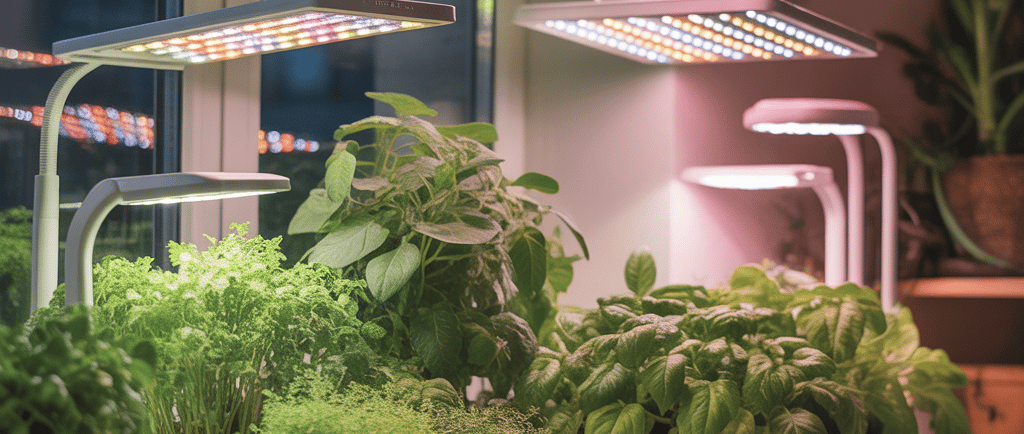
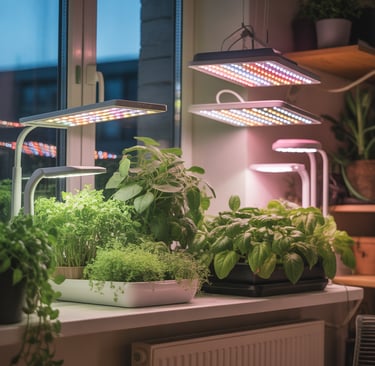
The light requirement range for herbs and leafy greens — roughly 200 to 400 μmol/m²/s PPFD at the plant canopy — is achievable with relatively modest light intensity, which means bar-style LED lights mounted close to the plants are often the most practical and space-efficient solution for kitchen counter and shelf growing. Bar lights — long, narrow LED strips designed to mount horizontally above a growing surface — have become my preferred format for herb growing because they distribute light evenly across a linear growing area, they mount cleanly under shelves without protruding visually, and they produce minimal heat at the relatively low intensities herbs need. The Barrina T5 LED Grow Light bars are a budget-friendly option that works adequately for herbs and greens when mounted close — within six to twelve inches — of the plant canopy. Spider Farmer's SF series bars offer better light quality at a modest price premium and are my recommendation when budget allows a small upgrade from the absolute entry level.
For dedicated herb shelf setups — where you're growing multiple varieties of herbs on a tiered shelf system — a panel light positioned above the top tier or bar lights under each shelf tier are both workable approaches. The bar-under-each-shelf approach provides more even light distribution across multiple levels and is my personal preference for tiered herb setups. Mounting bar lights to the underside of each shelf with simple adhesive clips or small screws creates a clean, functional growing system that looks intentional rather than improvised. Using a single outlet timer to control all the shelf lights simultaneously maintains the consistent photoperiod that herbs and greens benefit from.
Clip-on and desktop grow lights have improved significantly in quality and are now genuinely useful for small herb setups — a few pots on a windowsill needing supplemental light, or a single pot of basil on a kitchen counter. The GE Grow Light LED bulb — available in a standard A19 form factor that fits any lamp or socket — is a legitimately useful option for very small-scale supplemental lighting when used in a reflective lamp or positioned close to plants. Clip-on lights from brands including Juhefa and Lordem have decent reviews for small-scale herb and succulent growing. These options won't replace a dedicated LED panel or bar light system for serious growing, but they're a low-commitment, low-cost starting point that serves many beginners well.
For photoperiod, herbs and leafy greens generally do well with fourteen to sixteen hours of light daily. I run my herb shelf lights from 6am to 9pm — fifteen hours — controlled by a simple mechanical outlet timer that cost about eight dollars and has run reliably for three years without a single missed cycle. Some plants adjust well to slightly shorter or longer periods, but fourteen to sixteen hours is a reliable starting point that supports active, healthy growth without the stress that very long photoperiods can cause in some varieties.
Best Grow Lights for Fruiting Plants and Vegetables
Fruiting plants — tomatoes, peppers, cucumbers, dwarf citrus — have substantially higher light requirements than herbs and greens, and meeting those requirements indoors is the most technically demanding aspect of apartment grow light selection. The difference between adequate and inadequate light for fruiting plants shows not just in growth rate but in whether the plants flower and set fruit at all — a tomato plant in insufficient light will grow vegetatively but produce few flowers and even fewer fruits.
The target PPFD range for fruiting plants is roughly 400 to 800 μmol/m²/s at the canopy — two to four times what herbs need — which requires meaningfully more powerful light sources. This is where entry-level clip-on lights and basic bar lights fall short, and where panel lights from quality brands become the appropriate tool. The Spider Farmer SF2000 — a 200-watt panel covering a 2x4 foot growing area at appropriate hanging heights — is my current recommendation for apartment-scale fruiting vegetable growing. It produces PPFD values in the appropriate range for fruiting crops within its coverage footprint, runs at manageable heat levels, and has demonstrated consistent performance across multiple growing seasons in my own setup and in widespread community use. The Mars Hydro TS2000 is the comparable product from that brand and performs similarly — choosing between the two often comes down to pricing at time of purchase.
Grow tents deserve specific mention for apartment fruiting vegetable growing because they dramatically improve the efficiency and effectiveness of any grow light. A grow tent is a collapsible fabric enclosure with reflective interior lining — typically Mylar — that reflects light back onto plants rather than allowing it to dissipate into the surrounding room. The practical effect of a grow tent is that the same grow light produces significantly more usable light at the plant canopy inside a tent than it would in open air. A 2x2 or 2x4 foot grow tent takes up minimal floor space in an apartment, contains light spillover (important for neighbors and sleeping), manages humidity within the growing environment, and makes a mid-range grow light perform like a premium one. For anyone growing fruiting vegetables under artificial light in an apartment, a grow tent is not a luxury — it's a system component that makes the whole setup work better.
Heat management becomes a more significant consideration with the higher-wattage lights appropriate for fruiting plants. A 200-watt LED panel doesn't produce the intense heat that an equivalent-wattage HID light would, but it does produce meaningful warmth that needs to go somewhere. In a grow tent, a small inline fan exhausting warm air out of the tent while drawing cooler room air in keeps temperatures in the appropriate range and provides the air circulation that fruiting plants benefit from. In open room growing, positioning the light where its heat can dissipate into the room without concentrating near heat-sensitive plants or surfaces is sufficient for the wattage levels typical of apartment growing.
Aesthetic Grow Lights — Beautiful Enough for Living Spaces
The aesthetic dimension of grow light selection matters enormously for apartment gardeners in a way that it doesn't for basement growers or greenhouse operators — because in an apartment, your grow lights are in your living space, visible from your sofa, present in the rooms where you spend your waking hours. A setup that looks like industrial equipment in a living space is a setup that eventually gets dismantled because it's intolerable to live with. Grow lights that are designed with aesthetic quality create setups you're happy to display, which means they actually get used consistently rather than getting moved to a closet after two weeks.
Soltech Solutions has built their entire brand identity around this insight, and their flagship Aspect pendant grow light is the product that most clearly demonstrates what's possible when design quality is treated as seriously as light output. The Aspect is a single pendant grow light — essentially a designer lamp that happens to produce full-spectrum plant light — available in matte black, brass, and white finishes with a clean, minimal profile that works in contemporary, mid-century, and Scandinavian interior contexts. Hanging above a collection of herbs on a kitchen island, or above a statement plant in a living room corner, the Aspect reads as a considered design choice rather than a horticultural intervention. The light quality is genuine — adequate for herbs, low-demand houseplants, and good-light supplementation — though as I mentioned earlier, the price premium over equivalent-output functional lights is significant. For the right person in the right space, it's absolutely worth it.
The Soltech Growth Series represents their higher-output option for more demanding plants, with the same aesthetic sensibility applied to a more powerful light. It's available in a longer bar format and produces higher PPFD values appropriate for herbs and some fruiting plants while maintaining the visual quality that distinguishes the Soltech line from utilitarian grow lights. The combination of a Soltech Growth Series bar above a kitchen herb shelf and an Aspect pendant above a floor plant in an adjacent living space creates a cohesive, designed look that integrates grow lighting into the home's aesthetic in a way most grow light brands never attempt.
Beyond Soltech, the grow light market has started to respond to the apartment aesthetic demand with products from unexpected directions. Philips and GE have both introduced grow light products in standard bulb formats that fit decorative lamp fixtures, allowing the use of existing lamps as grow light delivery systems — particularly useful when you want to supplement light in a specific spot without adding new fixtures. IKEA's VÄXER grow light series — LED strips and panels in IKEA's characteristically clean design language — represents good value for apartment herb growing with a visual profile that suits IKEA-furnished spaces naturally. The Sill and similar direct-to-consumer plant subscription companies have introduced branded grow lights with design quality appropriate for visible living space use.
Integrating grow lights into interior design rather than treating them as a separate functional element is the mindset shift that transforms an apartment grow light setup from something you tolerate into something you're proud of. Think about the grow light the same way you'd think about any other light fixture — its placement, its visual presence, its relationship to other objects and surfaces in the space. A bar light mounted under a floating shelf, with the shelf itself styled as a living display of plants and objects, reads as interior design. The same bar light hanging awkwardly from a hook in the middle of a wall reads as an afterthought. The difference is entirely in how intentionally it's integrated — the light itself can be identical.
Smart Grow Lights and Automation
Consistency of light schedule is one of the most important factors in plant health and productivity — plants benefit from predictable, repeatable photoperiods the way humans benefit from consistent sleep schedules — and automation is the most reliable way to achieve that consistency. The good news is that automating your grow light schedule ranges from extremely simple and cheap to sophisticated and integrated, depending on your preference and how much control you want.
The simplest and most reliable automation solution is a basic mechanical outlet timer — a device that plugs into a standard outlet and controls when power flows to whatever is plugged into it. These cost five to fifteen dollars, require no setup beyond turning the dials to your desired on and off times, and work reliably for years without any maintenance or connectivity requirements. I've used mechanical outlet timers for my grow lights for years and they're genuinely the approach I recommend to most beginners — reliable, cheap, completely set-and-forget. The only limitation is that they can't be adjusted remotely or integrated with other smart home systems, which matters to some people and not at all to others.
Smart plugs represent the next step up in automation sophistication — devices that offer the outlet-control function of a mechanical timer but with app control, remote adjustment, and smart home integration. A smart plug from TP-Link, Kasa, or Wemo — all well-established, reliable brands — costs fifteen to thirty dollars, connects to your home WiFi , and allows you to control and schedule your grow lights from your phone anywhere you have a connection. The practical benefit over a mechanical timer is the ability to adjust schedules without physically accessing the outlet — useful if you're traveling and want to adjust photoperiod, or if you want to fine-tune your schedule based on seasonal light changes without getting behind your growing shelf. Smart plugs also provide energy monitoring in many models, which is genuinely useful for tracking the electricity cost of your grow light setup.
App-controlled grow lights — lights with integrated WiFi connectivity and dedicated apps rather than requiring a separate smart plug — are a growing category that ranges from genuinely useful to unnecessary complexity depending on implementation. Govee's plant grow lights include app control with programmable schedules, intensity adjustment, and in some models spectrum adjustment — features that are genuinely useful for growers who want precise control and are willing to engage with an app to achieve it. The concern with app-controlled devices is longevity — if the manufacturer discontinues the app or the cloud service that supports it, devices can become uncontrollable. For grow lights specifically, where a mechanical timer provides the core function reliably for less money, the case for integrated app control needs to be evaluated against that simple alternative.
Integration with broader smart home systems — Google Home, Amazon Alexa, Apple HomeKit — is achievable with smart plug solutions that support those platforms, and it's genuinely useful for growers who want voice control or automation rules that integrate grow light schedules with other home functions. Turning on grow lights automatically when you leave for work and off when you arrive home, or triggering grow lights to turn on earlier during winter months when natural light delays, are automations that are easy to set up with compatible smart plugs and smart home platforms. For most apartment gardeners, this level of integration is an enjoyable enhancement rather than a necessity — but it's available and straightforward to implement if it appeals to you.
Setting Up Your Apartment Grow Light System
The physical setup of your grow light system — where lights go, how high they hang, how cords are managed, how the whole thing integrates with your living space — is where the conceptual work of choosing good lights becomes a practical growing reality. Good setup decisions make the difference between a system that's easy to use and maintain and one that's constantly causing small frustrations.
Calculating coverage area is the first setup decision, and it requires honesty about the actual footprint of your intended growing space rather than the optimistic maximum coverage claims manufacturers often make. A light claiming to cover a 4x4 foot area typically means it produces adequate light for that area at minimum intensity — for fruiting crops, the effective coverage area at the intensity they actually need is often significantly smaller. For herb and leafy green growing, manufacturer coverage claims are more realistic. My practical recommendation is to plan for roughly 75% of the stated coverage area for herbs and leafy greens, and 50% to 60% for fruiting plants — then verify with a PPFD meter or app-based lux meter once the light is installed. Adjusting hanging height changes coverage area and intensity inversely — lower hanging height increases intensity and reduces coverage area, higher hanging height decreases intensity and increases coverage area.
Hanging height matters significantly and varies by light type, plant type, and growing stage. The PPFD maps published by reputable manufacturers show recommended hanging heights for different growing contexts — these are the most useful reference for initial setup. As a general starting point, bar lights and lower-output panels for herbs and greens are typically hung six to eighteen inches above the plant canopy. Higher-output panels for fruiting plants are often hung eighteen to thirty-six inches above the canopy, using the larger distance to spread light across a wider area while maintaining appropriate intensity. Adjustable hanging systems — cables with ratchet adjusters are cheap and widely available — make it easy to fine-tune height after initial setup and to raise lights as plants grow.
Light spillover is a genuine consideration in apartments that it isn't in dedicated grow spaces. A bright grow light on a timer that turns on at 6am in a studio apartment where you're sleeping is a problem. A grow light in a living room that's bright enough to affect a neighbor's view from their building is a consideration in some dense urban situations. Solutions include grow tents that contain light within the growing space, positioning lights against walls rather than in the center of rooms, using dimmers to reduce intensity during hours when full output isn't needed, and choosing lights with focused beam angles rather than wide-dispersion designs. Blackout curtains or opaque dividers can contain light spillover in open floor plan apartments where separating the growing space from sleeping space is otherwise difficult.
Electrical considerations for apartment grow light setups are simpler than for larger operations but worth thinking through. A standard 15-amp household circuit handles up to 1800 watts, which is far more than any reasonable apartment grow light setup draws. More practically relevant is outlet availability near your growing location — a power strip with surge protection provides multiple outlets from a single wall outlet and allows clean cord management. Running extension cords across traffic areas is both a tripping hazard and an aesthetic problem — planning your growing locations around available outlet proximity, or routing cords along walls and baseboards with cable clips, keeps the setup clean and safe. Tracking electricity cost is straightforward: a 100-watt grow light running sixteen hours daily uses 1.6 kilowatt-hours per day, which at average US electricity rates costs roughly twenty to twenty-five cents per day — under eight dollars per month for continuous operation.
Grow Light Mistakes Beginners Make (And How to Avoid Them)
After years of growing with artificial light and talking with other apartment gardeners about their setups, I've noticed the same mistakes appearing consistently. These are avoidable with the right information — which you now have — but they're common enough that walking through them explicitly is worth doing.
Lights too far from plants is probably the single most common grow light mistake and it's the error that most reliably explains disappointing results from otherwise adequate lights. Light intensity follows the inverse square law — doubling the distance between a light and a plant reduces the intensity to one quarter, not one half. A light that produces 400 μmol/m²/s at twelve inches produces only 100 μmol/m²/s at twenty-four inches. This means that a light positioned at a visually comfortable but functionally inadequate distance from plants is delivering a fraction of its rated output to the plants. The fix is simple — measure your hanging height and compare it to the manufacturer's recommended height for your plant type, and adjust accordingly. If the correct hanging height is uncomfortably close to your plants in visual terms, the solution is a light with appropriate output for the distance you need it at, not hanging an inadequate light at an ineffective distance.
Wrong photoperiod — either too much or too little light duration — is a mistake that affects plant health and productivity in ways that aren't always immediately obvious. Too little light duration — fewer than twelve hours for most food plants — limits the total photosynthesis the plant can perform daily, slowing growth and reducing productivity. Too much light duration — more than eighteen hours for most plants — can disrupt the dark period that many plants need for certain physiological processes, causing stress that manifests as slowed growth, leaf curl, or in some cases triggering premature flowering in varieties that respond to light duration as a flowering cue. Setting a timer at fourteen to sixteen hours and leaving it alone is the right approach for almost all herb and vegetable growing — resist the temptation to run lights longer thinking more is always better.
Ignoring heat output near plants is a mistake that's more relevant at higher light intensities but worth being aware of at all levels. LED lights produce far less heat than older light types, but high-output LEDs still generate meaningful warmth that can stress plants if lights are too close or if heat has no path to dissipate. The practical check is to hold your hand at plant canopy height — if it feels uncomfortably warm after thirty seconds, your light is too close or your growing space needs better air circulation. Combining adequate hanging height with a small fan for air movement — which also benefits plants directly through strengthened stems and CO2 replenishment — addresses heat concerns at the intensities typical of apartment growing.
Buying cheap lights with misleading specifications is a mistake I've made personally and watched many others make. The temptation is understandable — a light claiming 1000W equivalent output for thirty dollars sounds like extraordinary value. In practice, these lights typically produce a fraction of the light output the specification claims, often use poor-quality LEDs that degrade quickly, and sometimes have safety issues with their electrical components. The money spent on a light that doesn't work is money spent twice when you replace it with something that actually performs. Spending modestly more on a light from a brand with transparent specifications — actual wattage, published PPFD maps, verifiable efficiency ratings — is always the better investment. The difference between the cheapest unreliable lights and entry-level quality brands is typically twenty to forty dollars — the kind of price difference that feels significant at purchase and trivial when you're actually growing healthy plants under reliable light.
Neglecting to adjust light height as plants grow is a maintenance mistake that compounds over time. A light set at the correct height for a seedling is too far from the plant canopy when that plant has grown six inches. As plants grow toward the light, the hanging height needs to increase to maintain the appropriate distance — or the light intensity at the canopy becomes too high, risking light stress or bleaching in sensitive plants. Building adjustable hanging into your setup from the beginning — using ratchet hangers or adjustable cables rather than fixed attachment — makes this adjustment a thirty-second task rather than a disruptive reconfiguration. Check hanging height whenever you check on your plants and adjust as needed — it's one of those small, consistent maintenance steps that has outsized impact on growing outcomes.
Conclusion
The right grow light doesn't just improve your indoor garden — it changes what's possible in your apartment growing space entirely. Plants that were barely surviving become genuinely productive. Crops that were impossible in your specific apartment's light conditions become straightforward. Seasonal growing limitations disappear. The consistency and control that grow lights provide over one of the most critical variables in plant growth fundamentally transforms indoor gardening from a hopeful experiment into a reliable, rewarding practice.
Start with one quality light — a Spider Farmer or Mars Hydro bar light for herbs and greens, or a similarly specced panel if you want to try fruiting crops — mounted at the correct height over a dedicated growing area, on a timer set for fourteen to sixteen hours. Get comfortable with that setup, watch what it does to your plants, and let the results guide your next steps. The indoor growing community — in forums, in subreddits like r/IndoorGarden and r/UrbanGardening, in the community spaces associated with the subscription boxes and seed companies many of you are already using — is full of people sharing their setups, their results, and their hard-won knowledge about what actually works.
Drop your grow light setup, your brand questions, your apartment-specific challenges, or your first harvest photos under artificial light in the comments below. Every shared experience makes the collective knowledge more useful, and knowing what's actually working in real apartments — not in grow rooms, not in dedicated indoor farm setups, but in the same kind of spaces most of us actually live in — is genuinely valuable. Now go get your plants some light. 💡