Balcony Gardening Tips: Everything You Need to Grow a Thriving Outdoor Space
Looking for balcony gardening tips that actually work? Discover how to set up, grow, and maintain a beautiful and productive balcony garden — no yard required.
BALCONY TINY PLOTS: TURN YOUR OUTDOOR SPACE INTO A MINI FARM
Introduction
Urban gardening has grown by more than 200% over the last decade — and balcony gardens are leading that charge in a big way. I see it everywhere I look now. Neighbors with tomatoes climbing their railings. Instagram feeds full of lush herb walls and trailing petunias. Friends who used to say "I don't have space to garden" now texting me photos of their first homegrown pepper like it's a newborn baby. Which, honestly, it kind of is.
And I get it. I really do. When I moved into my apartment six years ago, my balcony was a concrete rectangle with a rusty chair and a dead potted plant the previous tenant had left behind. It was not inspiring. It took me a full year before I even thought about gardening out there because the space felt so limited and so bleak. Where would I even start?
Turns out, I would start with one tomato plant and one pot of basil. That's it. That was the beginning of what is now a genuinely productive, genuinely beautiful balcony garden that grows food, feeds my soul, and gives me a reason to be outside every single morning. The learning curve was real — I made a lot of mistakes, killed a lot of plants, wasted some money on things that didn't work — but I figured it out. And now I'm going to hand all of that hard-won knowledge directly to you.
This is the balcony gardening tips guide I wish I'd had when I started. Everything from assessing your space and choosing the right plants, to designing a balcony that's beautiful enough to actually want to spend time in. Whether you've got a sprawling apartment terrace or a tiny Juliet balcony just big enough for two chairs, there is a garden in there. Let's find it. 🌱
Start With Your Balcony's Conditions — Know What You're Working With
The single biggest mistake I see new balcony gardeners make — and I made it myself — is going straight to the garden center before they understand what they're actually working with. You buy plants based on what looks pretty or what you want to eat, bring them home, and then discover that your north-facing balcony gets three hours of sun a day and your beautiful tomato plant is doomed. It happens constantly and it's completely avoidable.
Before you spend a single dollar on plants or containers, spend some time observing and assessing your balcony. It takes maybe a week and it makes every subsequent decision so much easier and smarter.
Sun exposure is the most critical variable. Spend a few days noting which direction your balcony faces and how many hours of direct sun it gets. South-facing balconies in the Northern Hemisphere get the most sun — often six to eight hours of direct light in summer — and are ideal for vegetables, herbs, and sun-loving flowers. West-facing balconies get strong afternoon sun, which works well for most edibles but can be intense for heat-sensitive plants. East-facing balconies get gentler morning sun — good for herbs and cool-season crops, trickier for tomatoes and peppers. North-facing balconies get the least direct light and are really best suited to shade-tolerant plants like ferns, begonias, and leafy greens. Know your direction and plan accordingly. Putting a sun-loving plant in a shady spot is a slow, frustrating disaster.
Wind exposure changes dramatically with floor level. This one surprises a lot of people. A ground-floor balcony might feel perfectly calm while a tenth-floor balcony is consistently breezy to genuinely windy. Wind desiccates plants, snaps stems, knocks over containers, and stresses your garden in ways that are hard to compensate for after the fact. Before you plant anything, spend some time on your balcony at different times of day and in different weather conditions. Note which direction the prevailing wind comes from and how strong it gets. This will inform where you place tall plants, what kind of windbreak you might need, and which containers need to be heavy enough to stay upright.
Weight limits are a serious practical concern that most balcony gardeners either don't know about or choose to ignore until something alarming happens. Balconies have structural weight limits — usually somewhere between 50 and 100 pounds per square foot, but it varies significantly by building age and construction. Soil is heavy. Water-saturated soil is heavier. A large container fully planted and freshly watered can weigh 50 to 100 pounds on its own. Multiply that across a fully planted balcony and you're potentially looking at significant load. Check with your building manager or landlord before setting up a substantial garden. Distribute weight around the perimeter of the balcony where it's structurally strongest, use lightweight potting mixes rather than heavy garden soil, and consider fabric and plastic containers over heavy ceramic or concrete ones.
Measure your actual usable space — not just the total square footage of the balcony, but the space you can realistically garden in after accounting for furniture, walking paths, and any areas that are structurally off-limits. Sketch it out roughly. Note where the outlets are if you're considering grow lights or a drip irrigation timer. Note where the railing is and how it's constructed, since this determines what railing planters you can use. This simple exercise takes fifteen minutes and will save you from buying containers that don't fit or setting up a layout that blocks your door.
Essential Balcony Gardening Tips for Beginners
If I could go back and give myself five pieces of advice before I started my balcony garden, this would be the list. These aren't the obvious stuff — these are the things that actually made the difference between failure and success in my first couple of seasons.
Start smaller than you think you should. Seriously. The urge when you're excited about a new garden is to go big right away — fill every surface with plants, try every vegetable, create an instant lush paradise. I did this. It was overwhelming, I couldn't keep up with the watering and maintenance, and I lost half my plants by midsummer because I'd overcommitted. Start with three to five containers. Learn what works in your specific space. Build from there next season. The people with the most beautiful balcony gardens you see online? Almost all of them started small and grew their setup over multiple years.
Choose plants for your conditions, not your wish list. This is the hard truth. If your balcony gets four hours of afternoon sun, growing beefsteak tomatoes is going to be a frustrating experience. If you're on a high-floor apartment with significant wind exposure, tall trellised plants are going to be a constant battle. The most successful balcony gardens are built around what the space can support, not what the gardener wants to grow. Start by figuring out your sun exposure and wind conditions, then choose plants that match. There are genuinely good options for almost every condition — it's just about matching the plant to the reality.
Invest in decent containers from the start. Cheap, thin plastic pots crack in UV exposure within a season. Containers without drainage holes kill plants. Containers that are too small stunt growth and require constant watering. I went through a phase of buying the cheapest possible containers and replacing them constantly, and I would have saved money just buying decent ones once. You don't have to go expensive — mid-range plastic or fabric containers are perfectly good — but avoid the very cheapest options and always, always prioritize drainage holes.
Set up a simple, sustainable watering routine early. Container plants need consistent watering, and the time to figure out your system is before your plants are stressed and struggling, not during. In my first balcony gardening season I was totally reactive about watering — I'd notice a plant wilting and panic-water it. Now I check my plants every morning while I drink my coffee, do a quick finger-test on anything that looks dry, and water as needed. It takes ten to fifteen minutes and it's become one of my favorite parts of the day. Build the routine early and watering stops feeling like a chore.
Don't skip drainage — ever. Every container needs drainage holes. Every single one. I know some beautiful decorative pots don't have them. Use those as cachepots — decorative outer covers over a plain nursery pot that does have drainage. Soil that can't drain becomes waterlogged, roots suffocate and rot, and your plant dies. This is not an exaggeration. It is the most common structural cause of container plant death, and it's completely preventable with thirty seconds of attention when choosing your containers.
Best Plants for Balcony Gardens
Here's where it gets fun — actually choosing what to grow. My philosophy on balcony plant selection is pretty simple: grow things you'll actually use or genuinely enjoy looking at, and make sure they match your conditions. Everything else is secondary.
For edibles, cherry tomatoes are still my number one recommendation for any balcony with at least six hours of sun. Patio and dwarf varieties like Tumbling Tom, Sweet 100, and Tiny Tim are bred specifically for container growing — they stay compact, they fruit prolifically, and they bring an enormous amount of satisfaction. There is nothing quite like walking out to your balcony and eating a warm, sun-ripened cherry tomato straight off the vine. It never gets old, no matter how many seasons I've done it.
Peppers are my second favorite balcony vegetable — both sweet and hot varieties. They're compact, they love the warm reflected heat that balconies generate, and they produce over a long season. I grow banana peppers, jalapeños, and sweet mini peppers every year. They're reliable, they're productive, and they look gorgeous while they're growing — the fruits are genuinely ornamental as well as edible.
Lettuce and salad greens are perfect for cooler seasons — spring and fall on most balconies. They grow fast, they're cut-and-come-again, and they thrive in window boxes and railing planters where other vegetables might struggle. I grow a continuous supply of mesclun mix from early spring through June, then restart in late August for a fall harvest. Two window boxes of lettuce supply more salad greens than my household can eat.
Herbs are non-negotiable on any balcony garden. Basil, chives, parsley, mint, rosemary, thyme — all of them grow beautifully in containers and all of them are genuinely useful in the kitchen every single day. Fresh herbs elevate cooking in a way that dried herbs simply can't replicate, and growing your own eliminates the constant irritation of buying a bunch of fresh herbs from the grocery store, using a tablespoon of it, and watching the rest go slimy in the fridge. Grow what you actually cook with.
Flowers deserve more real estate in balcony gardens than most vegetable-focused gardeners give them. Petunias, geraniums, marigolds, and lavender are all excellent balcony flowers — they're tough, they bloom prolifically, they attract pollinators which benefit your vegetable plants, and they make the space genuinely beautiful. Marigolds do double duty as pest deterrents. Lavender handles heat and drought with grace and smells incredible. I now dedicate about a third of my balcony to flowers and it's made the whole space feel more intentional and joyful.
How to Maximize Space on a Small Balcony
The transformation of my balcony from a sad concrete rectangle to a lush productive garden happened almost entirely through vertical thinking. Floor space on a balcony is limited and precious. Vertical space is largely untapped, and learning to use it is the single most effective thing you can do to maximize your growing capacity.
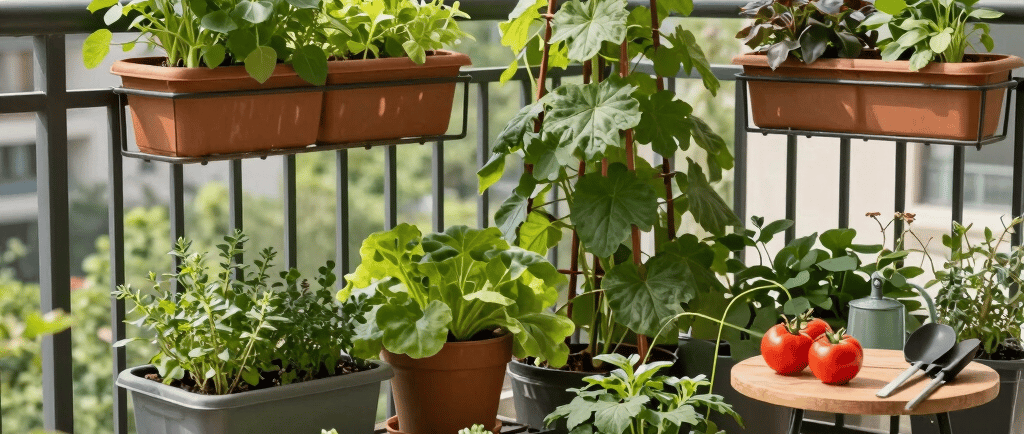
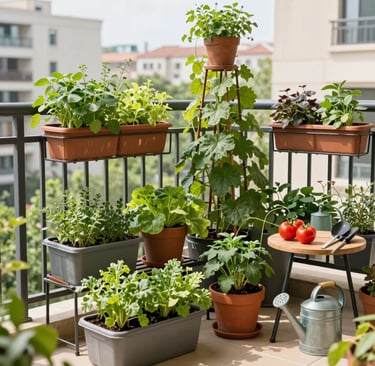
Trellises are the workhorses of vertical balcony gardening. A simple bamboo or metal trellis secured against a wall or railing gives climbing plants — cucumbers, pole beans, small squash varieties — somewhere to go, converting a single container footprint into multiple feet of productive growing space reaching upward. My six-foot trellis against the back wall of my balcony supports a cucumber plant every summer. It takes up maybe two square feet of floor space and produces cucumbers consistently from July through September. That's an extraordinary return on floor space.
Railing planters are the most underutilized balcony gardening tool I know of. These hook-mounted or clip-on planters attach directly to your balcony railing and hang either inside or outside, taking up zero floor space whatsoever. I have railing planters running the entire length of my balcony — probably twelve feet total — planted with herbs and trailing flowers. That's a significant amount of growing space that would otherwise be completely unused. Most railing planters are renter-friendly too, requiring no drilling or permanent installation.
Wall-mounted planters work well on solid balcony walls for lighter plants. Fabric pocket planters, mounted wooden pallet gardens, and modular wall planting systems all let you turn a blank wall into a vertical garden. I have a fabric pocket planter on my interior balcony wall that grows chives, parsley, and mint. For renters, pressure-mounted systems and heavy-duty adhesive hooks can support lighter wall planters without drilling.
Tiered plant stands bring organization and vertical dimension to your container collection without requiring any wall attachment. A three or four-tier stand can hold six to twelve small pots in the footprint of one or two, and it looks intentional and styled rather than cluttered. I use a tiered stand specifically for my herb collection — it keeps everything in one manageable spot, looks great, and frees up floor space for larger vegetable containers.
Hanging baskets from ceiling hooks use the most underutilized real estate on any balcony — the ceiling and overhead space. Trailing plants like petunias, strawberries, cherry tomatoes (the trailing varieties), and sweet potato vine look spectacular in hanging baskets, and they're completely out of the way of foot traffic and floor space. If your balcony ceiling allows hooks — many do — this is an easy win for both beauty and productivity.
Choosing the Right Containers for Your Balcony Garden
Container selection seems like a minor detail until you've watched a plant struggle or die because its container was wrong for it. I've learned — slowly and sometimes expensively — that the container you choose has a significant impact on how your plants grow, how often you need to water, and how your balcony looks overall.
Fabric pots are my personal favorite for vegetables on the balcony. They air-prune roots, which prevents the circling and root-binding that happens in rigid containers and leads to healthier, more productive plants. They drain perfectly — you'll never have waterlogging in a fabric pot. They're lightweight, which matters for balcony weight limits. And they fold flat for storage in the off-season, which is a practical benefit I didn't appreciate until I had a collection of rigid containers taking up my storage unit. The downside is they dry out quickly in hot weather, so be prepared to check moisture daily in summer.
Plastic containers are the practical workhorse of balcony gardening — affordable, lightweight, moisture-retentive, and available in every size. They don't look as beautiful as ceramic or terracotta, but they function well and they're easy to find. If you're starting on a budget, good quality plastic containers are a completely reasonable choice. Look for UV-resistant options that won't crack and degrade in their first season of sun exposure — the very cheapest plastic pots often do.
Terracotta is beautiful but thirsty. The porous clay walls wick moisture away from the soil, which is wonderful for succulents and Mediterranean herbs that like to dry out between waterings. For moisture-loving vegetables and tropical plants, though, terracotta means watering significantly more frequently than you would with plastic or fabric. In the heat of summer, a small terracotta pot might need water daily. Worth it for the aesthetics if you're willing to commit to the watering frequency — but go in with eyes open.
Self-watering containers are worth every penny for tomatoes, peppers, and any plant that suffers from inconsistent moisture. The reservoir system wicks water up to the roots as needed, maintaining consistent soil moisture without daily intervention. For tomatoes specifically, consistent moisture is critical — inconsistent watering is the primary cause of blossom end rot, which is one of the most common and frustrating tomato problems. Self-watering containers essentially eliminate this issue. They're also a genuine lifesaver for busy people and anyone who travels.
Size matters more than most people realize. A tomato plant in a two-gallon container will be stunted, stressed, and unproductive no matter how well you care for it. Most vegetables need at least three to five gallons of soil volume, and tomatoes do best in five gallons or more. Herbs are happy in smaller containers — four to six inches is usually sufficient. When in doubt, go bigger. More soil volume means more root space, more nutrient and moisture reserves, and more resilient plants overall.
Balcony Garden Watering Tips
Watering is the area where most balcony gardeners struggle the most — not because it's complicated but because containers behave so differently from in-ground gardens. I've written a whole separate guide on how often to water container plants, but here are the most important principles specifically for balcony conditions.
Balcony plants dry out faster than indoor container plants, full stop. Wind, sun exposure, reflected heat from walls and railings, and the generally more exposed conditions of a balcony environment all accelerate moisture loss from containers. What might need watering every ten days indoors might need water every two days on a sunny, breezy balcony. The only reliable way to know when to water is the finger test — stick your finger one to two inches into the soil, and water when it's dry. No schedule substitutes for this.
Deep watering every single time. Water until it flows freely from the drainage holes at the bottom. Not a quick splash on the surface — a thorough saturation of the entire soil volume. Deep watering encourages roots to grow deep and strong, which makes plants more resilient to heat, wind, and the occasional missed watering. Surface-only watering creates shallow-rooted plants that stress out constantly. It seems counterintuitive — like deep watering would cause overwatering — but with proper drainage it doesn't. The water flows through and out, which is exactly what you want.
In summer, check daily. This is non-negotiable for vegetable containers on a sunny balcony during July and August. I do my balcony check every morning before work — it takes ten to fifteen minutes, it's become genuinely enjoyable, and it means I catch problems early rather than coming home to wilted, stressed plants that have been dry all day. During heat waves I sometimes do a second check in the evening.
Drip irrigation systems are the best investment I've made in my balcony garden, and I recommend them without hesitation to anyone who wants to garden without constant watering stress. A basic timer-controlled drip system costs $40-80, takes a couple of hours to set up, and then runs automatically on whatever schedule you set. My plants are watered every morning at 6am whether I'm home or not. I travel for work occasionally and my garden keeps growing without me. It's changed balcony gardening for me in a fundamental way.
Mulching the top of containers with a thin layer of straw, shredded bark, or even decorative stones reduces evaporation from the soil surface significantly — sometimes by 30-40%. This is especially useful for balcony containers in full sun where surface evaporation is rapid. It also discourages fungus gnats, which love to lay eggs in moist bare soil. A simple, low-effort intervention that makes a real difference.
Protecting Your Balcony Garden From Wind, Heat, and Pests
This is the section that separates successful balcony gardeners from frustrated ones. The challenges specific to balcony environments — wind, reflected heat, pests in an elevated setting — are real, and ignoring them is how you end up with a garden that looks great in May and is a mess by July.
Wind is the most underestimated threat to balcony gardens, especially on higher floors. Wind desiccates leaves, snaps stems, tips over containers, and stresses plants to the point of reduced productivity and increased disease susceptibility. My first serious balcony tomato plant was snapped at the stem by a windstorm in late June. I stood there looking at it for a long time.
The most effective wind protection is a bamboo or reed screen attached to the railing on the windward side of your balcony. These screens reduce wind speed significantly without blocking light, and they're relatively inexpensive and easy to install. Within my screen, my plants grow noticeably better than the ones I accidentally placed on the exposed side of the balcony. Beyond screening, stake everything — every tomato, every pepper, every tall plant — regardless of whether it seems like it needs it. It will need it eventually, and staking before a storm is infinitely better than staking after one.
Reflected heat is a double-edged sword. Balconies surrounded by light-colored concrete or brick walls and railings absorb solar heat during the day and radiate it back around your plants, creating a microclimate that's significantly warmer than the surrounding air. This is fantastic for heat-loving tomatoes and peppers — they produce noticeably better in a warm balcony microclimate than in a cooler garden. But it's hard on cool-season crops like lettuce and spinach, which bolt quickly in heat. Position your heat-lovers in the warmest, most reflected-heat spots, and put your cool-season crops in the shadier, cooler areas. Use the microclimate intentionally rather than fighting it.
Organic pest control works well on balconies because the elevated, somewhat isolated environment means pest pressure is often lower than in a ground-level garden. But aphids, spider mites, mealybugs, and fungus gnats still find their way up. My first line of defense is always prevention — healthy, well-watered plants in good-quality soil resist pests far better than stressed plants do. My second line is regular inspection — I check the undersides of leaves weekly and catch problems early when they're easy to manage. When I do have a pest issue, I start with the least aggressive intervention: a strong spray of water to knock aphids off, neem oil spray for mites and mealybugs, letting soil dry out to discourage fungus gnats.
Companion planting works on balconies just as well as in ground gardens, and it's one of my favorite strategies for keeping pests manageable. Marigolds are the classic companion plant — they deter aphids, whiteflies, and other common pests through their scent, and they look gorgeous next to tomatoes and peppers. Basil planted near tomatoes is said to improve flavor and deter pests. Chives deter aphids. Nasturtiums act as trap crops, attracting aphids away from your vegetables. Building a companion planting strategy into your balcony layout is smart, practical, and beautiful.
Balcony Garden Design Tips for a Beautiful Outdoor Space
Here's a truth I came to slowly over several years of balcony gardening: a garden that's only productive but not beautiful is a garden you won't enjoy spending time in. And a garden you don't enjoy is one you'll eventually neglect. The design matters. The aesthetics matter. Making your balcony a space you genuinely want to be in is part of what makes the gardening sustainable long-term.
Color coordination goes a long way toward making a balcony garden feel intentional rather than random. You don't need to be an interior designer — just pick a color palette and stick to it roughly. I work with deep greens, terracotta oranges, and purple-blue tones — my pots, my flowers, and even my plant stakes follow this palette loosely. The result feels cohesive and styled rather than like a collection of random pots. Even choosing containers in two or three complementary colors rather than whatever happens to be on sale makes a noticeable difference.
Mixing edible and ornamental plants creates a balcony garden that's both productive and beautiful — and the two actually complement each other in practical ways too. Flowers attract pollinators that benefit your vegetable plants. Certain flowers deter pests. And visually, the combination of lush vegetable foliage with colorful blooms is genuinely stunning. I grow tomatoes and peppers alongside petunias and marigolds, herbs next to lavender, lettuce bordered by trailing lobelia. It looks beautiful and it functions better than either a purely edible or purely ornamental garden would alone.
Create layers and depth rather than putting everything at the same height. Tall plants at the back or sides, medium plants in the middle, low-growing or trailing plants at the front or edges. This creates visual interest and depth that makes even a small balcony feel lush and full. Trellises, tiered stands, railing planters, and hanging baskets all contribute to this layered effect. When everything is at ground level in similar-sized containers, it looks flat. Layer it up and it looks like a real garden.
Lighting transforms a balcony in the evening and extends the time you actually spend out there. Solar string lights are my absolute favorite balcony addition — warm, ambient, zero electricity cost, and they make the whole space feel magical in the evening. Drape them along railings, over trellises, around hanging baskets. Solar lanterns dotted among your containers add depth and warmth. Good lighting is cheap, easy, and dramatically changes the feel of your outdoor space after dark.
Make it a space you actually want to use. This sounds obvious but it's something a lot of gardeners overlook. A chair. A small table. A rug that defines a seating area. A place to set down your coffee while you do your morning plant check. Your balcony garden should be an extension of your living space, not just a growing area. The more comfortable and inviting the space is, the more time you'll spend out there — and the more time you spend out there, the better you'll know your plants, the earlier you'll catch problems, and the more you'll enjoy the whole experience. Design for living in the space, not just growing in it.
Conclusion
Balcony gardening changed my relationship with my apartment, with my food, and honestly with my mornings. That concrete rectangle with the dead plant and the rusty chair is now the first place I go every day, coffee in hand, to check on things that are alive and growing and slowly producing food I'll eat that evening. It's a small thing in the grand scheme of life. But it doesn't feel small.
The most important balcony gardening tips I can leave you with are these: know your conditions before you plant anything. Start smaller than feels right and build from there. Choose plants that match your space, not just your wish list. Go vertical wherever you can. Water deeply and consistently. Protect your garden from wind and heat with intention. And make the space beautiful enough that you actually want to spend time in it — because the time you spend in your garden is what makes you good at gardening.
You don't need a lot of space. You don't need a big budget. You don't need experience. You need one container, one plant, and the willingness to pay attention and learn as you go. Everything else follows from that.
So — what are you growing this season? Are you a first-timer setting up your first balcony containers, or a seasoned balcony gardener with tips of your own to share? Drop everything in the comments below. I read every single one and genuinely love hearing what people are growing and what's working for them. And if this guide helped you, share it with someone who's been eyeing that empty balcony and wondering if it's worth trying. It is. I promise you it is. 🌿🌸