Apartment Patio Gardening: The Complete Guide to Growing Food and Beauty in a Small Outdoor Space
Transform your apartment patio into a thriving garden — food crops, herbs, flowers, and smart container setups that make the most of every square foot. Real advice from someone who's done it.
BALCONY TINY PLOTS: TURN YOUR OUTDOOR SPACE INTO A MINI FARM
Introduction
A well-planned apartment patio — even a modest six-by-ten-foot concrete rectangle — can produce over two hundred pounds of food in a single growing season. That number surprises most people because it doesn't match the mental image of an apartment patio as a place for a couple of chairs and maybe a sad potted plant. But a patio with eight to ten large containers, a trellis along one wall, railing planters across the full railing length, and a vertical pocket system on the back wall is a genuinely productive growing space — one that provides daily harvests of tomatoes, peppers, cucumbers, herbs, and salad greens through the summer months and cool-season greens through spring and autumn.
I've been gardening on apartment patios for most of my adult life — ground floor patios, elevated patios, narrow side patios, generous corner patios — and the throughline across all of them has been the same discovery: the gap between what a patio looks like when you move in and what it becomes when you treat it as a serious growing space is remarkable. What starts as a concrete square with a single sad bench becomes, over one or two seasons of intentional planting, a layered, productive, genuinely beautiful outdoor room that changes how you cook, how you spend your evenings, and how you feel about where you live.
The principles that make apartment patio gardening work are specific — different from in-ground gardening, different even from balcony gardening in some important ways — and this guide covers all of them. How to assess and maximize your patio's potential. How to design a space that's productive and beautiful rather than just crowded with containers. Which crops deliver the best return on patio space. How to manage the particular challenges of patio growing — heat reflection, wind, limited soil volume — and how to build a garden that improves season over season rather than starting from scratch every spring. Let's turn that concrete rectangle into something worth spending time in.
Assessing Your Apartment Patio — Sun, Space, and Potential
The assessment phase is where most patio garden mistakes are prevented before they happen, because the decisions that follow — which crops to grow, which container setup to use, where to place what — all depend on accurately understanding what your specific patio offers. Spending an hour on assessment before spending any money on plants or containers saves multiples of that time in frustration later.
Light assessment on a patio is both more important and more complex than most beginners expect, because patio light environments are shaped by multiple interacting factors — orientation, surrounding structures, overhead coverage, reflected light from surfaces, and seasonal sun angle changes — that produce a light environment unique to each specific patio. Start with compass orientation: a south-facing patio in the northern hemisphere receives the most direct sun throughout the day, a north-facing patio receives the least, and east and west-facing patios receive morning and afternoon sun respectively. But orientation is only the starting point — a south-facing patio beneath a substantial overhang may receive less direct sun than a north-facing one that's fully open to the sky. The definitive assessment is observation: spend a clear day on your patio noting when and where direct sun falls, from early morning to late evening, and how the pattern shifts.
Concrete and paved patio surfaces add a light dimension that balcony and indoor gardeners don't experience — reflected light. Light-colored concrete and pale stone reflect significant quantities of light upward onto plant foliage and into shaded areas of the patio, effectively increasing the light available to plants positioned near the ground. This reflected light is less intense than direct overhead sun but meaningfully supplements shade from overhangs and surrounding structures. Dark-colored paving absorbs light as heat rather than reflecting it — a different effect that warms the root zone of plants sitting on dark surfaces, which can be beneficial in spring and harmful in peak summer heat.
Space measurement should be done with precision because effective patio garden design at small scale requires accurate planning. Measure the full patio dimensions and note fixed obstacles — exterior walls, support columns, hose bibs, and any permanent furniture that won't be moved. Then assess what you want the patio to do beyond gardening — if you want space for a table and two chairs for outdoor dining, mark that area on your sketch and plan your garden around it rather than in competition with it. The productive gardening area available after accounting for furniture and movement space is often smaller than the total patio but larger than the corners and edges that most people initially think of as the only growing positions.
Identifying microclimates within your patio is worth doing once you've spent a season or at least several weeks observing conditions. Patios have hot spots — areas where concrete absorbs heat and radiates it back, where walls create thermal mass effects, or where reflected sunlight from adjacent surfaces concentrates — and cool spots where shade is more consistent and temperatures more moderate. Plants placed in hot spots need more frequent watering and may struggle in peak summer heat. The same hot spots are often the best positions for heat-loving crops like tomatoes and peppers that want maximum warmth. Cool, shadier spots suit lettuce, spinach, and cool-season herbs that bolt and become bitter in excessive heat. Matching plant placement to microclimate is one of the highest-leverage optimizations in patio garden design.
Designing Your Apartment Patio Garden for Maximum Productivity
Design is the difference between a patio that's genuinely pleasant and productive and one that feels crowded, chaotic, and difficult to maintain — and the good news is that effective patio garden design follows a small number of principles that aren't complicated once you understand them.
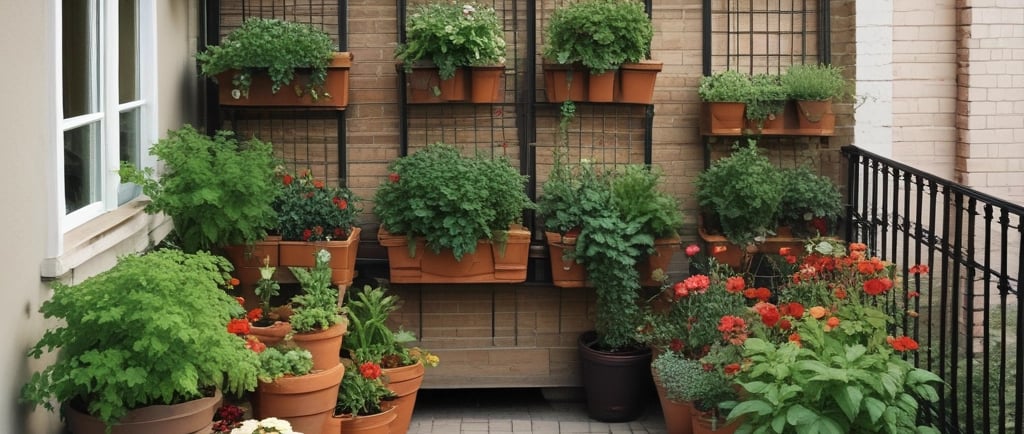
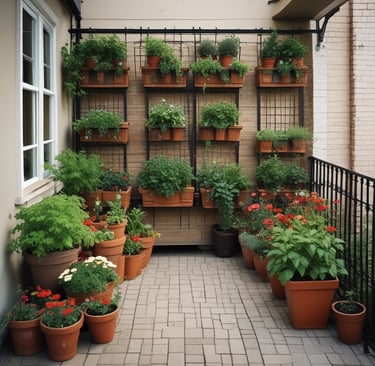
The layered approach is the foundational design principle for small patio gardens, and it comes directly from how productive natural plant communities work. Rather than placing all plants at the same height on the patio floor and competing for the same horizontal space, a layered patio garden uses three vertical zones simultaneously: the floor level for large containers and grow bags, the mid level for raised planters, railing planters, and medium-height freestanding structures, and the overhead and vertical level for climbing plants on trellises, hanging baskets, and wall-mounted systems. A patio that uses all three zones grows dramatically more food and looks dramatically more lush than the same patio with everything at floor level — the layering creates depth, visual interest, and genuine additional growing capacity without consuming any additional floor space.
Creating zones within the patio — even in a small space — prevents the feeling of clutter that a random arrangement of containers creates. A simple zoning approach divides the patio into a living zone — where furniture sits and the primary human activity happens — and a growing zone — where containers, trellises, and vertical systems live. These zones don't need to be separated by a physical barrier; visual distinction through container arrangement, flooring materials, or the natural separation created by grouping plants together is sufficient. The growing zone wraps around the living zone — along walls, across the railing, on the corners — rather than competing with it for central floor space.
Making the garden look intentional rather than accumulated is an aesthetic principle with practical consequences because a beautiful, well-designed patio garden is one you'll spend more time in, maintain more carefully, and continue investing in — and one your landlord is less likely to object to than a cluttered mess of mismatched containers. Intentional design uses a limited palette of container materials and colors — ideally two or three complementary options rather than every container you happened to acquire — and arranges plants in groups with visual logic: taller plants at the back, shorter ones at the front; repeated elements creating rhythm rather than random variety. A patio garden where someone has clearly thought about how it looks is a patio garden that's genuinely pleasant to be in and that functions as an outdoor room rather than just a growing operation.
Combining food and ornamental plants in the same patio design is both aesthetically rewarding and practically beneficial. Flowers attract pollinators that improve vegetable yields. Ornamental plants fill visual gaps between food crops. And the combination of productive plants and beautiful ones creates a space that serves multiple purposes simultaneously rather than looking like either a purely utilitarian growing operation or a purely decorative planting. The most beautiful apartment patio gardens I've seen integrate tomatoes climbing a trellis alongside clematis, herbs spilling from railing planters between calibrachoa, and salad bowls of colorful lettuce varieties as intentional ornamental accents.
The Best Containers for Apartment Patio Gardening
Container selection for apartment patio gardening involves balancing several considerations — size, weight, material, aesthetics, drainage, and cost — that interact in ways worth understanding before making purchases that you'll live with through multiple growing seasons.
Fabric grow bags have become the container of choice for serious apartment patio vegetable growing, and for a combination of reasons that make them genuinely superior to rigid alternatives for most applications. Their breathable fabric walls air-prune roots — when roots reach the container wall, air contact causes the root tip to stop growing rather than circling the container, stimulating more branching and producing a denser, more efficient root system. They drain freely and completely, preventing the waterlogging that rigid containers can develop when drainage holes become partially blocked. They're dramatically lighter than ceramic, terracotta, or even plastic rigid containers, making patio weight management much more practical. And they're inexpensive enough that upgrading to larger sizes as needed doesn't feel like a major investment. Five-gallon, ten-gallon, and fifteen-gallon fabric bags handle the full range of patio vegetable crops from herbs to full-size tomatoes.
Self-watering containers are the technology that makes apartment patio gardening genuinely sustainable for people who work full time and can't water every day in hot weather. A patio in summer sun — particularly on a south-facing concrete patio where reflected heat accelerates evaporation — can require daily watering or more for large containers at peak growing season. Self-watering containers with adequate reservoir capacity reduce this to every three to five days for most crops, dramatically reducing the maintenance burden. The full mechanism and DIY build options were covered in the previous article in this series, but for purchased options the Lechuza, EarthBox, and City Picker brands all produce reliable self-watering containers appropriate for patio vegetable growing.
Window boxes and trough planters are the most space-efficient container shapes for patios because their elongated form makes optimal use of linear space along walls and railings — positions that round containers use inefficiently. A thirty-inch window box along a patio wall holds three to four herb plants or a continuous planting of lettuce in a footprint that a series of individual round pots would use much less efficiently. Trough planters — deeper than window boxes and typically freestanding — work well for root vegetables and deeper-rooting herbs in positions where floor space is available but the linear layout is more efficient than clusters of round containers.
Container sizing matched to plant rather than to aesthetic preference is the principle that most affects plant health and productivity on a patio. Undersized containers — a tomato in a five-gallon pot that needs fifteen gallons, or a cucumber in a container it quickly roots out of — produce stunted, underperforming plants that require more frequent watering, deplete nutrients faster, and disappoint at harvest. The general guidance for common patio crops: herbs need a minimum of one to two gallons per plant; lettuce and salad greens work in four to six-inch depth containers at high density; peppers want five gallons minimum; cucumbers and eggplant want seven to ten gallons; tomatoes want fifteen gallons or more for indeterminate varieties, ten gallons for compact determinate types.
The Best Food Crops for Apartment Patios
The crops that deliver the best return from apartment patio space are those that combine high productivity with meaningful value — things that are expensive or poor quality at the grocery store, that benefit dramatically from being eaten fresh, and that produce continuously through the season rather than delivering a single harvest and being done.
Tomatoes are the patio vegetable most worth the container space and the care they require, and this conviction comes from the simple fact that homegrown tomatoes are among the most dramatically better-at-home-than-store-bought foods in existence. The flavor difference between a tomato harvested sun-warm from a patio container and a grocery store tomato picked green and ripened in transit is not subtle — it's the difference between something genuinely delicious and something that merely looks like a tomato. On a patio with adequate direct sun — six or more hours daily — a single large container of an indeterminate cherry tomato variety like 'Sun Gold', 'Sweet 100', or 'Black Cherry' will produce abundantly from midsummer through first frost, providing handfuls of fruit daily for weeks. Compact patio varieties like 'Patio', 'Bush Early Girl', and 'Celebrity' perform well in smaller containers and require less staking than indeterminate types. Give tomatoes your best sun position, your largest container, and consistent water and fertilizer, and they'll deliver more return than any other single patio plant.
Peppers are the underappreciated patio crop that most gardeners who try them once grow forever — beautiful, productive, ornamentally attractive plants that produce prolifically in containers and deliver both sweet and hot pepper varieties in greater flavor diversity than any grocery store offers. Sweet bell peppers, banana peppers, Italian frying peppers, and the full range of hot peppers from mild jalapeños to incendiary habaneros all grow well in five to seven-gallon containers in full sun. Pepper plants are also genuinely attractive — compact, glossy-leaved, and studded with colorful fruit through the season — in a way that makes them dual-purpose ornamental-edible plants ideal for a patio that needs to look good as well as produce food.
Herbs are the highest value-per-square-foot crop on any apartment patio because fresh herbs at full flavor — harvested at their peak and used immediately — are categorically better than anything available at retail, and their price per ounce at grocery stores makes every container of homegrown herbs a meaningful cost saving. A patio herb section with basil, rosemary, thyme, oregano, chives, parsley, and mint provides daily kitchen value, transforms cooking in ways that dried herbs never match, and requires minimal space — a window box, a few small containers, and a corner of a railing planter handles the full standard herb collection. Basil is the herb that most rewards patio growing — it produces abundantly in warmth and sun, deteriorates fastest after harvest, and is most expensive at retail, making the combination of quality, freshness, and cost savings from a patio basil plant among the most compelling in food growing.
Salad greens and lettuce in cut-and-come-again plantings provide continuous daily harvests from minimal container space throughout the cooler parts of the growing season. A single window box of mixed loose-leaf lettuce produces enough salad greens for one to two people daily when managed with the cut-and-come-again approach — harvesting outer leaves while leaving the growing center intact. Succession planting every three weeks ensures continuous availability through spring and autumn. In summer heat, replacing bolted lettuce with heat-tolerant alternatives like chard, basil, or New Zealand spinach maintains productivity through the warmer months. The continuous harvest model — daily salad from the patio rather than weekly grocery store purchases — is one of the most satisfying rhythms in patio food gardening.
Cucumbers and climbing beans deserve mention as the crops that make the best use of vertical growing space on a patio. A single cucumber plant on a four-foot trellis section alongside a wall or fence produces a dozen or more cucumbers through the season from a floor footprint of perhaps one square foot. Pole beans climb enthusiastically and produce abundant harvests from a similarly small footprint. Both crops reward the vertical approach that makes patios with trellis systems significantly more productive than those relying entirely on floor containers.
Flowers and Ornamentals That Earn Their Space
On a small apartment patio where every square foot matters, ornamental plants need to earn their space — and the ones that belong in a productive patio garden are those that contribute something beyond pure aesthetics. Fortunately, the overlap between beautiful and functional is substantial, and the right ornamental choices actively improve the productivity of the food crops around them.
Pollinator-attracting flowers are the ornamental category with the most direct impact on food crop productivity, and their inclusion in a patio garden is both beautiful and practically significant. Container tomatoes, peppers, cucumbers, and beans all depend on pollination for fruit set, and in an apartment patio environment — particularly on upper floors away from natural pollinator habitat — the density of visiting bees and other pollinators can be surprisingly low. Planting calibrachoa, marigolds, zinnias, and sweet alyssum alongside food crops creates a patio that pollinators actively seek out and visit repeatedly, dramatically improving fruit set on crops that need it. The visual effect of brightly colored flowers woven through a vegetable patio is genuinely beautiful — and the practical effect on tomato and cucumber yield is measurable.
Marigolds in particular deserve emphasis as the most versatile companion plant for a patio food garden. Their strong scent deters aphids, whiteflies, and other common patio pests. Their roots exude compounds that reduce certain soil-borne pest populations. They attract beneficial insects that prey on common pests. They're beautiful throughout a long season. And they're virtually impossible to fail with — fast-growing, heat-tolerant, drought-resistant, and prolific. A marigold planted in every large vegetable container and clustered at the edges of the patio growing area is among the best investments in patio garden health available.
Edible flowers add a culinary dimension to ornamental planting that makes the most efficient possible use of patio space — plants that are simultaneously beautiful, pollinator-attracting, and edible, contributing to the kitchen as well as the garden aesthetic. Nasturtiums are the flagship edible flower for patio growing — fast from seed, prolific in color, completely edible from flower to leaf to seed, and effective at attracting beneficial insects and repelling pests. Violas and pansies produce small, delicately flavored flowers that work beautifully as garnishes and in salads. Borage produces star-shaped blue flowers with a mild cucumber flavor that looks extraordinary floating in cold drinks. Growing edible flowers rather than purely ornamental ones in the patio's decorative planting positions maximizes the garden's contribution to the kitchen without sacrificing beauty.
Fragrant plants transform the experience of spending time on a patio in a way that purely visual plants can't match — and since the point of an apartment patio is partly to provide a pleasant outdoor space for human enjoyment, plants that make the space smell wonderful serve a purpose beyond food production. Lavender in a sunny container provides months of fragrance alongside significant pollinator attraction and useful dried flowers for cooking. Scented geraniums — particularly the rose, lemon, and mint varieties — produce intensely fragrant foliage that releases its scent when touched, making them perfect near a seating area where incidental contact is frequent. Sweet alyssum, planted at the base of larger containers or in gaps in a railing planter, produces a honey-like fragrance that makes a warm summer evening on the patio genuinely sensory.
Vertical Gardening on Your Apartment Patio
Vertical gardening is not optional for a productive apartment patio — it's the approach that converts a patio from a collection of floor containers into a genuinely layered, maximally productive growing space. The vertical dimension is where much of the most dramatic productivity improvement lives, and the systems that unlock it are accessible and affordable even for renters who can't make permanent modifications.
The case for going vertical on a patio is the same as for balconies but often even more compelling because patios typically have more wall surface available. A ground-floor patio backed by a building wall offers substantial vertical growing real estate — a six-foot-wide, seven-foot-high wall behind the patio is forty-two square feet of potential growing surface that adds to rather than competes with floor container space. A freestanding trellis panel positioned against that wall requires no wall attachment, supports climbing food crops through a full season, and creates a living green wall that transforms the visual character of the space as dramatically as any renovation.
Trellis systems on patios fall into the same categories discussed in the vertical balcony gardening article — freestanding in containers, railing-attached, and wall-mounted — with the additional option on ground-floor patios of fencing or existing wall structures that provide natural attachment points. A bamboo or metal trellis leaned against a back wall and weighted at its base in a large container planter is the simplest freestanding trellis setup — no drilling, no attachment, completely portable, and adequate for cucumbers, beans, and climbing nasturtiums through a full season. More elaborate freestanding A-frame structures and obelisk trellises provide more three-dimensional growing surface and look more architectural as design elements within the patio space.
Railing planters along the full railing perimeter of a patio create a growing tier that uses none of the floor space while adding significant productive capacity. A ten-foot patio railing fitted with over-railing hook planters at twelve-inch intervals accommodates roughly ten individual planting positions — enough for a complete herb collection, a cascade of trailing flowers, or a combination of both. The railing position typically receives good light since it's at the outer edge of the patio away from overhead coverage, making it often the best light environment on the patio and worth planting accordingly with the most light-hungry crops.
Wall pocket systems and modular panel planters bring the pocket-planter approach to patio walls — particularly useful for the often-blank back wall of a ground-floor patio that faces the building. A fabric pocket panel covering half of a back wall provides twenty or more individual planting positions for herbs, strawberries, lettuce, and small flowering plants. Mounted to existing hooks or to a freestanding frame leaning against the wall, it requires no drilling, leaves no permanent marks, and moves completely when you leave. The visual transformation of a bare concrete wall into a living plant panel is among the most dramatic single changes you can make to a patio's appearance and productivity simultaneously.
Watering and Feeding Your Apartment Patio Garden
Watering and feeding are the ongoing management practices that determine whether a well-designed patio garden maintains its productivity through the season or gradually declines as the summer heat and intensive cropping deplete moisture and nutrients from the containers. Getting these practices right is the operational skill that container vegetable gardening is built on.
Building a sustainable watering routine starts with understanding what sustainable means for your specific situation — your schedule, your patio's conditions, and your plants' needs. A patio in full summer sun with large tomato and cucumber plants can require watering once or twice daily for large conventional containers at peak growth. That's not sustainable for most people with full-time jobs and normal lives. The path to a sustainable watering routine runs through a combination of self-watering containers for the most demanding crops, mulching container surfaces to reduce evaporation, and grouping containers to create a more humid microenvironment that slows drying. These three measures together can shift the watering requirement from daily to every two to three days for most patio setups — a rhythm that's compatible with most people's lives.
Drip irrigation systems for patios are more accessible and less expensive than most apartment gardeners realize, and a simple gravity-fed or pump-based drip system connected to a mechanical timer can automate watering almost completely for under fifty dollars in materials. The system consists of a water source — either a hose connection or an elevated reservoir — thin-wall drip tubing distributed to each container, individual drip emitters adjusted to deliver appropriate volumes to each container size, and a mechanical timer set to run for the right duration and frequency. The full DIY version described in the self-watering planter article works for patios as well as balconies. For patios with access to an outdoor hose bib, a timer connected directly to the hose bib and drip lines run to each container is even simpler.
Fertilizing patio container vegetables is necessary through the season because containers are inherently nutrient-limited — the fixed volume of growing medium can only store so much nutrition, and intensive crops deplete available nutrients faster than the slow-release components of a quality potting mix can replenish them. The practical fertilizing program for most patio vegetable gardeners combines a slow-release fertilizer incorporated at planting with liquid fertilizer applications every two to three weeks through the active growing season. Tomatoes and peppers benefit from a switch to a lower-nitrogen, higher-potassium fertilizer once they begin flowering and setting fruit — too much nitrogen at this stage produces lush foliage at the expense of fruit development. Liquid seaweed and fish emulsion fertilizers provide a balanced, gentle nutrition boost that improves plant health beyond what synthetic fertilizers alone deliver.
Managing watering on vacation — the perennial challenge of apartment gardeners who can't water for a week or two — is genuinely solvable without sacrificing an entire season of plant growth. Self-watering containers with large reservoirs handle a week to ten days without intervention for most crops. Grouping all containers together in the shadiest available position reduces water demand during absence. Asking a neighbor to water once or twice is more feasible when the setup is simple and instructions are clear. And setting up a basic drip system with timer specifically for vacation periods — a bucket reservoir elevated for gravity feed, with drip lines to each container — requires an hour of setup that saves the entire garden during a two-week absence.
Dealing with Patio Gardening Challenges
Every patio presents specific challenges that affect growing success, and the challenges that apartment patios present most commonly — heat reflection from concrete, wind exposure, pests, and the tension between productive gardening and pleasant living space — all have practical solutions once they're understood clearly.
Heat and reflected light from concrete patios create a growing environment significantly warmer than ambient air temperature, with consequences for plant health and watering demands that patio gardeners need to account for. Concrete and paving stones absorb heat during the day and release it at night, creating a warmer microclimate that benefits heat-loving crops like tomatoes and peppers in spring and early summer but can create heat stress for those same crops during peak summer heat waves. Surface temperatures on sun-exposed concrete can reach temperatures far higher than air temperature — hot enough to heat root zones in small dark containers to damaging levels. The practical responses: use light-colored or white containers that reflect rather than absorb heat; place containers on wooden decking tiles, bamboo mats, or other insulating surfaces rather than directly on concrete; water in the evening to cool the root zone through the night; and mulch container surfaces heavily to reduce both evaporation and heat absorption.
Wind on patios — particularly ground-floor patios in urban environments where building configurations create channeling effects — can be surprisingly damaging to plants and drying to soil. Tall plants like tomatoes and staked cucumbers become top-heavy and prone to wind damage as they grow. Fabric containers on exposed patios can tip in strong gusts. And wind dramatically accelerates evaporation from container surfaces, making the watering challenge significantly worse than it would be in still conditions. Solutions include positioning the most wind-sensitive plants against walls and in corners where wind is reduced, staking larger plants more thoroughly than would be necessary in still conditions, and using wind-tolerant ornamental plants as windbreaks on the windward side of the patio.
Common patio pests differ somewhat from indoor plant pests because the outdoor environment exposes plants to a wider range of insects, both harmful and beneficial. Aphids are the most common and most damaging patio pest — soft-bodied insects that cluster on new growth and suck plant sap, causing distorted leaves and reduced vigor. A strong spray of water knocks them off plants effectively and is the first response for any aphid infestation. Tomato hornworms — large green caterpillars that blend almost invisibly into tomato foliage and can strip significant portions of a plant overnight — require hand-picking when spotted. Spider mites appear in hot, dry conditions and are controlled by increasing humidity around affected plants and applying neem oil spray. The best pest management strategy for patios is preventive — marigolds, basil, and other companion plants that deter pests, regular visual inspections that catch infestations early, and healthy plants with good nutrition that are more resistant to pest pressure than stressed ones.
Keeping the patio functional as both garden and living space is the ongoing design challenge that requires regular reassessment as the garden grows and changes through the season. Plants that were small in May are large in August, and a patio layout that felt spacious in spring can feel crowded by midsummer as containers fill with mature plants. Building this growth into the initial layout — leaving more space between containers than seems necessary in spring, positioning the tallest-growing plants where their eventual size won't block paths or seating areas — prevents the end-of-season claustrophobia that characterizes patio gardens that weren't planned for mature plant sizes. And regularly stepping back from the garden to assess whether the space still feels like a pleasant place to sit and eat, rather than just a growing operation you pass through, keeps the patio functioning as the outdoor room it's meant to be.
Building Your Apartment Patio Garden Season by Season
The apartment patio garden that genuinely works — that produces consistently, looks beautiful through the whole growing year, and improves season over season — isn't created in a single afternoon of planting. It's built progressively through the seasons, with each period of the year contributing something specific to the whole.
Spring setup is the most energizing period of the patio gardening calendar and the one where the decisions made determine the whole season's trajectory. The practical spring sequence starts four to six weeks before the last frost date — starting tomato and pepper seedlings indoors or purchasing transplants, refreshing container soil with the end-of-season amendments or fresh mix described in the potting soil article, and planning the container layout before anything goes outside. Cool-season crops — lettuce, spinach, arugula, peas, and herbs like chives, parsley, and cilantro — go out first, as soon as nighttime temperatures are consistently above 40°F. Warm-season crops wait until after last frost and until nighttime temperatures are reliably above 50°F. Getting this sequence right — cool crops first, warm crops after — extends the productive season by four to six weeks at both ends compared to planting everything after the last frost date.
Summer management is about maintaining the momentum that good spring setup creates — watering consistently, fertilizing every two to three weeks, harvesting frequently to keep productive crops producing, and catching pest and disease problems early enough to address them without losing plants. The most important summer management habit is harvesting regularly and thoroughly — tomatoes left on the vine past peak reduce the plant's incentive to produce more fruit, and lettuce not harvested promptly bolts in summer heat. Ten minutes of daily or every-other-day attention — checking water, harvesting ripe produce, tucking in any wayward climbing stems, quickly scanning for pest pressure — is what distinguishes a thriving midsummer patio garden from one that's declining.
Autumn transition is the season shift that most container gardeners miss or manage poorly, because the instinct when summer crops start declining is to let the garden wind down rather than pivot it to autumn productivity. The pivot is straightforward: as summer heat passes and tomatoes and peppers approach the end of their productive lives, direct-sow cool-season crops — lettuce, arugula, spinach, Asian greens, radishes — in the same containers once cleared, or in any container that's been freed up. Autumn-grown cool-season crops are often better than spring ones — the shortening days produce the cool temperatures these crops prefer without the risk of late cold snaps that can damage spring plantings. A well-managed autumn patio garden extends productive harvests from September through November in most temperate climates.
Winter on the patio is a period of relative dormancy for most crops in cold climates, but it's also when the planning and preparation that makes next season better happens. Clean containers of spent crops and old soil, refresh or replace growing medium, plan what you'll grow differently based on what worked and what didn't, order seeds for the coming season, and — in mild climates — continue growing cold-hardy greens through the winter months. A winter patio that's been maintained rather than abandoned — containers cleaned and stacked neatly, structural plants pruned and tended, the space kept orderly — is a patio you look forward to returning to in spring rather than one you dread cleaning up before you can start.
The year-over-year improvement that makes long-term patio gardening so satisfying is real and significant. The second season on the same patio is better than the first. The third is better than the second. You know where the best sun falls and at what times. You know which varieties produced best in your specific microclimate. You've built up a collection of containers that work and identified the ones that don't. You have an established herb collection that overwinters in mild conditions or comes back quickly from established root systems. You've worked out the watering rhythm and the fertilizing schedule that keeps your specific plants productive without constant attention. That accumulated specific knowledge, built season over season from direct experience in your own patio's unique conditions, is the most valuable gardening asset there is — and the apartment patio is where it gets built, one season at a time.
Conclusion
An apartment patio is one of the most genuinely transformable spaces in urban living — and the transformation from concrete rectangle to layered, productive, beautiful garden is available to virtually anyone willing to spend one afternoon on setup and ten minutes every couple of days on maintenance through the growing season. The food production potential alone — daily tomatoes, peppers, herbs, and salad greens through summer, cool-season greens through spring and autumn — justifies the investment of time and modest resources. But the full return on a well-planted apartment patio is something that food production numbers alone don't capture: the quality of life improvement from having a genuinely pleasant outdoor space to sit in, cook from, and spend time in is real and significant.
Start this season with one tomato in a large container, a window box of herbs along the railing, and a packet of lettuce seeds in a shallow trough. That's enough to begin — enough to get the first harvest, develop the first season's intuition about your specific patio's conditions, and build the confidence that grows into a full patio garden over the seasons that follow.
Share your patio garden setups, your best variety discoveries, your creative container solutions, or your questions in the comments below. The apartment patio gardening community has figured out extraordinary things about growing food and beauty in small outdoor spaces, and every setup shared adds to the collective knowledge that makes the next gardener's patio a little better from the start. Now go find a tomato transplant and a big container. 🌿