Apartment Balcony Garden: How to Grow a Lush, Productive Space From Scratch
Ready to build your apartment balcony garden? Learn how to set up, plant, and maintain a beautiful balcony garden in any size apartment — no yard, no experience required.
BALCONY TINY PLOTS: TURN YOUR OUTDOOR SPACE INTO A MINI FARM
Introduction
Here's a number worth sitting with: more than 80% of Americans now live in urban areas — and that number keeps climbing every year. That's a lot of people in apartments, condos, and urban housing with little or no access to traditional garden space. And yet, according to the National Gardening Association, home food gardening participation has hit record highs in recent years. People living in cities, in apartments, on the sixth floor with a balcony the size of a dining table — they're gardening anyway. Creatively, persistently, and often beautifully.
I know because I'm one of them. I've been apartment gardening for going on seven years now, across three different apartments with three very different balconies. One was tiny — barely enough room for two chairs. One faced north and got almost no direct sun. The current one is medium-sized, south-facing, and honestly the best growing space I've ever had, including the backyard I had for a brief, glorious two years before apartment life reclaimed me.
Each balcony taught me something different. The tiny one taught me to think vertically. The north-facing one taught me which plants actually tolerate low light and which ones are just lying about it. The current one has taught me that even with good conditions, success in apartment balcony gardening comes down to planning, systems, and a willingness to learn what your specific space needs.
This guide is everything I know about building an apartment balcony garden from scratch — whether you're working with a postage-stamp Juliet balcony or a generous urban terrace, whether you're a first-time plant person or someone who's tried before and lost a few battles. We're covering plant selection, layout, containers, watering, renter-friendly setups, budget tips, and how to make your balcony genuinely beautiful year-round. Let's build something green. 🌱
Why Every Apartment Dweller Should Have a Balcony Garden
I want to make the case for apartment balcony gardening before we get into the how, because I think a lot of people talk themselves out of it before they even start. "My balcony is too small." "I don't have the time." "I'll just kill everything." I've heard all of these — I said most of them myself at various points. So let me push back on each one, because the reasons to have a balcony garden are genuinely compelling.
The mental health benefits are real and research-backed. Multiple studies have found that interacting with plants and nature — even in small doses, even in urban settings — reduces cortisol levels, lowers blood pressure, and improves mood. There's even a specific concept called "attention restoration theory" that describes how natural environments, including indoor and balcony gardens, help restore depleted mental energy in ways that urban environments can't. I can tell you from personal experience that my ten-minute morning plant check on the balcony sets a tone for the entire day that nothing else quite replicates. It's meditative without requiring me to be good at meditating.
The food independence angle is genuinely meaningful, even if your balcony isn't going to replace your grocery store. Growing even a portion of your own food — fresh herbs every day, salad greens through spring and fall, cherry tomatoes all summer — builds a connection to where your food comes from that changes how you eat and shop in subtle but real ways. And the economics aren't nothing. A pot of basil that cost $3 in seeds and potting soil can produce more basil than a dozen of those little grocery store herb packages over a season. Fresh herbs alone can save a household $20-30 a month easily.
Turning dead space into living space is a transformation that apartment dwellers often underestimate until they've done it. Most apartment balconies are underused — a place to put bikes, maybe a couple of chairs, occasionally a grill. Adding a garden turns it into a destination. A place you actually go. A room, essentially, that happens to be outside. Once my current balcony had a garden in it, I started eating breakfast out there, working out there occasionally, having friends over for drinks out there. The garden made the space worth being in.
The community aspect of apartment gardening is something I didn't expect but genuinely love. Balcony gardens spark conversations with neighbors. You share cuttings and seedlings. You compare notes on what's working and what isn't. You belong to a growing community of urban gardeners online and in person who are passionate, helpful, and enthusiastic in a way that's kind of contagious. Starting a balcony garden connected me with three of my current close friends. That's not a small thing.
Assessing Your Apartment Balcony Before You Plant Anything
Every single apartment balcony is different. Different orientation, different floor level, different sun exposure, different wind conditions, different structural limits. The gardeners who struggle most in their first season are almost always the ones who skipped this step and went straight to buying plants. Don't be that person. Spend a week observing your space before you spend a dollar on it.
Sun direction determines everything about what you can grow. The cardinal direction your balcony faces is the single most important variable in your gardening success. South-facing balconies get the most direct sun in the Northern Hemisphere — typically six to eight hours or more in summer — and support the widest range of plants including all vegetables and most herbs. West-facing balconies get strong afternoon sun, which is good for most edibles but can be intense and hot during peak summer. East-facing balconies get gentle morning sun, which suits herbs, leafy greens, and cool-season crops reasonably well but makes fruiting vegetables more challenging. North-facing balconies get the least direct light and are best suited to shade-tolerant plants — ferns, begonias, impatiens, and leafy greens that tolerate partial shade.
Stand on your balcony at different times of day — morning, midday, afternoon — and note where the sun hits and where shade falls. Watch for shadows cast by the building above you, neighboring buildings, or roof overhangs. These shadows can significantly limit your available sun even on a south-facing balcony. Know exactly what you're working with before you commit to sun-hungry tomatoes or peppers.
Wind exposure increases with floor level in ways that aren't always intuitive until you've experienced them. A balcony on the third floor might be barely breezy while a balcony on the fifteenth floor is consistently windy enough to damage plants, desiccate soil rapidly, and knock over lightweight containers. Spend time on your balcony in a variety of weather conditions and honestly assess wind exposure. High wind exposure doesn't mean you can't garden — it means you need to plan for it with windbreaks, heavier containers, and staking from the start.
Weight limits are a legitimate structural concern that most apartment gardeners either don't know about or cheerfully ignore. Balconies have rated load limits — typically somewhere between 50 and 100 pounds per square foot, though it varies by building age and construction type. A large container of moist soil can weigh 50-80 pounds on its own. A fully planted, recently watered balcony garden can add up to hundreds of pounds. Find out your building's rated load limit before you set up — your building manager or super should have this information. Prioritize lightweight containers like fabric pots and plastic over heavy ceramic, concrete, or terracotta. Use lightweight potting mixes rather than dense garden soil. Position your heaviest containers near the outer perimeter of the balcony where structural support is greatest.
Renter considerations are real and worth addressing upfront. Review your lease before you set up any garden infrastructure. Most leases are silent on balcony container gardening, which is generally fine — containers aren't structural modifications. But some leases restrict drilling into walls or railings, hanging things from the ceiling, or placing anything on the railing itself. Know your rules before you invest in railing planters or ceiling-mounted hanging baskets. I'll cover renter-specific strategies in detail later in this guide, but the short version is: almost everything can be done without drilling and without violating standard lease terms.
Best Plants for an Apartment Balcony Garden
Choosing the right plants for your specific balcony conditions is where the real work of apartment gardening happens. The plants that thrive for someone on a sunny south-facing terrace are completely different from what works on a shady north-facing fourth-floor balcony. I'll break this down by category with honest notes on conditions needed.
Cherry tomatoes are the star of any sun-kissed apartment balcony and my most enthusiastic recommendation for anyone with six-plus hours of direct sun. Compact patio varieties — Tumbling Tom, Sweet 100, Tiny Tim, Patio Princess — are bred specifically for container growing and deliver remarkable yields from a single five-gallon pot. I grew two cherry tomato plants on my current balcony last summer and genuinely couldn't eat them fast enough. The plants were small — maybe two feet tall — but they fruited from late June through early October. For the apartment gardener with good sun, cherry tomatoes deliver the most satisfying return on investment of any plant I know.
Peppers — both sweet and hot varieties — love apartment balconies with their warm, sun-baked microclimate. The reflected heat from concrete walls and railings that can be tough on cool-season crops is actively beneficial for peppers. Banana peppers, jalapeños, cayennes, sweet mini peppers — all of these grow beautifully in three-gallon or larger containers and produce prolifically. They're also genuinely ornamental while they're producing, with colorful fruits in red, yellow, orange, and deep red decorating the plants through summer and into fall.
Herbs are the most practical plants for apartment gardening, period. Basil, chives, parsley, mint, rosemary, thyme, oregano — all grow happily in small containers, all produce food you'll use constantly in the kitchen, and all are significantly better fresh-grown than anything you can buy. The economics of growing your own herbs are immediately compelling. A $2 seed packet of basil grown in a $4 pot of potting soil will produce more basil over a season than fifty of those $3 grocery store herb packages. Grow what you actually cook with and you'll notice the savings quickly. Keep mint in its own container — it is enthusiastically invasive and will crowd out everything else given the chance.
Lettuce and salad greens are perfect for spring and fall apartment gardening and especially well-suited for east-facing and partially shaded balconies that struggle with sun-hungry crops. They grow fast, they're cut-and-come-again, they thrive in window boxes and railing planters, and they taste dramatically better homegrown than store-bought. I use succession planting — sowing a small amount every two to three weeks — to maintain a continuous supply from April through June and again from late August through October.
Flowers earn their place in any apartment balcony garden — both for beauty and practical function. Marigolds deter aphids and other common pests through their scent and are one of the best companion plants for tomatoes and peppers. Lavender handles heat and drought beautifully, smells extraordinary, and attracts the pollinators that benefit your vegetable plants. Petunias and geraniums bloom prolifically through summer with minimal care and add the kind of cheerful color that makes a balcony feel genuinely inviting. I dedicate roughly a third of my balcony to flowers and the whole space is better for it.
Setting Up Your Apartment Balcony Garden on a Budget
One of the most persistent myths about apartment balcony gardening is that it's expensive to set up. It doesn't have to be. My first balcony garden cost me under $50 total and it produced fresh food all summer. Here's how to do it without breaking the bank.
DIY containers are everywhere once you start looking. Almost any container with drainage holes can grow plants. Large tin cans from tomato paste or coffee. Mason jars with holes poked in the bottom. Old colanders with their built-in drainage. Wooden wine crates lined with landscape fabric. Broken ceramic bowls. Old rain boots. The thrift store is genuinely one of the best places to source interesting, cheap containers — mugs, bowls, pots, and baskets that cost fifty cents and look great with plants growing in them. Add drainage holes with a nail and hammer or a drill and you're done.
Seeds are dramatically cheaper than seedlings. A seed packet containing thirty to fifty seeds typically costs $1-3 and produces far more plants than you'll have space for. Starting from seed requires a little more lead time — most seeds need four to eight weeks of indoor growing before they're ready for the balcony — but the economics are compelling and the process of starting seeds is genuinely satisfying. Dollar stores often carry seed packets for $1 or less. Online seed suppliers offer huge variety at low prices. End-of-season sales at garden centers can get you quality seeds for pennies on the dollar.
Propagating plants for free is one of the most underutilized money-saving strategies in gardening. Many common herbs and houseplants propagate easily from cuttings placed in a glass of water. Mint, basil, rosemary, pothos, spider plants, and many others will develop roots within a week or two and can then be potted up into containers. Ask friends, neighbors, or local plant groups for cuttings. Online plant swap communities are vibrant and generous. I've built a significant portion of my current plant collection entirely through propagation and trading cuttings.
Potting mix is where a lot of beginners overspend. Premium branded potting mixes are fine but not necessary. A basic all-purpose potting mix works perfectly well for most container plants. You can extend it further by mixing in homemade compost if you have it, or perlite bought in bulk which significantly stretches your potting mix while improving drainage. Never use garden soil in containers — it compacts and drains poorly — but a modest, middle-of-the-road potting mix does the job just as well as premium options at a fraction of the cost.
Fertilizer doesn't have to be expensive either. Liquid fertilizers are generally more efficient than granular ones for container plants because they're immediately available to roots. A basic balanced liquid fertilizer diluted to half strength and applied monthly during the growing season is all most container plants need. Worm castings — available cheaply in bags or produced yourself if you're inclined toward a small worm bin — are an excellent, gentle, natural fertilizer that keeps container plants healthy all season without risk of burning.
Apartment Balcony Garden Layout Ideas
Layout is where apartment balcony gardening becomes almost architectural — you're working with a defined, limited space and trying to get the most out of every square inch while also making it beautiful and liveable. Here's how I think about layout for different balcony sizes.
For small balconies under 40 square feet, vertical is your entire strategy. Floor space is too precious to dedicate entirely to containers — you need some of it to actually stand and move. Go vertical with railing planters on every available railing section, wall-mounted planters on any solid wall surfaces, and hanging baskets from ceiling hooks if your lease and ceiling allow. Keep floor containers to two or three maximum — prioritize your highest-value plants for floor space, which for most edible gardeners means tomatoes and peppers. Everything else goes vertical. A small bistro table and one or two folding chairs can coexist with a genuinely productive small balcony garden if you're intentional about the layout.
For medium balconies between 40 and 80 square feet, you have real options. I'd divide the space roughly into thirds: one third for a comfortable seating area, one third for floor containers and a tiered stand, and one third for vertical growing along railings and walls. This gives you a garden that produces meaningfully while also being a space you actually want to spend time in. Keep tall plants — trellised tomatoes, staked peppers — toward the back or sides where they don't block light from shorter plants in front. Put trailing plants on elevated surfaces where they can hang down beautifully.
For larger terraces, the world opens up considerably. You can create genuine garden zones — a vegetable section, an herb section, a flower section — with a defined seating area that feels like an outdoor room. Raised planter boxes, larger containers, a small water feature, a proper outdoor rug — all of these become possible with more space. The design principles are essentially the same as for smaller balconies, just scaled up: work vertically, think in layers, create visual depth, and always keep the weight distribution in mind even with more space.
Mixing edibles and ornamentals makes any balcony layout more beautiful and more functional simultaneously. Tomatoes and marigolds. Peppers and petunias. Herbs and lavender. Lettuce bordered by trailing lobelia. The combination of productive plants and purely decorative ones creates a garden that feels intentional and styled rather than purely utilitarian — and the flowers attract the pollinators that make your vegetable plants more productive. It's a win all around.
Container and Soil Choices for Apartment Balcony Gardens
The containers you choose and the soil you put in them are the foundation of everything else. Get these right and you're set up for success. Get them wrong and you'll be fighting uphill all season. Here's what I've learned through a lot of trial and — honestly — a lot of error.
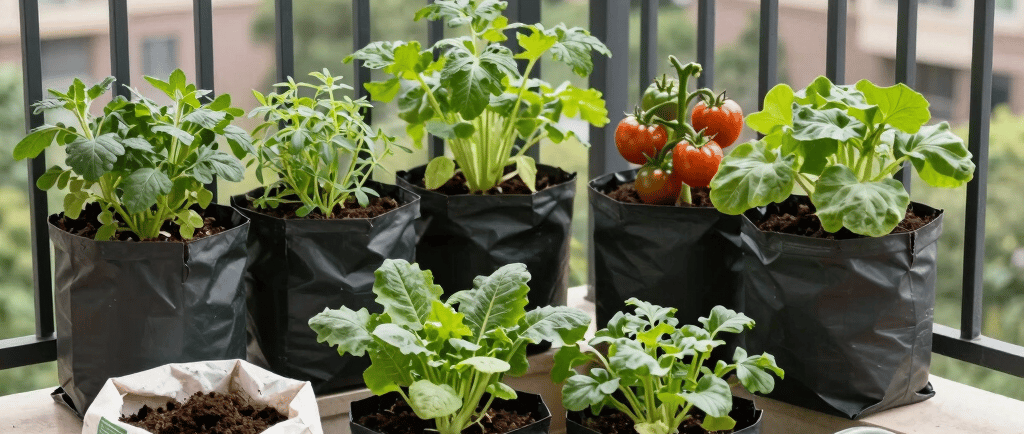
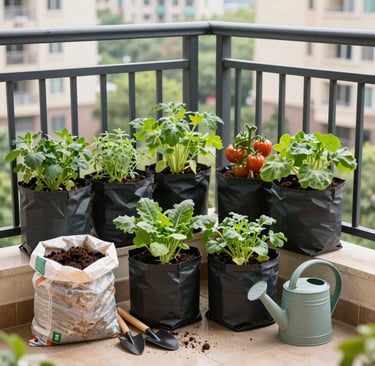
Fabric pots are my personal first choice for most vegetables on an apartment balcony. They air-prune roots, which prevents the circling and binding that happens in rigid containers and produces healthier, more vigorous root systems. They drain perfectly, eliminating overwatering risk. They're lightweight — critical for balcony weight limits. And they fold flat for winter storage, which is a practical benefit that matters when you're in an apartment with limited storage space. The trade-off is that they dry out faster than other container types, especially in hot sunny conditions, so you'll need to check moisture more frequently in midsummer.
Plastic containers are the practical workhorse of apartment balcony gardening — affordable, lightweight, moisture-retentive, and available in every size and shape imaginable. For anyone starting out on a budget, good quality plastic containers are completely sensible. Look for UV-stabilized options that won't crack and degrade in their first season of sun exposure. Cheap thin plastic pots are false economy — they crack within months. Mid-range plastic holds up for years.
Terracotta is beautiful and has real horticultural advantages for plants that prefer to dry out between waterings — Mediterranean herbs like rosemary, thyme, and oregano genuinely do better in terracotta than in plastic, because the porous walls wick moisture away and keep the root zone drier. But terracotta is heavy — a significant consideration for balcony weight limits — and requires more frequent watering for moisture-loving plants in warm weather. Use terracotta strategically rather than universally.
Self-watering containers are genuinely transformative for apartment balcony gardens, especially for anyone who works long hours, travels, or just wants to spend less mental energy on watering. The reservoir system delivers consistent moisture to roots through capillary action, eliminating the peaks and valleys of manual watering. For tomatoes — which are notoriously sensitive to inconsistent moisture and develop blossom end rot when water delivery is irregular — self-watering containers are close to magic. They're more expensive upfront but they pay for themselves in better plant performance and reduced plant losses.
Potting mix quality affects everything downstream. A good all-purpose potting mix that drains well while retaining adequate moisture is the foundation of container plant health. I add a generous amount of perlite to whatever mix I buy — roughly 20-30% by volume — which improves drainage and aeration significantly. For succulents and cacti, use a purpose-made cactus mix or make your own by combining regular potting mix with coarse sand and extra perlite. Never use straight garden soil in containers — it compacts into a dense, poorly draining brick that suffocates roots.
Watering Your Apartment Balcony Garden
Watering is the daily practice of apartment balcony gardening, and getting it right is probably the single most impactful thing you can do for your plants' health. The good news is it's not complicated once you understand a few core principles. The bad news is those principles go against some of the instincts most beginners bring to plant care.
The finger test is your most reliable watering guide — more reliable than any schedule, any app, any reminder. Stick your finger one to two inches into the soil. Moist? Leave it alone. Dry? Water thoroughly. That's the whole method. It takes three seconds, it costs nothing, and it accounts for all the variables — season, temperature, wind, container type, plant size — that make fixed schedules unreliable. I do this every morning on every container and it's become completely automatic.
Deep watering every single time is the principle most beginners get wrong. When you water, water until it flows freely from the drainage holes. Not a surface splash. Not a quick pour. A thorough saturation of the entire soil volume. This encourages deep root growth, which makes plants more resilient and productive. Shallow watering produces shallow roots that stress out constantly. I know it seems like deep watering would risk overwatering, but with proper drainage it doesn't — the water flows through and exits cleanly.
Morning watering is ideal for outdoor balcony plants. Watering in the morning gives leaves time to dry during the day, reducing fungal disease risk. It also means water is available to plants during the warmest, most metabolically active part of the day when they need it most. I water my balcony every morning as part of my routine — coffee in one hand, watering can in the other. It takes fifteen minutes and it's genuinely one of my favorite parts of the day.
Drip irrigation is the smartest system upgrade for anyone serious about their apartment balcony garden. A basic timer-controlled drip system — connecting to your outdoor tap, running thin drip lines to each container — costs $40-80 to set up and eliminates watering as a daily task. My plants get watered automatically every morning at 6:30am whether I'm there or not. During the heat of midsummer when containers might otherwise need checking twice daily, the system handles it. During travel it's completely worry-free. It was the single best investment I've made in my balcony garden setup.
Watering while traveling is the perennial anxiety of balcony gardeners, and there are several good solutions beyond the drip system. Self-watering containers extend worry-free time significantly. Terracotta watering spikes and glass globes provide slow, gradual moisture delivery for short absences. The plastic bag greenhouse method — placing the entire pot loosely inside a clear plastic bag — creates a closed moisture system that keeps plants going for two to three weeks. And a plant-sitting arrangement with a neighbor is always worth pursuing for longer trips.
Apartment Balcony Garden Tips for Renters
Renting introduces a specific set of constraints to apartment balcony gardening that owner-occupiers don't have to think about. Lease restrictions, deposit concerns, building rules, the possibility of moving — all of these are real considerations. But almost none of them are dealbreakers with the right approach.
No-drill vertical gardening is completely achievable and honestly better than drilled solutions in many ways — easier to reconfigure, easier to take with you when you move. Tension-mounted curtain rods can support lightweight hanging planters. Heavy-duty adhesive hooks rated for significant weight can support small wall planters and hanging baskets on solid surfaces. Freestanding shelving units and ladder shelves require no wall attachment and provide vertical growing space. Pressure-mounted systems designed for balconies attach between floor and ceiling without drilling. The no-drill toolkit for vertical gardening has expanded significantly in recent years and there are good solutions at every price point.
Railing planters that hook over railings require no drilling and no permanent modification, which makes them one of the most renter-friendly container solutions available. The hook-over design is completely reversible — they go on and off in seconds and leave zero trace. Most balcony railings accommodate standard hook-over planters, though it's worth measuring your railing width before buying. Some railing planters are designed for round railings, some for square or flat — know what you've got.
HOA and building rules vary enormously and it's genuinely worth knowing yours before investing in your balcony garden setup. Review your lease carefully. Most standard leases are silent on container gardening, which is generally interpreted as permissible since containers aren't structural modifications. Some buildings have rules about what can be placed on railings, whether anything can hang over the edge of the balcony, or how the exterior of the building can look from the street. If your lease is ambiguous, a quick friendly conversation with your building manager can clarify things and build goodwill at the same time.
Protecting your floors and railings from water damage and staining is good practice and shows respect for the property — which matters both for your deposit and for your relationship with your landlord. Use saucers under every container to catch drainage water. Elevate containers slightly on pot feet or small risers to allow airflow underneath and prevent moisture damage to floor surfaces. On wooden balcony floors, be especially attentive — standing water causes warping and rot and is exactly the kind of thing landlords notice at move-out. A balcony mat under your container area provides an additional layer of protection and looks more intentional.
Moving your garden when you move is a real practical consideration for renters, and thinking about it upfront saves a lot of stress later. Fabric pots fold flat. Plastic containers stack. Choose container sizes that fit in your car or moving truck. For plants you're particularly attached to — a mature rosemary, a well-established tomato — consider whether they'll survive transplanting and transport. Plants that propagate easily can be moved as cuttings rather than whole plants, which is often more practical. I've moved my apartment garden twice now and the second time I'd designed it so specifically with mobility in mind that the whole thing packed up in about an hour.
Making Your Apartment Balcony Garden Beautiful Year-Round
The most visited, most loved balcony gardens I know aren't just productive — they're genuinely beautiful. They're spaces that look intentional and inviting, that change with the seasons, that reward you with something to look at and enjoy even when you're not actively gardening. Getting there is a design project as much as a gardening one.
Seasonal planting keeps the garden fresh and alive year-round. Spring belongs to cool-season crops — lettuce, spinach, pansies, violas, sweet peas — and the fresh, light palette that comes with them. Summer is the peak of the edible garden — tomatoes, peppers, basil, marigolds — all lush and productive and colorful. Fall is a second cool-season growing window with rich tones — ornamental kale, asters, mums, late lettuce and arugula. Winter, even on an apartment balcony, can have life — evergreen plants, ornamental conifers in containers, winter jasmine, and perhaps a collection of succulents that tolerate cool temperatures. Planning for each season means you always have something growing and something to look forward to.
Mixing textures and heights creates visual depth that makes a small balcony feel much larger and more interesting than it actually is. Tall plants at the back, medium in the middle, low and trailing at the edges. Spiky textures — grasses, lavender — next to broad-leafed ones. Glossy leaves next to matte. Fine-textured plants next to bold ones. These contrasts create visual interest that flat, same-height, same-texture planting simply doesn't achieve.
String lights are the single most affordable, highest-impact improvement you can make to an apartment balcony. Warm-toned solar string lights draped along the railing, over a trellis, or threaded through hanging baskets transform the space after dark into something genuinely magical. I'm not overstating it — the difference is dramatic. My balcony at night with string lights and the soft glow of plants is honestly one of my favorite places to be. Solar means no extension cords, no electricity cost, and no lease complications.
Privacy screens do triple duty on apartment balconies — they provide privacy from neighboring balconies and the street, they act as windbreaks that protect your plants, and they serve as a backdrop for wall-mounted planters and vertical growing systems. Bamboo roll screens, reed fences, and fabric privacy panels all attach to railings or can be freestanding, and most require no drilling. A privacy screen at the back of your balcony creates an immediate sense of enclosure and intimacy that makes the space feel more like a room and less like a ledge.
Treat your balcony like an outdoor room — not just a place to put plants, but a place to live in. An outdoor rug defines the space and adds warmth underfoot. A small bistro table and two comfortable chairs invite you to actually sit out there. Lanterns, candles, a small water feature, a stack of outdoor cushions — these things are inexpensive and they completely change the character of the space. The best apartment balcony gardens I've seen are ones where someone clearly thought about how to live in the space, not just grow in it. That intention shows, and it makes the gardening better too — because a space you love spending time in is a garden you'll actually tend.
Conclusion
Your apartment balcony — whatever size it is, whatever direction it faces, whatever floor it's on — is a garden waiting to happen. I genuinely believe that, and seven years of apartment balcony gardening across three very different spaces have only strengthened that conviction.
The path from concrete rectangle to thriving garden isn't long or complicated. Assess your conditions honestly. Choose plants that match your space. Start smaller than your ambition, build containers and systems that work for your life, and design for beauty as well as productivity. Make it a space you want to spend time in — because the time you spend in your garden is what makes you good at it and what makes it grow.
The first step is always the hardest — that moment of deciding to start, of buying the first seed packet or the first container and committing to the experiment. Everything after that is just showing up, paying attention, and adjusting as you go. You will make mistakes. Plants will die. Things won't go as planned. That's gardening, and it's completely okay. Every dead plant taught me something I carry into the next season.
Start where you are, with what you have, right now. One container. One plant. One morning spent with a coffee and a watering can on your balcony. That's the whole beginning.
I want to hear about your apartment balcony garden — what you're growing, what's working, what you're struggling with, what you're most proud of. Drop it all in the comments below. This community is one of the most supportive, knowledgeable, and genuinely enthusiastic groups of people on the internet, and your experience might be exactly what another apartment gardener needs to read today. And if this guide helped you get started or think differently about your space — share it. Let's get more apartment balconies growing. 🌿🏙️